
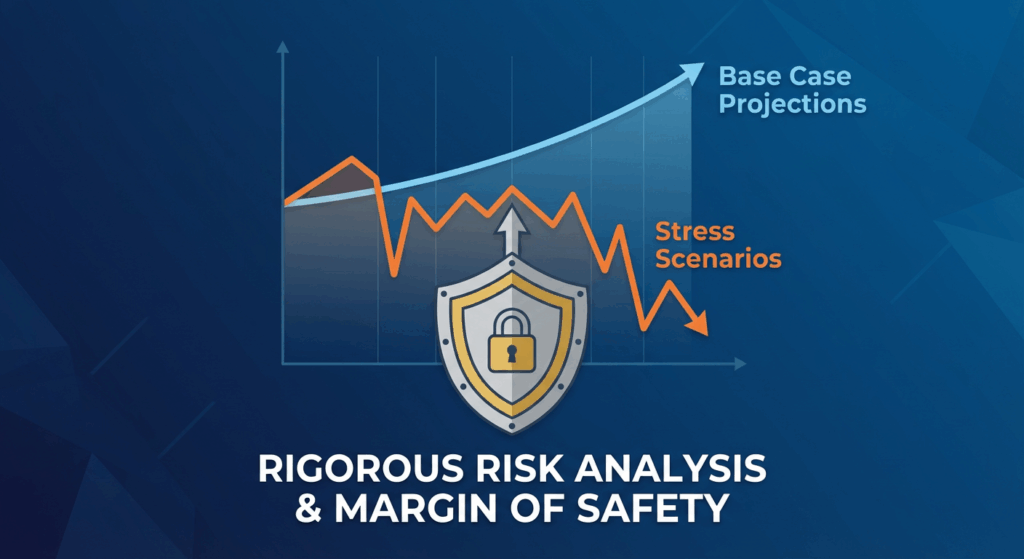
The Underwriting Challenge: Survival Over Growth
In credit underwriting, the primary objective is not to maximize upside but to ensure the return of principal. The difference between a performing loan and a default often lies not in the borrower’s base case projections, but in the resilience of their cash flows under duress. While equity investors focus on growth multiples, credit underwriters must fixate on the margin of safety.
Standard Debt Service Coverage Ratio (DSCR) calculations based on management’s EBITDA adjustments are insufficient for distinct risk assessment. By 2026, with the normalization of interest rates and evolving sector risks, lenders who fail to rigorously stress test assumptions face heightened default probabilities. As noted in the 2025 update to the Principles for the Management of Credit Risk by the Basel Committee, establishing an appropriate credit risk environment requires a “sound credit-granting process” that looks beyond immediate solvency to long-term viability across economic cycles.
The Framework: Multivariate Stress Testing
Effective stress testing moves beyond simple sensitivity analysis (e.g., “what if revenue drops 10%?”) to multivariate scenario modeling. This framework assumes that risks are correlated; a drop in revenue rarely happens in isolation without impacting working capital cycles or operating margins.
The methodology requires distinct modeling of three core levers:
- Top-Line Erosion: Distinguishing between volume declines (demand shock) and price deterioration (competitive pressure).
- Operating Leverage Impact: Analyzing the stickiness of fixed costs when revenue contracts.
- Working Capital Dilution: Assessing the liquidity trap where slowing inventory turnover and extended receivables trap cash exactly when it is needed most.
According to [assets.fitchratings.com](https://assets.fitchratings.com/downloadFile?reportType=report&sfReport=false&slug=corporate-finance%2Fcorporate-rating-criteria-06-12-2024), projections should cover a three-to-five-year horizon to capture a typical economic cycle, weighing the financial risk profile against industry peers.
The Analysis: Stressing a $10M EBITDA Profile
Consider a theoretical manufacturing borrower with the following Base Case profile:
- Revenue: $50,000,000
- Gross Margin: 40% ($20,000,000)
- Fixed OpEx: $10,000,000
- EBITDA: $10,000,000 (20% margin)
- Total Debt: $30,000,000 (3.0x Leverage)
- Interest Expense: $2,400,000 (8% blended rate)
The “Stump” Stress Test
A naive stress test might lower revenue by 10% and keep margins flat. However, a rigorous underwriter applies a margin compression scenario alongside revenue decline using degree of operating leverage (DOL).
Scenario: 15% Revenue Drop + 200bps Gross Margin Contraction
- New Revenue: $42,500,000 (-$7.5M)
- New Gross Margin: 38% ($16,150,000)
- Fixed OpEx: $10,000,000 (remains sticky)
- New EBITDA: $6,150,000
The Impact:
While revenue dropped 15%, EBITDA plummeted 38.5%. The leverage ratio balloons from 3.0x to 4.9x instantly. If the credit agreement contains a Total Leverage Covenant of 4.0x, the borrower is now in technical default, triggering cross-default provisions or reservation of rights letters, despite still being cash flow positive.
The Liquidity Bridge
Underwriters must then calculate the Fixed Charge Coverage Ratio (FCCR) under stress. With $10M EBITDA, cash taxes of $2M, and Capex of $1M, the base FCCR is robust. Under stress ($6.15M EBITDA), if Capex cannot be cut and taxes remain relative, the buffer for debt service ($2.4M) shrinks dangerously, leaving little room for working capital swings.
Industry Standards and Red Flags
Institutional lenders and rating agencies emphasize the “through-the-cycle” view. The OCC’s Loan Portfolio Management handbook highlights that valid stress testing must identify concentrations of risk and evaluate how changes in market conditions affect specific portfolios. A common red flag is a borrower with high fixed costs and low margins; these entities have high operating leverage, making them mathematically fragile to even minor revenue variances.
Data consistency is critical. Recent guidance suggests looking for:
- Covenant “Lite” Structures: Inability to monitor degradation early.
- EBITDA Add-backs: Excessive normalization (e.g., “identifiable synergies”) that vanishes during stress events.
- Customer Concentration: Where the default of a single customer triggers the downside scenario modeled above.
As outlined in the Basel Committee’s 2025 principles [bis.org](https://www.bis.org/bcbs/publ/d595.pdf), banks are expected to operate under a sound credit-granting process that explicitly assesses the borrower’s ability to withstand adverse economic conditions without relying intensely on collateral liquidation.
Underwriting Checklist: The Stress Test Workflow
To ensure rigorous risk assessment, underwriters should utilize the following workflow:
- Disaggregate Revenue: Model Price vs. Volume declines separately.
- Audit Fixed vs. Variable Costs: Verify the floor of the expense base. Can they actually cut OpEx in a downturn?
- Stress the Balance Sheet: Assume Days Sales Outstanding (DSO) increases by 10-15 days. Does this burn the revolver availability?
- Check Covenant Compliance: Map the stress capability against the proposed covenant levels (e.g., does a 10% dip breach the leverage cap?).
- Capex Flexibility: Classify Maintenance vs. Growth Capex. Only Growth Capex is truly discretionary in a crisis.
Key Takeaways
- Correlation is Key: Rarely does revenue fall without margins compressing and working capital dragging; stress them simultaneously.
- Operating Leverage Cuts Both Ways: High fixed-cost businesses suffer disproportionate EBITDA erosion on small revenue misses.
- Cash is Truth: EBITDA is an opinion; stress testing must ultimately solve for free cash flow and liquidity availability.
- Covenants are Tripwires: Design covenants to trigger before the cash runs out, not after.
- Forward-Looking Scope: As per Fitch and OCC standards, analysis must project 3-5 years out, covering a full economic cycle.


