
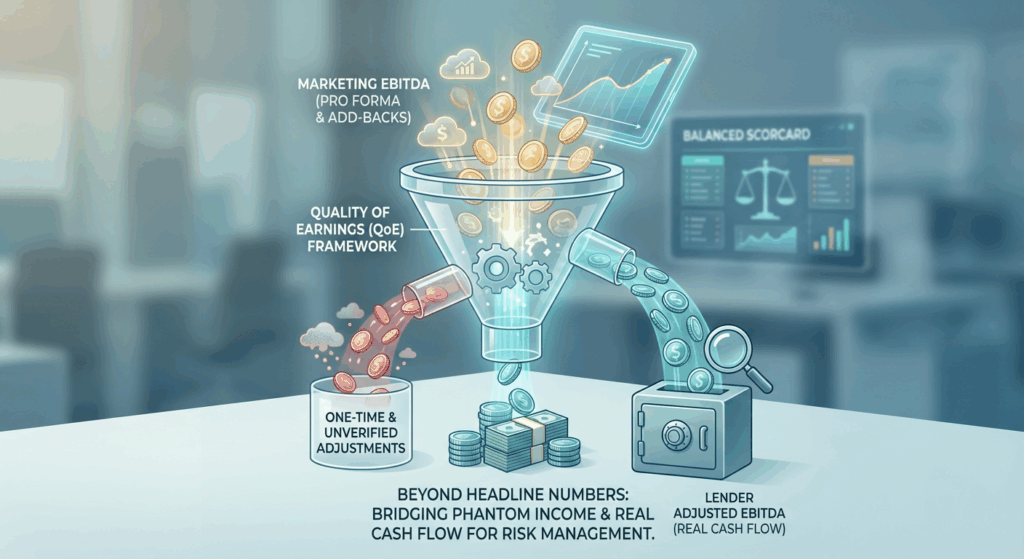
The Underwriting Challenge: Phantom Income vs. Real Cash Flow
In the high-stakes environment of middle-market lending, underwriters face a recurring challenge: bridging the gap between a borrower’s "Marketing EBITDA" and the actual cash flow available to service debt. It is not uncommon to encounter Confidential Information Memoranda (CIMs) where "Adjusted EBITDA" is inflated by 20% to 40% through aggressive pro forma add-backs. For a risk-conscious lender, taking these metrics at face value is a fundamental error. The cornerstone of verifiable credit underwriting is not merely accepting a Quality of Earnings (QoE) report, but critically re-underwriting it to determine Lender Adjusted EBITDA: the true foundational metric for leverage sizing and covenant design.
The Framework: Normalizing Earnings
Effective underwriting requires a disciplined methodological framework to separate verifiable, non-recurring expenses from standard operating costs. The objective is to arrive at a metric of Sustainable EBITDA that can reliably support debt service coverage throughout the economic cycle. Most institutional lenders, aligned with principles found in Fitch Ratings' Corporate Rating Criteria, view profitability through the lens of structural sustainability rather than optimistic projection.
Example Scenario
Consider a manufacturing target presenting $10 million in Last Twelve Months (LTM) Adjusted EBITDA. A surface-level review might suggest this supports a $35 million senior facility (3.5x leverage). However, a rigorous breakdown often reveals a different story:
- Reported (GAAP) EBITDA: $7.5 million
- Total Proposed Adjustments: $2.5 million
- Management Adjusted EBITDA: $10.0 million
The underwriter’s primary task is to validate the quality and realization probability of that $2.5 million delta.
The Analysis: Stress-Testing the Add-Backs
To determine the "bankable" EBITDA, an underwriter must dissect each adjustment category. Let's analyze the $2.5 million adjustments from the example above:
1. Synergies and Cost Savings ($1.0M)
Management claims $1 million in savings from a planned warehouse consolidation.
Lender View: Has the lease actually been terminated? Have the employees been severed? If these actions are future-dated, this is "pro forma" hope, not credit reality. A conservative underwriter accepts $0 until actions are executed, or perhaps 50% if board resolutions and legal notices are provided.
2. Owner Expenses ($1.0M)
Adjustments for personal travel, non-business vehicles, and excess officer compensation.
Lender View: Generally acceptable if clearly documented and legally ceasing post-transaction. This is a valid "control" adjustment.
3. Inventory Write-Down ($0.5M)
Management argues a recent write-down was a "one-time" event.
Lender View: The analyst must look back 3-5 years. Does the company write down inventory every 18 months? If so, this is a recurring operating cost, not a one-time event. We reject this add-back.
Calculation Impact
If we accept the owner expenses ($1.0M) but reject the synergies and inventory adjustments ($1.5M), the Lender Adjusted EBITDA falls to $8.5 million.
- Marketing Leverage: $35M Debt / $10.0M EBITDA = 3.5x
- Actual Credit Leverage: $35M Debt / $8.5M EBITDA = 4.1x
This re-calculation immediately reveals that the deal is half a turn more levered than advertised, triggering impacts on pricing grids and required equity contribution.
Industry Standards and Red Flags
Institutional guidelines, such as those noted in the FDIC's Risk Management Manual, emphasize that a borrower’s ability to repay must be assessed based on operating cash flow, not hypothetical scenarios. In the current credit environment, several red flags have become standard:
- "Run-Rate" Adjustments: Annualizing the single best month of performance to project a full year.
- Poor Cash Conversion: High EBITDA but low Free Cash Flow (FCF) often signals aggressive capitalization policies or unresolved working capital bloat.
- Capped Add-Backs: To mitigate risk, credit agreements often cap "soft" add-backs (synergies, restructuring costs) at 15% to 20% of EBITDA.
According to the Basel Committee's Principles for the Management of Credit Risk (2025), sound credit-granting processes must include a thorough understanding of the borrower’s risk profile, specifically avoiding over-reliance on borrower-generated financial models without independent stress testing.
Underwriting Checklist: Due Diligence Essentials
When reviewing a QoE report or CIM, the following diligence points are critical:
- Bridge Analysis: Require a waterfall chart connecting Audit EBITDA to Management EBITDA to Lender EBITDA.
- Proof of Payment: For "one-time" professional fees or settlements, demand wire transfer receipts, not just accrual logs.
- Trend Analysis: Look for consistency in "one-time" add-backs. If a "restructuring charge" appears in three consecutive years, it is an operating expense.
- Covenant Definitions: Ensure the definition of "Consolidated EBITDA" in the legal documentation matches the "Lender Adjusted EBITDA" methodology, specifically restricting uncapped add-backs.
Key Takeaways
- Cash is King: EBITDA is an opinion; cash flow is a fact. Always triangulate EBITDA with operating cash flow.
- Skepticism as a Tool: Treat all "pro forma" synergies as $0 until validated by executed contracts or termination letters.
- Structure Follows Earnings: Debt capacity and leverage covenants should be sized off the most conservative EBITDA view.
- Documentation Matters: Hardwire add-back definitions and caps into the credit agreement to prevent covenant erosion.
- Identify Serial Adjusters: Be wary of management teams that consistently present "normalized" earnings significantly higher than reported GAAP earnings year over year.


