
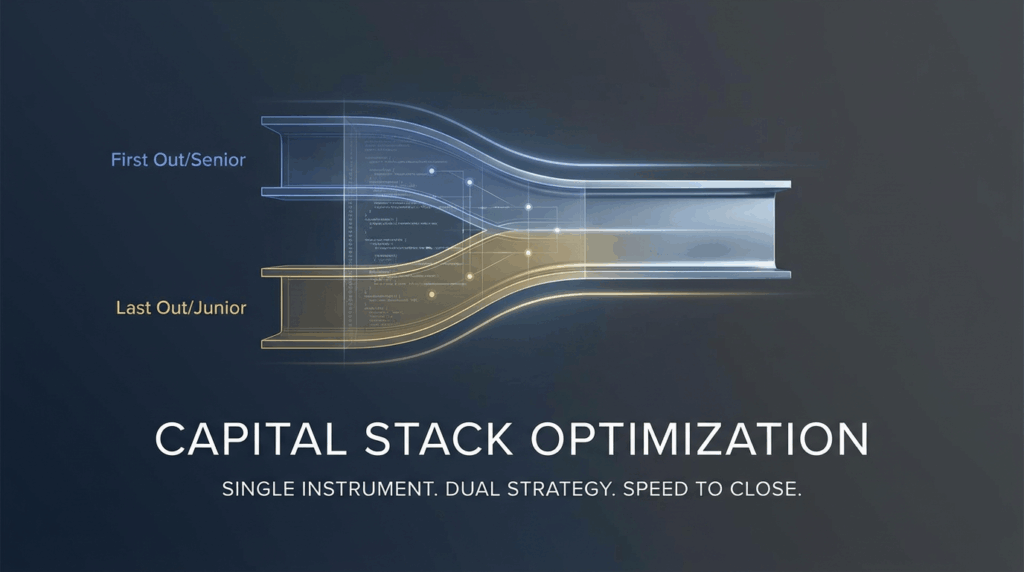
In the current leveraged finance landscape of 2026, where speed often trumps price, the unitranche facility has cemented itself as the cornerstone of middle-market acquisition financing. With global private credit assets heavily influencing buyout structures, understanding the mechanics of a unitranche deal is no longer optional for operators or sponsors; it is a fundamental requirement for efficient capital planning.
For borrowers facing the “financing challenge”, the need to close an acquisition with certainty in a volatile market, the unitranche offers a streamlined solution. Unlike the traditional dual-track process of securing a senior bank loan alongside a mezzanine tranche, the unitranche collapses the capital stack into a single instrument. This article dissects the anatomy of these facilities, using current market data to illustrate why sponsors are willing to pay a premium for this structural convergence.
Deconstructing the Structure: The “Bifurcated” Reality
On the surface, a unitranche facility appears simple: one credit agreement, one agent, and one interest rate. However, the engineering beneath the surface is complex. The structure relies on an Agreement Among Lenders (AAL), a private contract that effectively bifurcates the loan into “First Out” (senior) and “Last Out” (junior) tranches without the borrower needing to manage two separate creditor classes.
Deal Example: Project Velocity ($100M Enterprise Value)
Consider a software company with $10M EBITDA valued at 10x ($100M EV). A typical 2026 unitranche package might look like this:
- Facility Size: $55M (5.5x Total Leverage)
- Blended Coupon: SOFR + 625 bps (Floating)
- OID (Original Issue Discount): 98.0
- Amortization: 1.0% per annum
Behind the scenes, the lenders split the risk:
- First Out Tranche ($35M): Held by a commercial bank or low-cost insurance fund. Priced effectively at SOFR + 450 bps. Priority on repayment.
- Last Out Tranche ($20M): Held by a private debt fund. Priced effectively at SOFR + 950 bps. Takes the first loss after equity.
The borrower pays the weighted average (blended) rate. This “synthetic” structure allows lenders to optimize for their specific risk/return mandates while presenting a unified front to the borrower.
Comparative Analysis: Unitranche vs. Traditional Stacks
Why choose a unitranche over a traditional Senior/Mezzanine split or a Broadly Syndicated Loan (BSL)? The decision typically comes down to certainty of execution versus cost of capital.
The Speed Premium
Data indicates that unitranche executions can close 30 to 45 days faster than syndicated alternatives [privateequitybro.com]. In a competitive auction, this speed is a currency of its own. By eliminating the syndication process, the borrower avoids “market flex” risk, the possibility that arrangers will increase margins or tighten terms to clear the market just before closing.
Comparison Matrix
- Senior + Mezzanine: Typically offers a lower Weighted Average Cost of Capital (WACC) but requires negotiating an Intercreditor Agreement between two distinct public groups. This creates friction during restructurings or amendments.
- Unitranche: Higher spread (often 50-100 bps premium) but offers a “one-stop” shop. The AAL is internal to the lenders, meaning the borrower only needs consent from one agent for waivers or add-ons [redcliffetraining.com].
Current Market Terms & Standards (2025-2026)
Following the trends established in late 2025, the market has standardized around several key metrics. Private credit funds, now managing over $2.1 trillion in assets, have normalized “jumbo unitranche” facilities exceeding $2 billion, proving this structure is no longer limited to the lower middle market.
- Leverage Profiles: Total leverage for software and healthcare deals is hovering around 5.0x – 5.5x EBITDA.
- Pricing: All-in yields have settled in the 11-13% range for standard mid-market credits [privateequitybro.com].
- Covenants: While rarely “covenant-lite” in the pure BSL sense, modern unitranches typically feature a single springing leverage covenant set with 25-30% headroom against the base case model.
- Documentation: Adoption of “portability” clauses (allowing the debt to stay in place if the company is sold) has become a hotter negotiation point as borrowers anticipate future M&A activity.
Structuring Guidance: Practical Negotiation
For Operators (Borrowers):
Focus on the Accordion Feature. Since unitranche lenders are often buy-and-hold investors, ensure the facility allows for incremental aggressive expansion (e.g., free and clear baskets) without requiring a full refinancing. Additionally, scrutinize the “definition of EBITDA.” In private credit, the ability to add back run-rate synergies can effectively lower your leverage ratio and delay covenant triggers.
For Investors (Lenders):
In a bifurcated structure, the AAL voting rights are paramount. If you are a “Last Out” lender, you must ensure you have purchase rights (the ability to buy out the senior lender at par) if the deal goes sideways. Without this, the First Out lender may control the enforcement process, potentially foreclosing on collateral at a value that wipes out the junior tranche [lexisnexis.co.uk].
Key Takeaways
- Synthetic Bifurcation: Borrowers see one rate; lenders engineer risk tiers privately via the AAL.
- Certainty Premium: Borrowers effectively pay ~50-100 bps extra for execution speed and the removal of syndication flex.
- Single Document Efficiency: One credit agreement reduces legal costs and simplifies future amendments or M&A add-ons.
- Scale is irrelevant: Structures now scale from $20M middle-market deals to $2B+ mega-tranches.
- Covenant Focus: Expect one maintenance covenant with significant headroom, differing from the maintenance-heavy bank structures of the past.


