
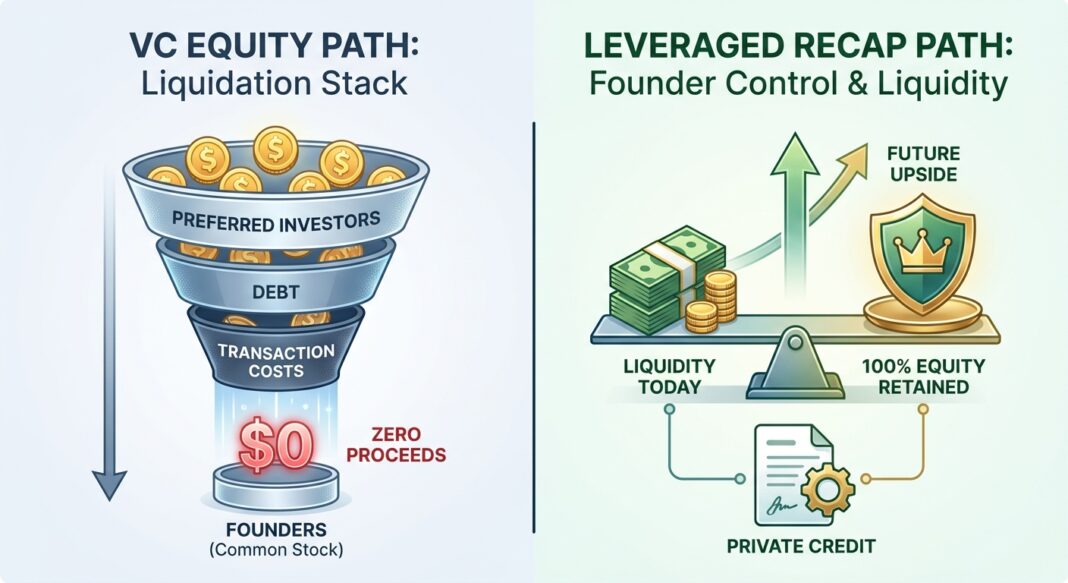
The Story: A Billion-Dollar Exit That Paid the Builder Nothing
In January 2025, the news crossed every founder’s feed like a cold splash of water. Divvy Homes, a proptech darling that had once carried a $2.3 billion valuation, raised hundreds of millions from Andreessen Horowitz and Tiger Global, and genuinely helped thousands of American families inch toward homeownership, was being sold to Brookfield Properties for approximately $1 billion.
That sounds like a success story. It was not.
In a letter to shareholders reviewed by TechCrunch, Divvy CEO and co-founder Adena Hefets confirmed that after repaying outstanding debt, covering transaction costs, and honoring liquidation preferences for preferred shareholders, neither common shareholders nor holders of founders’ preferred stock would receive any proceeds. Not a haircut. Not a reduced payout. Zero. As one report put it plainly: “A billion-dollar exit. Zero for the people who built it.”
The preferred shareholders, Divvy’s institutional VC investors, came first in the payout waterfall. Founders and employees, holding common stock and Series FF preferred, stood at the back. The line never reached them.
Hefets wrote that the decision to sell “was not the ending I had hoped for,” citing rising interest rates and a broken business model as the rationale. When rates surged in 2022, Divvy’s capital-intensive rent-to-own model cracked. Three rounds of layoffs followed. By 2023, the company had paused new home acquisitions entirely.
What is most striking about the Divvy story is not the bad luck or the macro headwinds. It is that the outcome was structurally predetermined, written into the capital decisions made years earlier, one VC round at a time.
The Decision: Two Founders, Two Roads, Same Market
To understand what Divvy’s founders could have done differently, consider a hypothetical counterpart, a real analog to the type of deal being executed across the mid-market right now.
Hypothetical Case Study: “Meridian Field Services”, A Founder-Owned Infrastructure Services Business
Imagine a founder, call her Elena, who built a regional infrastructure inspection services company to $8M in EBITDA over twelve years. Like Adena Hefets, Elena faced a genuine capital need: she wanted personal liquidity after more than a decade of illiquid ownership, and she needed growth capital to pursue two bolt-on acquisitions in adjacent markets.
She had two paths in front of her.
Path A: Venture or PE Equity Round. A growth equity sponsor offered to take a 60% stake at a $50M enterprise value: implying $30M to Elena personally, but leaving her with 40% of a company now subject to a 5-year hold period, a new board majority, and a PE firm’s exit timeline. Her remaining equity would be subject to the same liquidation preference mechanics that wiped out the Divvy founders if the exit multiple disappointed.
Path B: Leveraged Recapitalization via Private Credit. A direct lender offered Elena a $28M unitranche facility at 4.5x EBITDA, priced at SOFR plus 575 basis points (approximately 9.8% all-in at the time of structuring). The proceeds funded a $22M shareholder distribution: personal liquidity for Elena, plus a $6M delayed-draw facility earmarked for acquisitions. Elena retained 100% of the equity. No new board seats. No preferred shareholders with liquidation rights above her. No VC clock ticking toward a forced exit.
Elena chose Path B.
The debt service, approximately $2.7M annually, was comfortably covered by her $8M EBITDA at a 3.4x coverage ratio. The covenant package required a quarterly leverage test and a minimum liquidity threshold, standard terms for middle-market direct lending at this scale. The structure is squarely in line with market norms: according to Goldman Sachs Asset Management data cited in recent market reports, senior leverage on sponsored middle-market deals averaged 4.5x to 5.0x EBITDA in late 2024, and direct lenders typically offer delayed-draw facilities precisely for bolt-on acquisition use cases.
The Outcome: What Capital Structure Actually Determines
The contrast between Path A and Path B is not merely philosophical. It is arithmetic.
In Divvy’s case, the mechanics were almost textbook: preferred shareholders held cumulative liquidation preferences: the right to be made whole before any common stockholder sees a dollar. When the exit price fell below the stacked preferences, the waterfall ran dry before it reached the founders. “The first to cash in on the startup’s sale include debtholders and preferred shareholders,” reporting on the deal noted, while equity holders, including the VCs themselves, were expected to receive nothing.
Now run the same scenario for Elena under Path B:
- Year 0: Elena pockets $22M in personal liquidity: tax-efficiently structured, no equity surrendered.
- Years 1–3: She deploys the $6M delayed-draw to complete two bolt-on acquisitions, growing EBITDA to approximately $12M.
- Year 4: She refinances the original facility on improved terms, the business has deleveraged from 3.5x to 2.3x EBITDA through cash flow, and takes a second distribution of $8M.
- Year 5: She receives a strategic acquisition offer at 8x EBITDA on the expanded platform. At $96M enterprise value, with remaining net debt of approximately $14M, Elena pockets roughly $82M: 100 cents on the dollar, no preferred stack to clear.
Total personal proceeds over five years: approximately $112M. Equity surrendered: zero percent.
Compare that to Path A: a $30M upfront payment, 40% of a company worth perhaps $96M at exit ($38.4M), minus any PE-structured liquidation preferences on the capital above hers. Best case, Elena collects $68M in total, 39% less, while spending five years navigating board dynamics not of her choosing.
The difference is not the business. It is the capital structure layered on top of it.
And the market is moving decisively in this direction. According to PitchBook data, venture debt deal activity grew to $58.7 billion in 2024, up 119% from 2023: a surge that reflects exactly this shift in founder thinking. Private credit, meanwhile, has reached roughly $1.8 trillion in assets under management in 2025, with non-sponsor direct lending growing as founder-owned companies increasingly access institutional debt capital on their own terms. As one market analysis put it, private credit’s “ability to provide capital structure flexibility saw it dominate refinancings and recapitalizations” through 2024 and into 2025.
The Lessons: What the Waterfall Teaches
The Divvy story is not a story about a bad founder or a bad product. Adena Hefets built something real. It is a story about what happens when a founder’s equity sits at the bottom of a payout waterfall they didn’t fully model, and a market that rewards the builder only after every preferred investor has been made whole first.
Lesson 1: Every VC round you take adds a new priority claim above your equity. Liquidation preferences are standard, not sinister, but they compound across rounds. By the time Divvy had raised at a $2.3B peak valuation, its preference stack was insurmountable at a $1B exit. The FanDuel case is even starker: a company that raised $416M at a $1.3B valuation was sold for $465M, and “founders built the company up into a business worth hundreds of millions of dollars, yet walked away with nothing”, the sale price simply didn’t clear the stacked preferences.
Lesson 2: Debt service is a known cost. VC dilution is a hidden one. A 9.8% all-in rate on a direct loan is a real, calculable obligation. The cost of VC equity (expressed as compounded dilution through successive rounds, liquidation preference mechanics, and board control clauses) is far harder to model and almost always higher than founders expect at signing. The key difference is that debt leaves the cap table unchanged.
Lesson 3: Leverage works when cash flows are durable and the debt-to-EBITDA ratio is right-sized. The critical framework is coverage. Middle-market direct lending typically requires maintenance covenants (a leverage test, often quarterly) that force ongoing discipline. Structures that collapse are those layered onto businesses with volatile or contracting cash flows (as Divvy’s rent-to-own model proved to be when rates spiked). Businesses with predictable, recurring revenue streams are well positioned to service debt and use it to fund growth without reducing their ownership upside.
Lesson 4: The recap is not the exit; it is the optionality. A leveraged recapitalization creates personal liquidity today, while preserving the founder’s full economic interest in the upside yet to come. It is not an either/or with a future exit; it is a sequenced capital strategy. Founders who use debt to take chips off the table early never have to make a desperate exit decision at the bottom of a cycle.
Lesson 5: The private credit market is now structurally accessible to founder-owned companies. This was not always true. For decades, institutional debt capital was the exclusive domain of PE-sponsored buyouts. That has changed materially. Direct lenders today actively pursue non-sponsored founder-owned businesses, offering bespoke unitranche facilities, delayed-draw acquisition lines, and PIK toggle features, tools that give founders the flexibility previously reserved for PE portfolio companies alone.
The Framework: When Does This Approach Work?
| Factor | Favorable for Leveraged Recap | Caution Zone |
|---|---|---|
| Revenue predictability | Recurring, contracted, or highly resilient | Cyclical, rate-sensitive, or volume-dependent |
| EBITDA margin | >20%, with clear operational levers | Thin margins requiring constant reinvestment |
| Debt-to-EBITDA at closing | 3.0x – 4.5x (mid-market standard) | Above 5.5x, especially in volatile sectors |
| Interest coverage ratio | >3.0x; ideally 3.5x+ | Below 2.5x; stress-tests poorly |
| Founder’s goal | Personal liquidity + retain control + future upside | Full exit now; no desire to manage debt service |
| Business stage | Established, cash-generating ($3M+ EBITDA) | Pre-revenue or early-stage with negative cash flow |
Key Insights
- Capital structure is destiny at exit. Divvy Homes sold for $1 billion in January 2025, and its founders received zero proceeds. The outcome was not determined by the exit price; it was determined by years of VC rounds stacking liquidation preferences above founder equity.
- Debt leaves the cap table clean. A leveraged recapitalization funded by private credit creates personal liquidity for the owner without surrendering equity, adding board seats, or accepting a VC firm’s exit timeline. When the business eventually sells, the full upside flows to the founder, no preferred stack to clear first.
- The private credit market has unlocked this strategy for founder-owned companies. Venture debt deal activity hit $58.7 billion in 2024, more than double 2023 levels, as founders increasingly access institutional debt capital without the ownership trade-offs of equity rounds.
- The math of Path B compounds powerfully over time. A founder who takes $22M in recap liquidity today, retains 100% equity, and exits at a later multiple on a larger platform frequently outperforms a founder who sold 60% to a PE sponsor, even before accounting for liquidation preference mechanics that may reduce that sponsor-path payout further.
- Right-sizing matters as much as structure. Leverage works when cash flows are durable and the debt-to-EBITDA ratio is disciplined. The cases that end badly (overleveraged buyouts, rate-sensitive models buried in debt) are cautionary tales about the quantum of debt, not debt itself. Mid-market direct lending at 3.5x to 4.5x EBITDA, with strong coverage ratios, has a fundamentally different risk profile than a 7x leveraged sponsor deal on a growth-stage asset.


