
Opening: A minimum benchmark, not a maximum rate
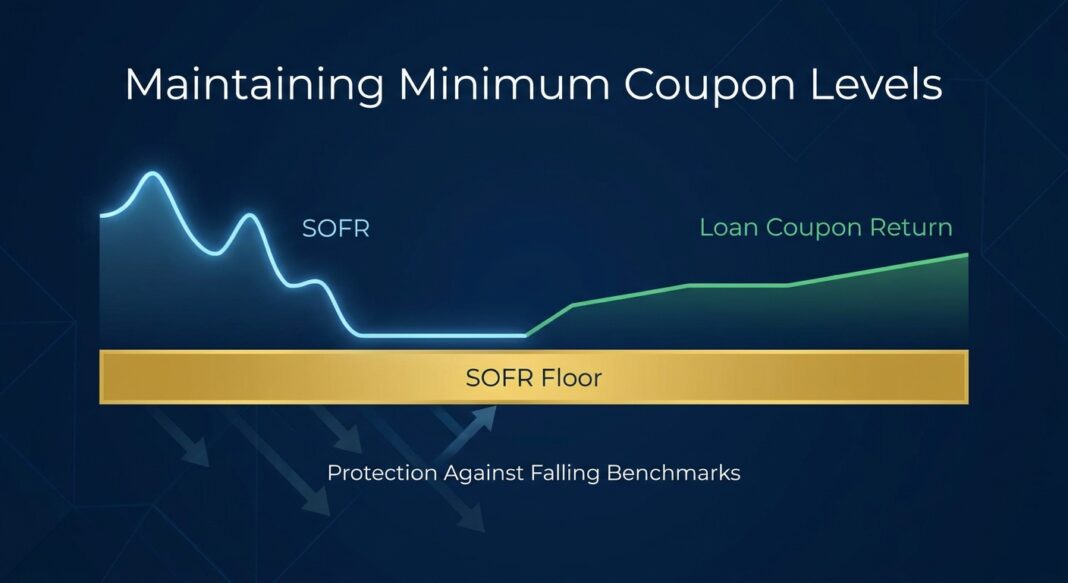
A SOFR floor is a contractual minimum for the reference rate used to calculate interest on a floating-rate loan. If the selected SOFR benchmark falls below that floor, the lender calculates interest as though the benchmark were at the floor. If SOFR stays above it, the floor has no effect on the coupon. The loan’s spread still applies in either case.
This clause can look inconsequential when rates are above the floor. Its value appears if rates fall far enough: the borrower’s interest expense stops declining at the floor, while the lender retains a minimum benchmark return. That distinction affects debt-service forecasts, refinancing comparisons, and the economics of a loan held through a rate cycle.
For example, a borrower paying SOFR plus 5.25% with a 1.00% SOFR floor pays a benchmark component of at least 1.00%, plus the 5.25% spread. The floor does not cap the borrower’s cost if SOFR rises. It only changes how far the coupon can fall.
The concept: How the floor enters the capital structure
Most floating-rate direct loans price as a reference rate plus a credit spread. SOFR, the Secured Overnight Financing Rate, is a benchmark based on overnight Treasury-backed financing transactions. Loan documents specify which SOFR convention applies, such as Term SOFR or a compounded average, plus the relevant observation and payment mechanics.
A SOFR floor sets the minimum value used for that reference-rate component. The basic coupon formula is: max(contractual SOFR, SOFR floor) + spread. The floor is not an additional spread and is not a separate fee. It is a condition within the benchmark calculation. When SOFR is above the floor, the actual benchmark determines the coupon. When it is below, the floor substitutes for it.
The distinction matters because the spread compensates the lender for borrower-specific credit risk and other loan features, while the floor addresses the benchmark component. A floor can protect lender income in a low-rate environment, but it does not protect principal from default or compensate for weak collateral. Nor does it prevent the borrower’s rate from rising when SOFR rises.
The loan agreement controls. Borrowers and investors need to check the floor level, benchmark definition, rate reset dates, day-count convention, and any transition language. A quoted spread without the floor and benchmark terms is an incomplete description of the coupon.
How it works: A $25 million loan example
Assume a company borrows $25 million under a five-year floating-rate loan with a 5.25% spread and a 1.00% SOFR floor. This example uses simple annual interest and an unchanged principal balance to isolate the floor’s effect. It excludes amortization, fees, payment timing, and any other loan terms.
At a SOFR benchmark of 3.90%, the floor does not bind. The coupon is 3.90% + 5.25%, or 9.15%. Annual interest is approximately $2.29 million. If SOFR later falls to 0.50%, the contractual benchmark input is 1.00%, not 0.50%. The coupon becomes 6.25%, or approximately $1.56 million per year.
Without the floor, the same 0.50% benchmark would produce a 5.75% coupon and about $1.44 million of annual interest. The floor therefore adds 0.50 percentage point, or approximately $125,000 per year on the assumed $25 million balance. The difference declines if the loan amortizes. It grows with a larger balance or a greater gap between the floor and the benchmark.
Now reverse the scenario. If SOFR rises to 5.00%, the coupon becomes 10.25% even though the floor remains 1.00%. The floor offers no ceiling. Operators still need to stress-test higher benchmark rates, and investors still need to evaluate whether the borrower can service the resulting cash interest.
These calculations assume the applicable loan benchmark is 3.90%. Actual contracts may use a term or compounded SOFR setting that differs from the New York Fed’s overnight rate.
Current market relevance
Recent data shows why floors remain a negotiated term rather than a theoretical footnote. The Federal Reserve Bank of New York’s reference-rate dashboard reported overnight SOFR at 3.90% for November 12, 2026 (as of November 12, 2026). At that level, a 1.00% floor would not bind in the example above. The rate is a dated observation, not a forecast.
The Federal Reserve’s October 28, 2026 FOMC statement held the federal funds target range at 3.75% to 4.00% (as of October 28, 2026). That policy range is not SOFR, but it provides current policy context for floating-rate borrowers.
In the October 2026 Senior Loan Officer Opinion Survey table, 8.5% of respondent banks reported increasing their use of interest-rate floors for large and middle-market C&I loans over the third quarter (as of October 2026). For small-firm C&I loans, 8.6% reported increased use. The same table reports that standards were basically unchanged at 88.3% of banks for large and middle-market borrowers and 91.5% for small firms. These are bank survey responses, not private-credit loan terms.
PitchBook’s October 2026 US Private Credit Monitor, published November 6, 2026, reported that direct-lending spreads widened while syndicated-loan spreads tightened, and that larger deals increasingly went to the syndicated market. The report provides market context, not a universal current spread or floor level. Together, the data show a market where a floor’s actual value depends on the contract and future benchmark path, while financing alternatives and pricing can differ by borrower size and deal type.
Decision framework for investors and operators
For investors: First identify the benchmark definition and floor in the credit agreement, then compare the floor with the current benchmark and plausible downside scenarios. Model interest income both above and below the floor, including amortization and expected prepayments. Assess the borrower’s capacity to pay at higher rates as well: a floor can support lender income in a falling-rate case, but it does not reduce default risk if rates rise or earnings weaken. Compare the floor with the spread and other economics rather than treating it as a substitute for underwriting.
For operators: Compare financing offers using total interest expense across several benchmark scenarios, not the headline spread alone. Estimate when the floor would begin to bind, how much annual cash interest it could add, and whether that amount changes borrowing capacity or planned investment. In negotiations, evaluate the floor level alongside spread, fees, amortization, prepayment terms, and covenant flexibility. A lower floor can have little immediate effect when SOFR is well above it, but can matter over a long maturity or during a sustained low-rate period. If the loan will be refinanced or repaid early, the floor’s expected life also matters.
Both sides should confirm how the contract handles benchmark replacement and calculation conventions. The precise reference-rate mechanics can change the cash coupon even when the stated floor and spread look identical.
Key takeaways
- A SOFR floor is the minimum benchmark input, not a cap on the borrower’s interest rate.
- Calculate the coupon as the greater of the contract’s SOFR measure or the floor, plus the spread.
- Quantify the floor’s cash impact against actual debt balance and potential benchmark declines.
- Stress-test rising rates separately, because a floor does not limit coupon increases.
- Compare the full loan terms, including benchmark convention, floor, fees, and refinancing assumptions.


