
Market Headline
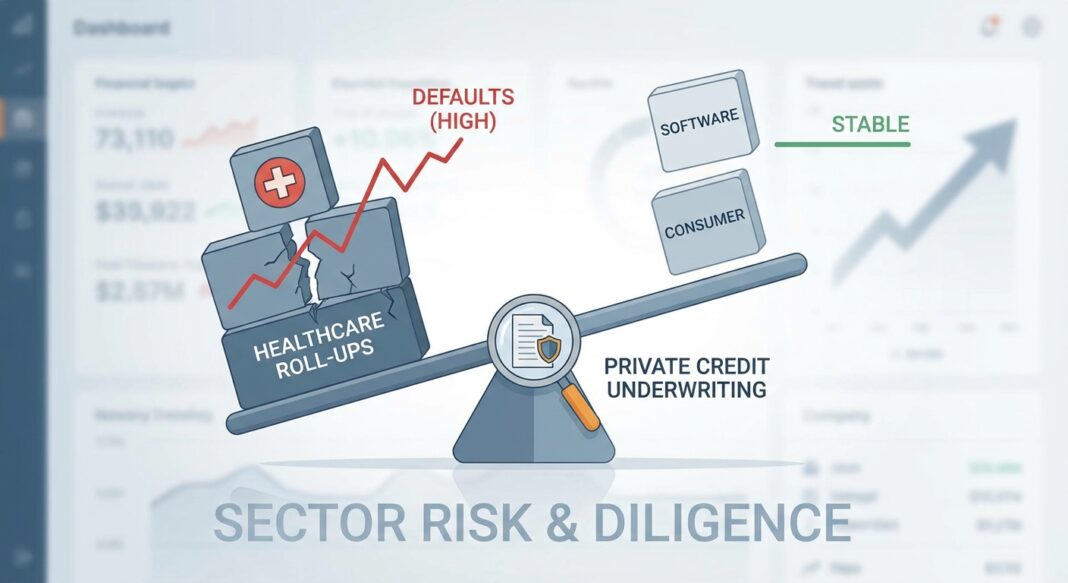
Private credit’s latest stress signal is concentrated in healthcare provider platforms built through acquisition, not spread evenly across borrowers. Houlihan Lokey’s November 19 release, based on its Q3 2026 Private Credit DataBank, put healthcare defaults at 7.1% by count and 4.6% by outstanding principal, the highest sector readings in its dataset. Consumer followed at 4.6% by count and 2.5% by principal. By contrast, software defaults were 1.0% by principal, while median software revenue and EBITDA remained above origination levels. The underwriting distinction is operational: serial acquisitions can leave providers carrying integration, labor and reimbursement exposures that a single leverage multiple may not capture.
This arrives as pricing divides by financing channel. Direct-lending LBO spreads widened in Q3 while syndicated spreads tightened, and banks reported tighter terms for riskier loans even as broad C&I approval standards were largely unchanged. The result is not a general credit shutdown. It is a stronger premium for transparent cash conversion, reliable interest coverage and demonstrable integration capacity, especially for healthcare borrowers whose growth plan depends on acquisitions.
Quantitative Snapshot
The latest market data show a wider private-versus-public loan spread differential alongside lower private-credit leverage and uneven borrower health. These measures cover different loan populations and default definitions, so they are directional comparisons, not like-for-like indices.
| Metric | Latest reading and comparison | Source |
|---|---|---|
| Direct-lending LBO spread | 520 bps over SOFR in Q3 2026, up from 494 bps in Q2 and 475 bps in Q1 | PitchBook LCD, Nov. 20 |
| BSL LBO spread | 307 bps in Q3 2026, down from 332 bps in Q2 | PitchBook LCD, Nov. 20 |
| Private-credit defaults | 1.5% of loan principal in Q3, versus 0.8% in Q2; 3.7% by borrower count, versus 2.5% | Houlihan Lokey, Nov. 19 |
| Borrower interest coverage | Median 1.68x in September, down from 1.73x in June; share below 1.0x rose to 15.1% from 13.9% | Houlihan Lokey, Nov. 19 |
| Public credit yields | Leveraged-loan 3-year yield 9.56% at October month-end, down 6 bps from September; high-yield bond yield 8.30%, flat month over month | UBS Credit Investments Group, Nov. 11 |
| Private-credit fundraising | $185bn through Q3 2026, equal to 95% of full-year 2025 fundraising; 79% of LPs planned to commit to one fund over the next 12 months | Preqin, Nov. 8 |
The financing trade-off is also visible in buyout structure. Covenant Review data reported November 19 put private-credit LBO debt at 4.0x first-lien and total debt to pro forma EBITDA, compared with 5.1x first lien and 5.3x total debt for BSL-financed LBOs. That lower private leverage comes with wider spread. Public index yields are not direct substitutes for private-loan coupons, but they show the continuing cost of floating-rate exposure.
Sector Analysis
Healthcare is the clearest underwriting pressure point. Houlihan Lokey’s Q3 readings show healthcare defaults at 7.1% by count and 4.6% by principal, with stress concentrated in provider platforms assembled through acquisitions. Those figures indicate a cohort problem, not a sector-wide collapse. Still, lenders have reason to test pro forma EBITDA against realized integration savings, clinician retention, reimbursement mix and working-capital needs rather than accept acquisition add-backs at face value. The firm also reports that borrower interest coverage slipped to 1.68x in September from 1.73x in June, a market-wide sign that cash interest capacity has weakened even as median EBITDA rose.
Consumer is also under pressure: Q3 defaults reached 4.6% by count and 2.5% by principal, according to Houlihan Lokey. Consumer borrowers with thin margins or discretionary demand have less room to absorb wage, input-cost or volume shocks. Software presents a contrasting credit signal. Its Q3 private-credit defaults were 1.0% by principal, with median revenue 24% above origination and median EBITDA 10% higher. That performance data do not settle forward AI-disruption risk, but they argue against treating all technology exposure as equally impaired.
Public loan-market sector returns offer a second, distinct lens on risk appetite. UBS reported October returns of 0.40% for energy, 0.28% for utilities and 0.26% for metals and minerals, while chemicals returned -1.48%, media and telecom -1.15%, and housing -1.00%. These are market performance figures, not direct-lending allocations, but the dispersion supports sector-specific pricing and diligence rather than broad sector labels.
Bank availability is similarly differentiated. The Federal Reserve’s October SLOOS, released November 2, found C&I standards basically unchanged for large and middle-market firms, while small-firm standards tightened. Banks also reported tighter premiums for riskier C&I loans across firm sizes and tighter collateral requirements and rate floors for small firms. For healthcare operators seeking acquisition financing, the implication is selective access: scalable platforms with audited integration results can compete, while add-back-heavy roll-ups face tougher scrutiny and potentially wider pricing.
Implications
For borrowers: Acquisition plans should be sized to standalone cash generation first, with synergies treated as contingent upside until achieved. Prepare lender-ready schedules that reconcile acquired EBITDA, one-time costs, working-capital changes and integration milestones. Report cash interest coverage quarterly and run sensitivities for both higher base rates and EBITDA shortfalls. The 1.68x market median is not a covenant target, but it is a warning that modest earnings volatility can erode debt-service headroom. Borrowers should also compare the full financing package, including amortization, call protection, covenants, delayed-draw capacity and refinancing flexibility, rather than focus on headline spread alone.
For lenders and investors: Separate healthcare provider sub-sectors and acquisition vintages in portfolio monitoring. Track leverage after each add-on, covenant headroom, provider concentration, reimbursement exposure and realized integration savings. The sector’s elevated default readings warrant more granular concentration limits, but software’s lower observed defaults and healthcare’s mixed performance caution against blanket exclusions. The high private-credit fundraising total does not imply equivalent deployment: Preqin found 79% of LPs expected to commit to only one private-credit fund over the next year, evidence of manager selectivity.
Next three to six months: The Federal Reserve held the target range at 3.75% to 4.00% on October 28, while the October SLOOS described tighter pricing for risky borrowers. Unless funding costs ease, lenders are likely to keep differentiating on coverage, scale and collateral rather than broadly relaxing terms. Deal activity may improve from low levels, but PitchBook LCD’s October monitor said year-to-date direct-lending volume still trailed 2025 and buyout financing was at its lowest level since 2020. Watch for healthcare refinancing and add-on transactions to clear only where cash-flow conversion and integration evidence support the debt load.
Key Market Insights
- Healthcare provider roll-ups show the highest sector default readings in the latest private-credit dataset; segment by business model and acquisition vintage.
- Direct LBO spreads rose to 520 bps in Q3 while BSL spreads fell to 307 bps, widening the cost gap between channels.
- Interest coverage weakened to 1.68x at September, so test debt service against EBITDA downside, not just base-rate scenarios.
- Bank standards are stable for larger C&I borrowers but tighter for riskier credits and small firms; availability is not uniform.
- Private-credit fundraising remains substantial, but LP commitments are concentrated in fewer managers; deployment discipline remains central.


