
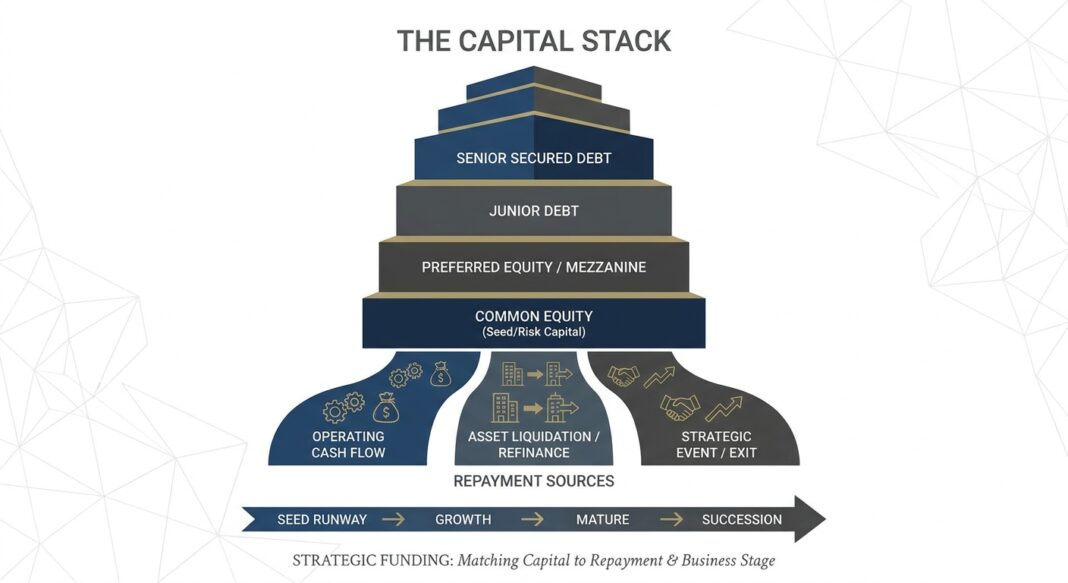
A company moving from growth toward maturity can have several different funding needs at once: payroll and materials ahead of customer collections, equipment with a multi-year useful life, and perhaps an acquisition or ownership transition. Treating these as one undifferentiated “capital gap” often produces a mismatch: long-term debt pays for short-lived working capital, or expensive equity funds assets that could support secured borrowing. The first question is not which instrument has the lowest headline rate. It is what cash flow, asset, or transaction event will repay each dollar, and when.
This repayment-source test also explains why the capital stack changes as a business matures. Seed capital absorbs product and market risk. Later, lenders can underwrite collateral and recurring cash flow. At succession, financing must account for both the business’s debt capacity and the seller’s liquidity and transition role. Below is a stage-based framework, with a closer look at a first-out working-capital structure used alongside a larger senior secured facility.
Start with the repayment source, then choose the layer
The cost-of-capital spectrum generally runs from bank credit through private or public debt, mezzanine, preferred equity, and common equity. It is not a universal price ranking: collateral, leverage, business risk, tenor, and control terms all affect the actual cost. Bank lines are typically designed around short-term liquidity and collateral. Private credit can accommodate more complex or larger financing needs, often with bespoke terms. Mezzanine and preferred capital can fill a gap when senior debt capacity is insufficient, but may add cash or PIK returns, participation rights, or governance provisions. Common equity has no scheduled principal repayment, but dilutes ownership and shares future upside.
Map proceeds before approaching funders. Receivables and inventory point toward a borrowing-base or monitored working-capital line. Equipment points toward an amortizing equipment loan or lease matched to useful life. A business acquisition may require term debt, buyer equity, seller financing, or a combination. A recapitalization or succession transaction usually needs a sources-and-uses schedule that separates seller consideration, fees, refinancing, and post-close liquidity. The SBA’s 7(a) program lists working capital, equipment, debt refinancing, and changes of ownership among eligible uses, illustrating why a single facility can cover more than one purpose when its terms and underwriting support them (SBA 7(a) program guidance).
Growth-stage gap: finance the cash-conversion cycle
Consider a growth company that must pay labor and suppliers before invoicing customers and collecting. Its cash gap is the peak cumulative funding shortfall across that cycle, not simply the total value of orders. Build a weekly cash forecast that identifies payment dates, deposit requirements, billing milestones, collection assumptions, minimum operating liquidity, and downside delays. Separate the temporary working-capital need from permanent investment, such as equipment or a lasting increase in overhead.
A borrowing-base revolver can fund eligible receivables and inventory as those assets arise, with availability recalculated under the facility’s definitions and reserves. An asset-based lender may offer capacity tied to collateral even when earnings are volatile, but borrowing-base reporting, audits, eligibility exclusions, and concentration limits matter. If a larger term facility sits behind a first-out lender, an intercreditor agreement sets payment priority and control rights. The first-out lender has priority to specified collections or proceeds; the last-out capital bears more loss risk and generally requires compensation for that position. Neither priority nor a blended rate should be assumed from the label alone. Review the credit and intercreditor documents.
A real example shows the mechanics without implying undisclosed terms. On November 19, 2026, Encina Commercial Finance announced a $39.25 million first-out commitment to Axios Industrial Services: a $20 million first-out revolver and a $19.25 million first-out term loan, within a $58.5 million senior secured facility supporting growth and strategic initiatives. The announcement does not disclose pricing, maturity, covenants, or the complete last-out economics, so those terms should not be inferred (Encina transaction announcement).
How the stack changes by business stage
- Seed: Product development and market validation usually lack predictable repayment cash flow or a meaningful borrowing base. Founder capital, grants where available, and equity are more aligned with that risk than scheduled amortizing debt.
- Early commercial: Equity may still fund customer acquisition and operating losses. Once sales create eligible receivables or inventory, a small revolving facility may finance a defined cash-conversion need. SEC materials explain that securities offerings, including private-company rounds, must use registration or an applicable exemption; structure and investor eligibility are part of the financing process (SEC capital-raising pathways).
- Growth: Match revolvers to working capital, equipment debt to equipment life, and term loans to durable cash flow or acquisition needs. Mezzanine or preferred capital may bridge a defined shortfall, but compare its total economic cost and control terms with adding equity or reducing the transaction size.
- Mature: Recurring cash flow can support senior debt and, where appropriate, public credit. Keep liquidity capacity separate from funded term debt so seasonal or collection swings do not force repeated refinancing.
- Succession: Assess buyer equity, senior or SBA-backed financing where eligible, seller notes, and any preferred capital against purchase price, post-close debt service, and the seller’s transition obligations. Size debt against sustainable cash generation after the owner’s departure, not solely historical earnings.
Gap capital playbook and negotiation
- Quantify: Build monthly or weekly sources and uses. Identify the peak cash deficit, the date it occurs, the expected repayment source, and a downside case for slower collections, lower margins, or delayed integration.
- Prepare: Assemble historical statements, a quality-of-earnings analysis where relevant, customer and receivables aging, inventory detail, backlog or contracts, debt schedule, forecast assumptions, and a precise proceeds schedule. Reconcile adjustments to reported financials.
- Run the process: Approach lenders whose underwriting matches the asset and repayment source. Compare bank, asset-based, cash-flow, and private-credit proposals on usable availability, funding conditions, reporting burden, fees, maturity, amortization, and flexibility, not just coupon.
- Negotiate: Define eligible collateral and reserves; cap discretionary reserves where possible; clarify advance-rate resets, cash dominion triggers, cure rights, baskets, incremental debt capacity, prepayment costs, and release mechanics. In a first-out/last-out arrangement, negotiate the intercreditor waterfall, enforcement standstill, and who can direct remedies.
Current bank availability is not uniform. The Federal Reserve’s October 2026 Senior Loan Officer Opinion Survey, published in November, reported that standards were basically unchanged for large and middle-market commercial and industrial borrowers but tightened for small firms; banks also tightened premiums on riskier loans. Those findings describe surveyed bank lending, not a quote for any borrower (Federal Reserve, October 2026 SLOOS). Use lender competition to test structure and execution, while retaining a credible fallback and avoiding debt sized to optimistic assumptions.
Key takeaways
- Match each funding layer to a repayment source and timing.
- Use revolving credit for revolving needs, term debt for durable uses.
- Asset-based capacity depends on eligible collateral and facility definitions.
- Compare total cost, availability, covenants, and control rights, not coupon alone.
- Size succession and acquisition debt against sustainable post-transition cash flow.


