
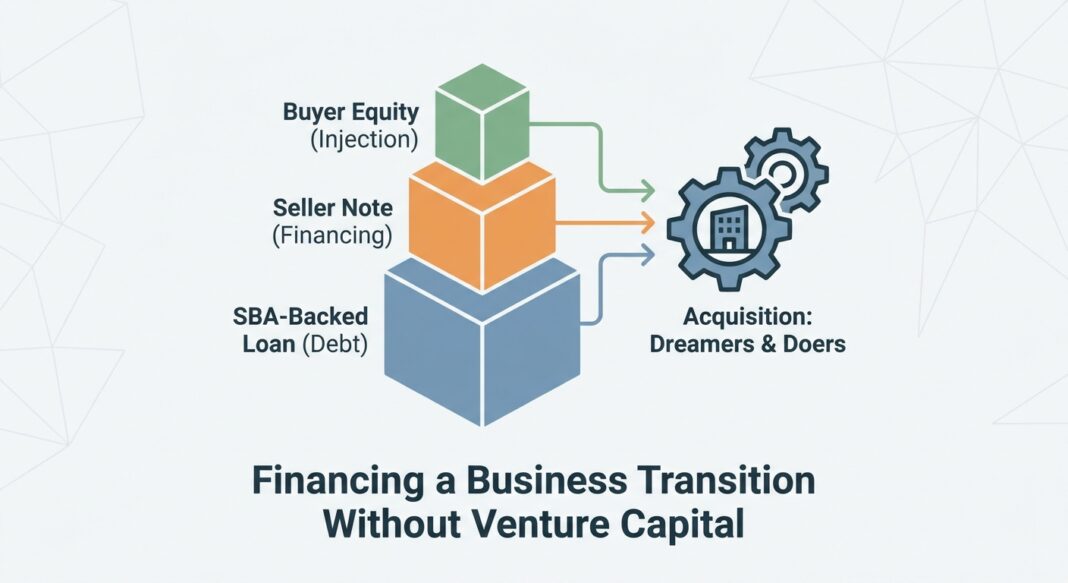
A buyer with operating experience, a seller who wanted a trusted successor, and a profitable company created an acquisition path that did not depend on venture capital. The financing preserved the buyer’s independence, but it was not debt alone: the disclosed structure combined an SBA-backed loan, buyer equity, and seller financing.
The Story
In November 2025, Christina Salerno was not searching for a company to buy. She had spent five years building Magical Teams, an operations consultancy, and had belonged to Dreamers & Doers, a paid community for women entrepreneurs, for more than a decade. Its founder, Gesche Haas, had built the business over twelve years. It was bootstrapped, profitable, and had reached seven-figure annual recurring revenue, according to the company’s account of the sale.
Haas had received two acquisition offers in 2022 and declined both. The issue was not simply price. She wanted a successor who understood the community and would preserve what members valued. Salerno already knew the business from the inside. She had advised Haas and helped with hiring, so a potential buyer-seller relationship began with operational familiarity rather than a cold approach.
The conversation became a real acquisition question: could Salerno buy a seven-figure business without a large personal cash reserve or an outside equity partner? She had operating experience, but had never acquired a company. The deal also carried a stewardship test. Dreamers & Doers was a membership business whose value depended on continuity and trust, not only recurring fees.
The parties began talking on November 5, 2025. Seven months later, on June 5, 2026, Salerno’s Magical Teams acquired Dreamers & Doers. The chronology and the founders’ account are described in Inc.’s June 19, 2026 report and the company’s account of the transaction.
The Decision
Salerno’s financing choice was between sourcing outside equity, relying on her own balance sheet, or using acquisition debt supported by the target’s cash flow. An equity investor could have supplied purchase capital, but would have required an ownership stake and potentially negotiated governance rights. A conventional loan might also have been constrained by the buyer’s limited acquisition history and available collateral.
The reported solution was a blended stack. An SBA 7(a) loan covered most of the purchase price. Salerno contributed the program’s required 10% buyer equity injection, and Haas provided a substantial seller note. The public accounts do not disclose the exact purchase price, loan principal, seller-note amount, interest rate, amortization, collateral, or covenants. No exact dollar allocation should be inferred from the description “seven-figure acquisition.”
The SBA guarantee is made to a lender, not paid directly to the buyer. The Small Business Administration says its 7(a) program can support complete or partial changes of ownership, and that borrowers apply through participating lenders. The structure allowed the buyer to purchase control without adding a venture-capital investor to the ownership group. It did not mean Salerno avoided equity entirely: her own injection was part of the financing.
The seller note mattered for more than proceeds. It reduced the amount Salerno needed to fund at closing and kept Haas financially connected to the transition. In the Inc. interview, Salerno described the SBA loan, buyer injection, and seller note as the components that made the purchase possible. The actual debt pricing and repayment burden were not made public.
The Outcome
The verified result is ownership transfer, not a reported investment return. Magical Teams acquired the company. The 12-person Dreamers & Doers team was expected to remain, and Haas continued in an advisory role, according to the company’s June 2026 announcement. Salerno stepped away from her role as CEO of Magical Teams to focus on the acquired business. The buyer had control and operating responsibility; the seller had a completed sale and continuing involvement.
There is no public disclosure of post-acquisition EBITDA, debt-service coverage, loan repayment, member retention after closing, or realized return on Salerno’s buyer equity. That limits what can responsibly be claimed. The transaction demonstrates access to ownership through a mix of senior guaranteed debt, buyer capital, and seller financing. It does not yet establish that the leverage produced a financial outperformance.
Consider the counterfactual carefully. If Salerno had funded the purchase with an outside equity investor, she might have reduced her borrowing but shared ownership and possibly some control. That is a hypothetical comparison, not a disclosed offer she received. Conversely, if the business’s cash flow weakened, the acquisition loan would still require payment, while an equity investor would generally bear more downside before the buyer’s debt obligations disappeared. Leverage preserved the possibility of greater ownership participation, but concentrated repayment risk in the acquired business and its new owner.
The sellers’ account also describes a contingency: if the acquisition failed to close, Salerno would have joined Dreamers & Doers as COO. That fallback helped the parties maintain continuity during the financing process. The deal’s reported value was therefore not only the funded purchase. It was also the fit between a buyer who knew the members and a seller willing to support the handoff.
The Lessons
This is a case for matching financing to the business and buyer, not a blanket case for debt over equity. Acquisition debt is most workable when operating cash flow is durable, earnings are documented, and the buyer has a credible plan to manage the company. A seller note can bridge a funding gap and align the departing owner with the transition, but it remains a liability with negotiated payment terms. Buyer equity injection provides a cushion, though it still exposes the buyer’s own capital.
Debt is less forgiving where revenue is volatile, customer retention is uncertain, margins are thin, or the business needs substantial reinvestment immediately after closing. Underwriting should stress-test lower revenue, delayed integration benefits, working-capital needs, and higher-than-expected expenses. The buyer should test debt service against cash available after taxes, maintenance investment, and a prudent liquidity reserve, not against a best-case forecast.
Salerno’s transaction also shows that equity preservation has more than one meaning. The seller transferred ownership; she did not keep her shares. The buyer used debt and a required personal equity contribution rather than bringing in a reported outside equity sponsor. That distinction is important for operators considering an acquisition: the relevant comparison is not “debt means no equity,” but how much ownership and control each financing source requires, and what fixed obligations it creates.
A practical framework begins with four questions: Does normalized cash flow cover scheduled debt service under a downside case? How much cash remains for working capital after closing? What are the seller note’s payment, subordination, and default terms? What control, dilution, or exit rights would an equity partner receive? Then test operational fit. Salerno already understood the company’s members and practices, reducing one source of transition risk, although familiarity cannot replace financial and legal diligence.
The central lesson is measured: SBA-backed acquisition debt can widen the buyer pool for a profitable small business, while seller financing can help close the capital gap. Neither removes risk. Dreamers & Doers closed with its buyer, seller, and team aligned around continuity. The financing structure made that transfer feasible; the available public record does not yet tell us how the debt performed over time.
Key Insights
- The disclosed financing blended an SBA 7(a) loan, a 10% buyer equity injection, and a substantial seller note.
- The purchase price and individual loan and note amounts were not publicly disclosed.
- Salerno acquired the company without a reported outside equity partner, but still contributed buyer equity.
- The seller note reduced the buyer’s closing cash requirement and tied part of the seller’s proceeds to the transaction terms.
- Deal completion and staff continuity are known; debt repayment and post-close financial returns are not public.


