
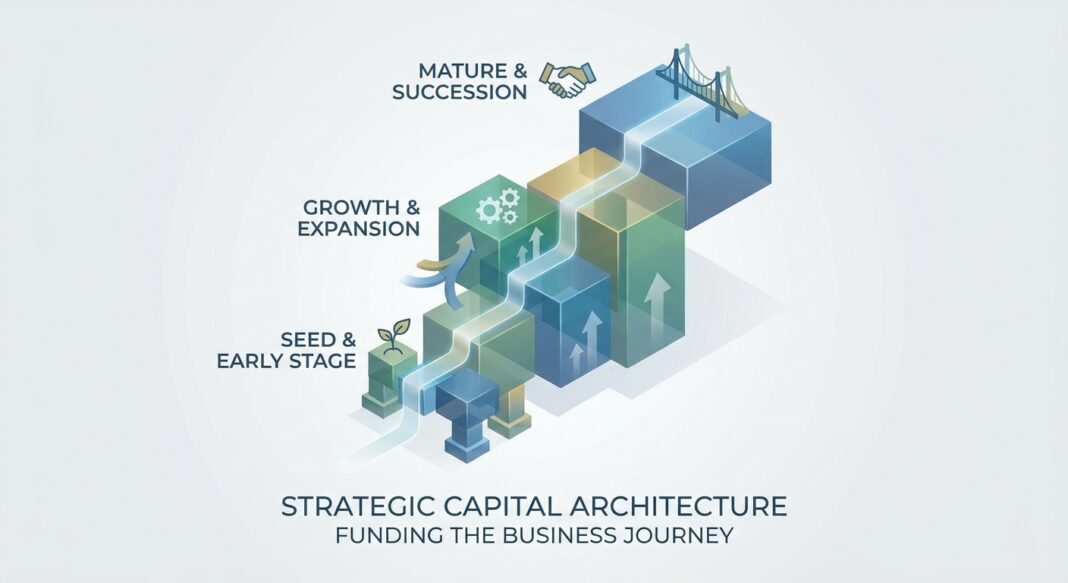
A growth-stage company preparing to add capacity may need to fund equipment, inventory and a longer cash-conversion cycle before its next owner transition. Treating all three needs as one borrowing request can create a mismatch: short-term working capital is tied up in a long-lived asset, while acquisition or succession debt may depend on cash flow the business has not yet established.
Capital choices should follow the business’s evidence of repayment and the use of proceeds, not a fixed debt-before-equity rule. As a company moves from seed to succession, its financing options generally widen as revenue, collateral, cash flow and reporting become more dependable. The practical task is to identify which stage the company has reached for each specific use, then build a stack that preserves enough liquidity and future capacity for the next stage.
Match the funding layer to the business stage
Seed: Product development and market validation usually have uncertain timing and limited collateral. Founder capital, grants where available, and equity or convertible securities can absorb that risk. Repayment debt is a poor fit when there is no demonstrated source of scheduled repayment.
Early revenue: The question shifts to whether customer receipts reliably cover operating costs. Equity can fund continued product or market investment. Where receivables are established, a small working-capital line or receivables facility may address timing gaps, but borrowing should be sized to collectible assets and cash conversion, not sales forecasts alone.
Growth: Separate recurring working capital from expansion spending. A revolver or asset-based facility can track eligible receivables and inventory; equipment loans or leases can match repayment to an asset’s useful life. Predictable EBITDA may support senior cash-flow debt. If an acquisition or expansion need exceeds senior capacity, subordinated debt, preferred capital or common equity can fill the residual, at a higher cost or with greater ownership consequences.
Mature: Banks may provide revolving and term facilities where cash flow, collateral and reporting support them. Larger, established borrowers can also evaluate private or public credit. Equity remains an option for a major investment, deleveraging or balance-sheet repair, but its cost includes dilution and governance rights. Match maturities to the time required for the proceeds to generate cash.
Succession: A change of ownership may combine buyer equity, senior debt and a seller note. Subordinated or preferred capital can address a remaining funding gap when repayment capacity or lender limits constrain senior borrowing. The SBA says its 7(a) program may finance complete or partial ownership changes, working capital, equipment and certain debt refinancing; eligibility and underwriting still depend on the borrower and transaction. SBA 7(a) program
Build the stack around each use of proceeds
Start with a proceeds schedule, not a target loan amount. Assign each dollar to working capital, equipment, acquisition consideration, transaction costs, refinancing or owner liquidity. Then identify the repayment source and expected timing for each category. Receivables and inventory may support a borrowing base; equipment can support an asset-specific facility; stable enterprise cash flow can support amortizing debt. Equity and preferred capital can absorb execution risk that fixed repayment obligations cannot.
For the gap, calculate total verified uses, subtract available cash and committed financing, then test the residual against lender capacity and downside cash flow. If senior debt stops short, compare reducing or deferring uses, adding buyer equity, negotiating a seller note, or introducing subordinated debt or preferred capital. These instruments are not interchangeable: a seller note may defer cash payment but require subordination terms; mezzanine debt adds scheduled or accrued return and may include equity rights; preferred equity can reduce near-term debt service while adding a senior claim on distributions or exit proceeds.
A disclosed example shows how layers can be combined. In its filing covering September 30, 2026, Teamshares reported senior debt, seller notes and a Series A preferred issuance to support acquisitions. The company said preferred dividends could be paid in cash or in kind, and described seller notes as supplemental to debt and equity. That is a company-specific structure, not a universal template. Teamshares Form 10-Q
Gap capital playbook for a growth-stage expansion
- Quantify: Build a sources-and-uses schedule by month. Include the working-capital peak, committed capex, contingency needs, fees and minimum operating liquidity. Reconcile the request to a base case and a downside cash forecast.
- Prepare: Assemble monthly financial statements, tax returns, debt schedules, accounts-receivable and payable aging, inventory reports, customer concentration, backlog and capex quotes. Explain material forecast assumptions and distinguish recurring cash earnings from one-time adjustments.
- Run the process: Present the same defined request to relevant bank, asset-based, private-credit and equity providers. Ask each to size only the use it can underwrite. Compare total cost, certainty, collateral reach, covenants, amortization, availability conditions and closing timetable, not headline pricing alone.
Current bank evidence supports careful segmentation by borrower profile. The Federal Reserve’s October 2026 Senior Loan Officer Opinion Survey reported that standards for C&I loans to small firms tightened in the third quarter, while standards for large and middle-market firms were basically unchanged. Banks also reported tighter premiums for riskier loans and tighter collateralization requirements and interest-rate floors for small firms. These survey findings describe bank responses, not a commitment or quote for an individual borrower. Federal Reserve, October 2026 SLOOS
Negotiate for capacity after closing
Borrowers should test covenant headroom under a downside case and negotiate reporting definitions, add-back limits, cure rights, permitted liens, incremental debt capacity and collateral release mechanics. For delayed-draw or asset-based facilities, clarify availability tests, advance rates, reserves and expiry dates. For seller notes or mezzanine debt, negotiate payment blockage, subordination, maturity, cash-versus-PIK return and any warrants or other equity participation. For preferred capital, review distribution priority, redemption terms, voting rights and how proceeds are treated in a sale.
Investors and lenders should focus on the verified repayment source, collateral quality, cash conversion and the position of their claim in a downside or sale. The best-structured gap is the one whose repayment burden and control rights fit the proceeds’ risk and duration.
Key takeaways
- Choose financing by business stage and specific use, not by a single capital-stack rule.
- Use asset-backed borrowing for eligible short-cycle assets and match equipment debt to asset life.
- Reserve cash-flow debt for demonstrable repayment capacity; use equity-like layers for greater execution risk.
- Quantify the funding gap only after detailing uses, timing, existing liquidity and downside needs.
- Negotiate for post-close liquidity and future financing capacity, not only the amount funded at closing.


