
Opening: Why repayment mechanics matter
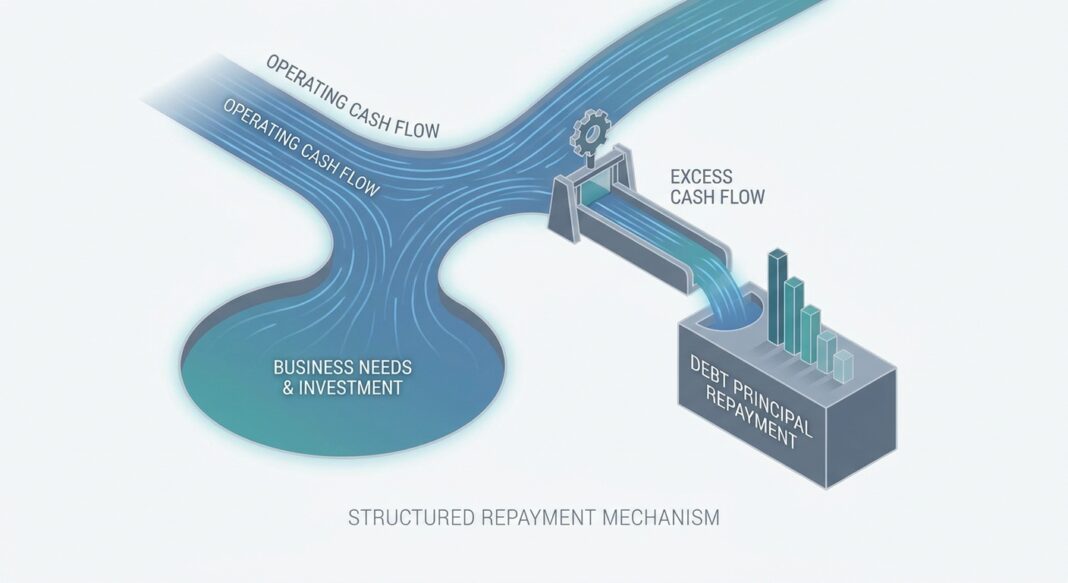
A private credit loan is defined by more than its coupon and maturity date. The agreement also determines what happens when the borrower generates cash beyond its operating needs. An excess-cash-flow sweep requires the company to use a stated share of that surplus to repay debt ahead of schedule. It changes the path of principal repayment without changing the loan’s stated maturity.
For lenders, a sweep can reduce exposure while the company is performing well, before a refinancing or downturn makes repayment harder. For owners and management teams, it can reduce interest expense and leverage, but it also limits cash available for hiring, acquisitions, inventory, or capital investment. The central question is not simply whether a sweep exists. It is how the agreement defines excess cash, what percentage is swept, and which reinvestment needs are protected.
This is a contractual allocation rule, not a forecast that cash will always be available. Understanding its mechanics helps investors assess the speed of principal reduction and helps operators plan liquidity after closing.
The concept: How a cash-flow sweep works
An excess-cash-flow sweep is a mandatory prepayment provision in a credit agreement. At an agreed measurement date, the borrower calculates excess cash flow using the contract’s definition, then pays a specified portion to lenders. The definition often starts with cash generated from operations and subtracts items such as cash interest, taxes, capital expenditures, working-capital needs, and scheduled amortization. The exact formula is negotiated, so two loans with the same headline sweep percentage can produce different payments.
The sweep is separate from scheduled amortization, which is the regular principal payment due under the loan’s payment schedule. It is also distinct from a voluntary prepayment, which the borrower elects to make when permitted. Sweep payments typically reduce principal and future interest expense. They do not automatically reduce the borrower’s required revolving-credit availability or guarantee that the company will meet its next maturity.
Agreements may set a flat sweep percentage or lower the percentage when leverage falls below specified thresholds. They may also allow a portion of cash to be retained for approved reinvestment, acquisitions, or other agreed purposes. A leverage-based step-down therefore rewards deleveraging with greater operating flexibility. The calculation, timing, permitted deductions, and payment application all matter as much as the stated percentage.
How it works: A simplified example
Assume a company borrows $80 million in a senior secured private credit loan and reports $20 million of EBITDA. Its opening gross leverage is 4.0x, calculated as debt divided by EBITDA. These figures are illustrative, not an observed transaction. During the year, the borrower pays operating costs, cash interest, taxes, and necessary capital expenditures. After the credit agreement’s specified deductions and scheduled amortization, it has $5 million of excess cash flow.
If the agreement requires a 50% sweep, the company pays $2.5 million toward principal. Debt falls from $80 million to $77.5 million. If EBITDA remains $20 million, gross leverage declines from 4.0x to 3.875x. The company retains the other $2.5 million, subject to any other cash-control or restricted-payment provisions in the loan documents.
Now consider a contract that reduces the sweep to 25% once leverage reaches 3.5x, and permits specified growth investment to be deducted from excess cash flow. The payment could be smaller in a later year, leaving more cash for the business. That flexibility has value, but it also means lenders need to examine the leverage test, the EBITDA definition, and the eligible deductions. A nominal 50% sweep is not necessarily half of all cash generated.
The same mechanism can create tension during expansion. If a company needs to fund a new facility or seasonal inventory, a large mandatory payment may force it to borrow again or seek sponsor equity. In that situation, the loan may repay principal on paper while the business faces a separate funding gap.
Current market relevance
Recent data make repayment flexibility relevant, but they do not establish how common any particular sweep term is. In the Federal Reserve’s October 2026 Senior Loan Officer Opinion Survey, banks reported that C&I lending standards for large and middle-market firms were basically unchanged in the third quarter of 2026, while standards for small firms tightened. Banks also reported tightening premiums on riskier C&I loans across firm sizes, and weaker net demand for C&I loans from firms of all sizes.
PitchBook’s October 2026 US Private Credit Monitor reported that direct-lending volume edged higher over the preceding three months on fewer, larger deals, while year-to-date activity remained below the prior year. The report also said buyout financing fell to its lowest level since 2020, the syndicated market won more large transactions, and direct-loan spreads widened while syndicated spreads tightened. These are market-activity and pricing observations, not evidence that lenders have adopted one standard cash-sweep formula.
Manager disclosures show the scale and breadth of credit capital, rather than specific loan-document terms. KKR reported $337 billion of credit and liquid-strategy AUM as of September 30, 2026, including $49 billion of corporate private credit, of which $39 billion was direct lending. Its Q3 2026 release also reported $8 billion of credit capital invested in the quarter and $31 billion year to date. Those figures describe KKR’s platform and deployment, not the terms or performance of a representative private loan. Together, the current evidence points to a market where lenders are weighing selectivity, pricing, and borrower cash generation. Contract-level analysis remains essential.
Decision framework for investors and operators
For investors: Read the definition of excess cash flow before relying on the sweep percentage. Identify how the agreement treats taxes, capital expenditure, working capital, acquisitions, asset-sale proceeds, and prior-period cash. Check whether the sweep declines as leverage falls, whether there is a minimum cash balance, and whether payments reduce the relevant tranche or are shared among lenders. Then test the borrower’s projected cash flow under lower EBITDA and higher interest expense. A strong sweep provision cannot compensate for cash flow that is too volatile to support scheduled debt service.
For operators: Model the sweep alongside the annual budget, not as an afterthought. Estimate the cash payment under base, downside, and growth cases, and compare it with planned investment and seasonal liquidity needs. Negotiate clear deductions for necessary investment and a workable reinvestment period where appropriate. Evaluate whether faster debt reduction offsets the loss of retained cash, and whether a revolver or sponsor support is realistically available if a large payment coincides with a cash need. A lower sweep percentage may preserve flexibility, but lenders may seek other protections or pricing in exchange.
In either role, focus on the cash waterfall in the actual documents. The headline percentage is only the starting point.
Key takeaways
- An excess-cash-flow sweep directs a defined share of surplus cash to mandatory principal repayment.
- The contract’s cash-flow definition and permitted deductions can matter more than the stated sweep percentage.
- Faster repayment reduces debt exposure and future interest, but can constrain operating investment and liquidity.
- Leverage-based step-downs can grant more flexibility after the borrower reduces debt, if the tests are clearly drafted.
- Assess the sweep against downside cash-flow scenarios and the borrower’s real reinvestment and working-capital requirements.


