
THE STORY
On March 12, 2026, British real estate adviser Savills agreed to buy Eastdil Secured, a New York-founded investment bank whose work spans property sales, debt placement, structured credit and loan sales. It was a strategic purchase with a material financing challenge: the agreed enterprise value was $1.1125 billion, while Eastdil had generated $633 million in revenue and $113 million in EBITDA in 2025. Savills was buying a business with a different revenue engine and a stronger North American footprint, not a small bolt-on that could be absorbed with routine cash flow.
The price equaled 9.9 times Eastdil’s 2025 EBITDA. Savills said the deal could add at least £15 million of annual EBITDA from direct revenue synergies over the medium term, but that was a forecast, not cash available at signing. The company needed acquisition capital now, while the benefits of the combination would arrive over time.
There was another constraint: an all-equity offer could have placed more of the purchase risk on existing Savills shareholders through dilution. An all-debt approach would avoid that dilution, but would leave Savills carrying a large short-term financing obligation against a cyclical advisory business. The deal therefore became a test of capital sequencing: use debt to close, issue shares to bring sellers and employees into the enlarged company, then replace the bridge with longer-dated funding. Savills’ March 12 transaction announcement set out the intended structure and the operating case behind it.
THE DECISION
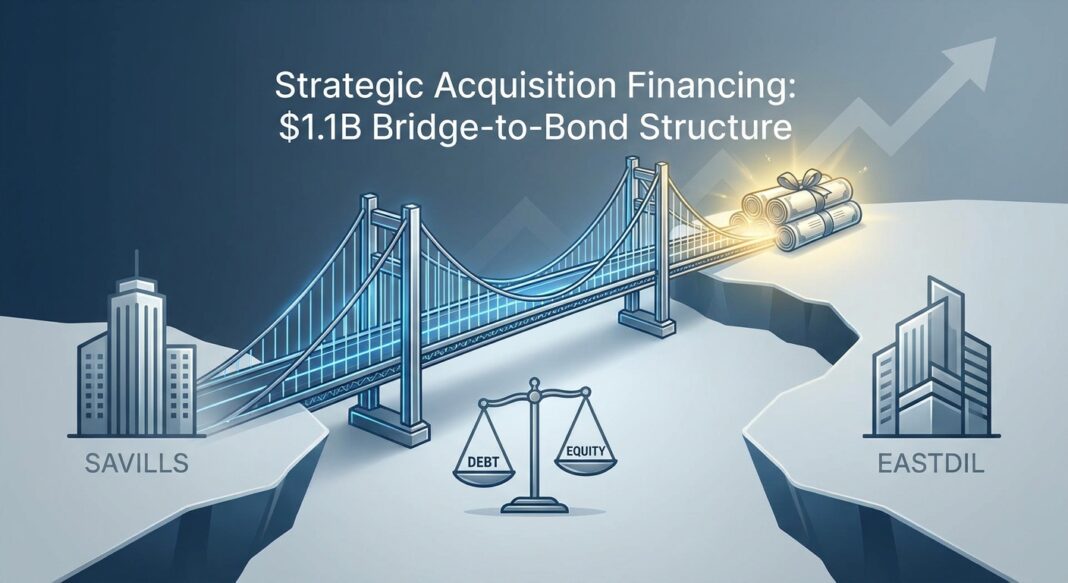
Savills did not choose debt instead of equity. It chose a mix that divided the purchase funding between cash financing and consideration shares. The company arranged an unsecured bridge facility of up to $800 million to fund the cash consideration and transaction costs. The facility had a 12-month maturity from signing, with two six-month extension options. Separately, Savills agreed to issue new ordinary shares equivalent to approximately 16% of its enlarged share capital to Eastdil’s existing equity holders.
Those shares went to Eastdil’s employee owners and institutional holders, including Guggenheim, Temasek and Wells Fargo. The structure converted some sellers into continuing Savills shareholders rather than paying them entirely in cash. That diluted existing Savills owners, but tied the sellers’ future value to the combined company. The debt provided acquisition capacity without issuing enough shares to fund the entire purchase.
The bridge was always meant to be temporary. Savills’ investor presentation said it expected to refinance the facility with a term loan and U.S. private-placement notes within the first year after completion. On October 21, Savills announced a $350 million private-placement note issue, with maturities of three, five, seven and ten years. Together with a $450 million, three-year bank term loan, the notes were intended to replace the $800 million bridge at a stated all-in cost of 5.7%. The note proceeds were scheduled to draw on December 2, 2026, subject to contract, so as of November 22 the final $350 million repayment was still prospective. The October 21 RNS announcement disclosed the terms and timing.
THE OUTCOME
Savills completed the acquisition on July 31, 2026, for the announced $1.1125 billion enterprise value. Eastdil joined the group as its real estate investment bank, with its existing leadership continuing in senior roles. Savills reported that 85 Eastdil senior employees would hold 6.3% of the enlarged group at completion. The deal therefore preserved an ownership connection for key employees, but it did not preserve every pre-deal Savills shareholder’s percentage ownership: the consideration shares represented about 16% of the enlarged share capital. The completion release confirms the close and share consideration.
The financing outcome is a sequence rather than a finished scorecard. A $450 million bank term loan was in place, and Savills had arranged the remaining $350 million of notes, but the announced draw date was still ahead on November 22. Savills’ CFO said the combined financing carried 5.7% all-in pricing and management expected net debt to EBITDA of about 1.0 times at the end of 2027. That leverage figure is a forecast, not a reported post-acquisition result. The company also forecast low-to-mid-teens earnings-per-share accretion in 2027 before synergies.
There is no disclosed public counterfactual showing what an all-equity purchase would have cost shareholders or how a wholly debt-funded offer would have performed. The useful comparison is structural. An all-equity deal would have avoided interest and refinancing risk but likely required more share issuance; an all-debt structure would have reduced dilution but increased fixed claims and left sellers with less continuing ownership. Savills’ actual structure shared those costs. The refinancing plan also reduced dependence on one short-maturity bridge, provided the notes fund on schedule.
THE LESSONS
This case is not evidence that debt always beats equity. It shows why the funding plan should be judged across the full life of an acquisition. A bridge can secure closing certainty, but only if the borrower has a credible route to permanent financing and enough liquidity if the market or integration plan disappoints. Savills matched the bridge with a stated refinancing timetable, divided the takeout among a bank loan and notes, and used several note maturities instead of replacing the whole obligation with one short-dated bullet.
The equity component also matters. Seller shares made Eastdil’s former owners and employees stakeholders in the combined company. That can align incentives, but dilution remains a real price paid by existing shareholders. A capital plan should compare that dilution with the expected cash interest, refinancing risk, covenant headroom and value of the sellers’ continued involvement. Synergy estimates should not be treated as debt-service cash until they are realized.
Market access is not uniform. KPMG Corporate Finance’s November 2026 credit update reported $164.2 billion of new-issue leveraged-loan volume in Q3 2026, the lowest quarterly total of the year, while September M&A and LBO loan issuance reached $30.6 billion, its highest monthly level since January 2022 (as of September 30, 2026). KPMG also reported that lenders favored higher-quality borrowers for M&A financing. The Q3 credit update supports a practical point: a refinancing plan depends on borrower quality and market access, not just a management target.
A useful decision framework starts with four questions. First, what cash flow can service debt under a downside case, before synergies? Second, what is the committed takeout plan, including maturity dates and extension conditions? Third, how much dilution is required to keep leverage within the company’s risk tolerance? Fourth, does the seller rollover create accountable, long-term ownership or merely defer a cash payment? Debt can preserve more equity only when the operating business can carry it through a weaker cycle. Savills’ case is a mixed-capital example, with the evidence so far strongest on deal structure and refinancing execution, not yet on realized operating returns.
KEY INSIGHTS
- A bridge loan buys time, not permanent financing. Set the takeout plan before closing.
- Savills’ $800 million bridge sat alongside seller shares equal to about 16% of enlarged equity.
- Employee and seller ownership can align incentives, while still diluting existing shareholders.
- Do not size acquisition debt against forecast synergies alone. Test the base business first.
- At November 22, 2026, the $350 million note draw was scheduled for December 2, subject to contract.


