
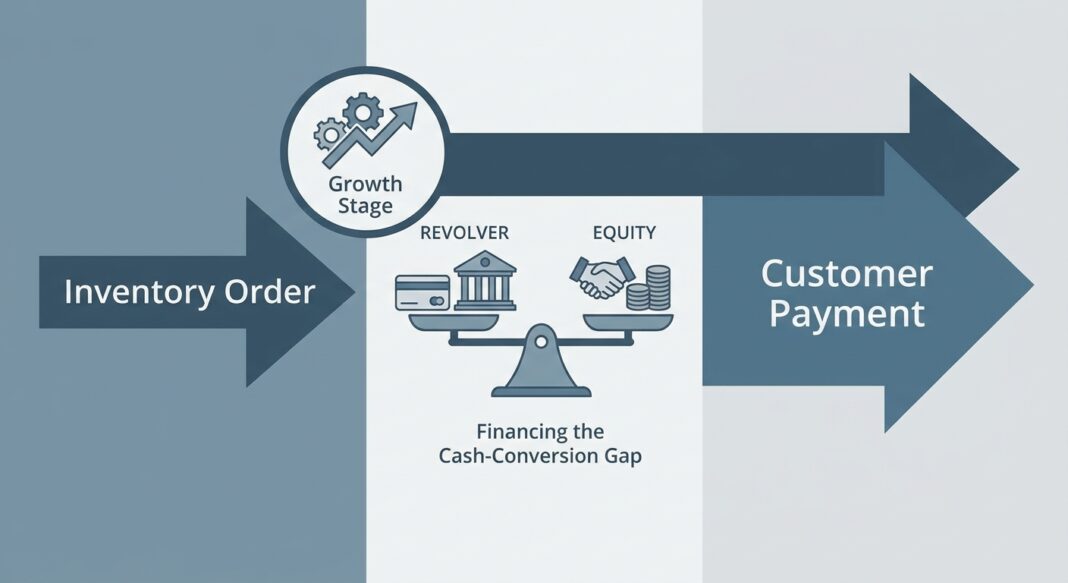
A growth-stage distributor wins a large customer order, but must buy inventory weeks or months before collecting the receivable. The financing question is not simply how much capital the business can raise. It is which part of the capital stack should fund a cash-conversion gap that will reverse when customers pay. A long-dated term loan or equity issuance can cover the need, but may leave the company paying for temporary working capital long after the inventory has turned. A revolving facility can better match borrowing to fluctuating receivables and inventory, if the business can document eligible collateral and manage availability tests.
This is one stage-specific choice within a broader capital plan. Seed companies generally rely on founder capital and equity while cash flows and collateral are limited. Early businesses may add venture debt or equipment financing where repayment has a defined source. At growth, recurring cash flow and working-capital assets can support bank or asset-based credit. Mature companies can access broader bank, private-credit, or public-credit options. Succession can require a different blend of senior debt, seller financing, mezzanine, preferred equity, and buyer equity. The use of proceeds, not a preference for debt or equity in the abstract, should drive the initial design.
Start with the use of proceeds, then choose the layer
For seasonal inventory and receivables, the lower-cost end of the capital spectrum is usually a bank revolver, including an asset-based lending (ABL) line sized against eligible receivables and inventory. It may provide access without issuing shares, but the borrowing base, collateral controls, reporting and lender diligence can constrain availability. A cash-flow revolver relies more on enterprise cash generation and covenant capacity than on collateral formulas.
Term debt is better matched to equipment, facility investment, or another asset with a useful life that extends beyond one working-capital cycle. Private credit may be considered when bank capacity, timing, or covenant flexibility is insufficient, but greater access can come with higher cash interest, fees, tighter documentation, or more lender control. Mezzanine sits below senior debt and can fill a financing shortfall for an acquisition or expansion when cash flow can support its repayment burden. Preferred equity and common equity have no scheduled debt service, but introduce ownership, governance, and return-sharing costs. Public credit and equity are typically relevant to companies with the scale and disclosure capacity to access those markets.
Do not fund a short-lived inventory build with permanent capital unless the operating plan requires a lasting increase in net working capital. Conversely, do not put long-life capex on a revolver that must be periodically renewed. Acquisitions need committed purchase-price funding; a recapitalization needs durable debt capacity after distributions; succession financing has to account for seller liquidity, buyer ownership, and debt service after closing. One facility can have more than one permitted use, but the borrowing base and repayment profile still need to fit the actual uses.
Structure the gap around the cash-conversion cycle
Consider a hypothetical growth-stage distributor preparing for a seasonal order surge. Its cash forecast identifies the peak funding need between supplier payments and customer collections. The revolver is sized to that peak, subject to the lower of the commitment and a borrowing base. Eligible receivables and inventory are defined; advance rates, reserves, concentration limits, field examinations, reporting frequency, and cash dominion triggers determine the usable amount. Availability should include a cushion for delayed shipments, slower collections, deductions, and inventory that becomes ineligible.
Keep equipment and durable expansion costs separate where practical. A term loan or equipment facility can amortize against the asset’s expected useful life, while the revolver pays down as receivables convert to cash. If a borrowing-base line cannot support the full requirement, first test whether the forecast reflects a permanent working-capital increase or a temporary peak. For a permanent increase tied to durable growth, a term facility, additional equity, or a carefully sized private-credit tranche may be more coherent than assuming the revolver will stay drawn indefinitely. This is an illustrative structure, not a reported transaction or a pricing quote.
What recent agreements show
Public agreements filed in October 2026 show that facilities can be tailored around seasonality, maturity, and availability rather than built as a single undifferentiated loan. Watsco disclosed an unsecured, syndicated $750 million multicurrency revolver with a five-year maturity, signed October 21, 2026. Its agreement permits seasonal capacity reductions of $100 million, $200 million, or $300 million during a defined period, and includes incremental borrowing capacity. The company disclosed a Term SOFR spread of 100 basis points at closing, with a leverage-linked range of 100 to 137.5 basis points, plus an unused commitment fee of 10 basis points at closing. These are Watsco-specific terms for a large public company, not a benchmark for a smaller borrower. (Watsco Form 8-K, filed October 27, 2026.)
Conduent announced on October 23, 2026 that a refinancing extended its $357 million revolving facility through May 2029 and added $90 million of commitments, including a $15 million letter-of-credit facility. The company also linked divestiture proceeds and reduced surety and letter-of-credit requirements to deleveraging and liquidity flexibility. The example shows that committed availability includes more than cash borrowing: letters of credit can consume capacity, while portfolio changes can release it. These transactions illustrate deal-specific structures, not a universal market standard. (Conduent refinancing announcement, October 23, 2026.)
The gap-capital playbook
Quantify: Build a monthly cash forecast through the seasonal peak and collection period. Separate inventory purchases, receivables, payables, capex, taxes, existing debt service, and minimum operating cash. Stress slower collections, customer concentration, margin compression, and inventory obsolescence. Reconcile the resulting peak need to the borrowing base, not only to a headline commitment.
Prepare: Assemble monthly financial statements, a 13-week cash forecast, borrowing-base detail, receivables aging, inventory reports, customer and supplier concentration, backlog, and a clear schedule of proceeds. Reconcile management EBITDA to lender-adjusted cash flow, but do not use EBITDA alone to size an asset-based line.
Run and negotiate: Compare bank, ABL, and private-credit proposals on usable availability, all-in cost, unused fees, field-exam costs, reporting, covenants, reserves, cash dominion, maturity, prepayment, and incremental debt baskets. Negotiate eligibility rules and reserves alongside price; a nominally large commitment can deliver less liquidity if the borrowing base is narrow. Protect headroom for ordinary seasonal volatility, specify how letters of credit affect availability, and test the maturity against the operating cycle. The investor’s parallel diligence is whether collateral converts to cash on a stressed basis and whether the facility can pay down from the stated proceeds cycle.
Key takeaways
- Match short-cycle working capital to a revolving structure that can pay down as customers pay.
- Size ABL proceeds from eligible collateral and reserves, not the stated commitment alone.
- Fund durable capex and permanent working-capital needs with capital that does not depend on a brief seasonal turn.
- Compare access and control costs, including reporting, covenants, fees, and collateral restrictions, alongside interest.
- In the full capital stack, use debt for forecastable repayment and equity for risk that the business cannot responsibly service.


