
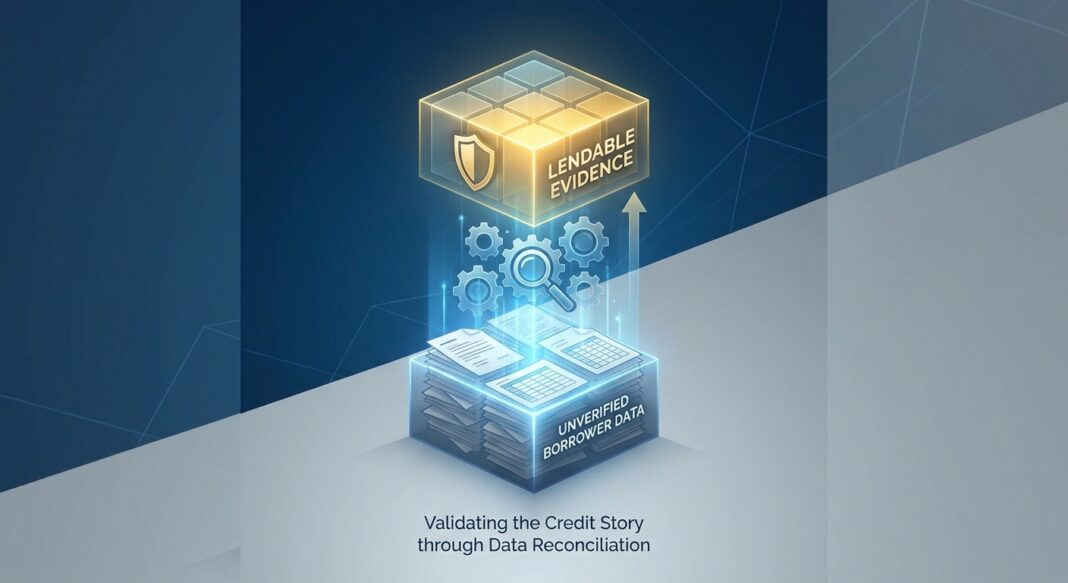
A lender receives a polished confidential information memorandum (CIM) showing $10 million of EBITDA. Which figure belongs in the credit model: the CIM number, the financial statements, or the cash the business can actually use to pay debt service? The answer requires a traceable bridge between all three. A CIM is a transaction summary, not independent evidence. When its historical periods, adjustment schedule, debt figures, and forecast assumptions do not reconcile, the lender may size debt against earnings that cannot be reproduced or cash flow that is already committed elsewhere.
The discipline is to treat the CIM as an index to source documents, then test every material claim against those records. The lender should be able to move from reported results to normalized earnings, from earnings to cash flow, and from cash flow to leverage, coverage, and liquidity without unexplained differences. This is especially important when a process is competitive or refinancing options are narrowing. Moody’s reported in October 2026 that leveraged-finance issuance had rebounded while credit stress and refinancing risks remained concentrated among weaker borrowers. A clean presentation does not reduce that risk. A verifiable record makes it visible before commitment.
The framework: organize the CIM around evidence
Build the review in four linked layers. First, define the borrower perimeter: legal entities, guarantors, subsidiaries, acquired businesses, and which entities own operating assets or owe debt. Second, establish a financial fact base. Reconcile monthly and annual income statements, balance sheets, and cash-flow statements to audited or reviewed accounts, tax filings, and the general ledger. Identify accounting-policy changes, fiscal-period mismatches, and any pro forma acquisitions or divestitures.
Third, reconstruct earnings and cash conversion. Present reported EBITDA beside every adjustment, its amount, source, timing, and evidence of realization. A one-time expense is not automatically an add-back if it recurs in different form. Separate cash expenses from noncash items, then account for cash taxes, maintenance capital expenditure, working-capital investment, lease payments, and other recurring obligations. Fourth, connect the operating case to proposed debt and covenant definitions. State gross debt, unrestricted cash, revolver availability, amortization, cash interest assumptions, maturity dates, and permitted debt that may sit outside the headline facility.
For each key figure, show the period, source document, preparer, and reconciliation. A lender should see the same EBITDA definition in the CIM, financial model, covenant calculation, and draft credit agreement, or a clearly explained bridge between them. The LSTA’s leveraged-lending diligence practice note describes diligence areas that include corporate structure, credit and financial analysis, collateral, cash controls, compliance, and ongoing monitoring. That breadth is useful: a CIM cannot be considered complete if its earnings story omits who owns the cash or who controls the collateral.
Analysis: reconcile leverage, coverage, and cash
Consider an illustrative manufacturer with $10 million of lender-accepted EBITDA, $50 million of gross debt, and $5 million of unrestricted cash. Gross leverage is 5.0x ($50 million / $10 million); net leverage is 4.5x (($50 million – $5 million) / $10 million). If annual cash interest is $5 million, EBITDA-to-cash-interest coverage is 2.0x ($10 million / $5 million). These are not substitutes for a cash-flow forecast. EBITDA does not pay principal, taxes, capital spending, or working-capital needs.
Now test a 20% EBITDA decline, with debt and cash interest held constant. EBITDA falls to $8 million, gross leverage rises to 6.25x, net leverage rises to 5.63x, and interest coverage drops to 1.6x. Then bridge EBITDA to free cash flow available for debt service. If the CIM forecasts $10 million EBITDA but omits a $2 million seasonal inventory build, the credit case has overstated near-term cash generation by that amount. Model the timing by month or quarter when the business is seasonal; annual averages can conceal a cash trough that exhausts revolver availability.
Use a base case, downside case, and reverse stress. The downside case should change operating drivers that have evidence behind them, such as volume, pricing, customer retention, input costs, or collection days. The reverse stress asks what decline in EBITDA or working-capital absorption causes a covenant breach or liquidity shortfall. Tie those outputs to covenant headroom and reporting dates. Do not assume a waiver, refinancing, asset sale, or sponsor contribution unless it is documented and available under the proposed structure.
Industry standards and credit performance
The OCC’s Lending and Loan Portfolio Risk Management handbook frames commercial underwriting around repayment sources, collateral, and controls, including reporting and covenants. For CIM diligence, that means management projections must be tested against historical performance, the stated repayment source must be operating cash flow rather than an assumed exit, and required information must remain available after closing.
Recent default data provides context, not a direct default forecast for an individual private borrower. In its October 21, 2026 release, Moody’s reported five rated speculative-grade issuers defaulted globally in September, compared with 13 in August. Moody’s put the global trailing-12-month speculative-grade default rate at 4.3% as of September 30, 2026, and forecast 3.8% by year-end 2026. These are rated speculative-grade corporate figures, not private-credit portfolio rates. The distinction matters: private deals often have limited public reporting, and extensions or covenant relief can signal stress before a missed payment appears in standard default statistics. Read the Moody’s September default update with its population and measurement in view.
Common CIM failures include stale interim statements, customer concentration shown only by broad category, add-backs without invoices or payroll support, debt schedules that omit leases or seller notes, forecasts with no working-capital build, and covenant calculations that use a wider EBITDA definition than the credit case. Missing or inconsistent records are themselves a diligence finding. They can delay verification, weaken reporting controls, and make post-close monitoring less reliable.
Underwriting checklist
- Confirm legal entity chart, ownership, guarantors, liens, debt, leases, contingent liabilities, and use of proceeds.
- Obtain audited or reviewed annual statements, monthly financials, trial balances, tax returns, bank statements, and general-ledger detail. Reconcile periods and accounting policies.
- Require a reported-to-adjusted EBITDA bridge with support for each adjustment, plus customer, supplier, backlog, churn, pricing, and concentration schedules where material.
- Rebuild cash flow from EBITDA through taxes, capital expenditure, working capital, interest, and amortization. Reconcile forecast assumptions to historical results and operating data.
- Model base, downside, and reverse-stress cases. Calculate gross and net leverage, cash-interest coverage, debt-service coverage where relevant, liquidity runway, and covenant headroom.
- Match financial definitions, reporting cadence, covenant tests, cure rights, permitted debt, and restricted-payment capacity to the documented risk case. Track unresolved diligence items to named owners and closing conditions.
Key takeaways
- A CIM is a presentation document. Source records and reconciliations establish the underwriting fact base.
- Calculate leverage and coverage using one consistent, evidenced EBITDA definition.
- Translate EBITDA into cash after taxes, capital expenditure, working capital, and scheduled debt service.
- Stress timing and liquidity as well as annual earnings; seasonal cash needs can drive a breach before year-end.
- Document every unresolved assumption, covenant trigger, and reporting requirement before the loan closes.


