
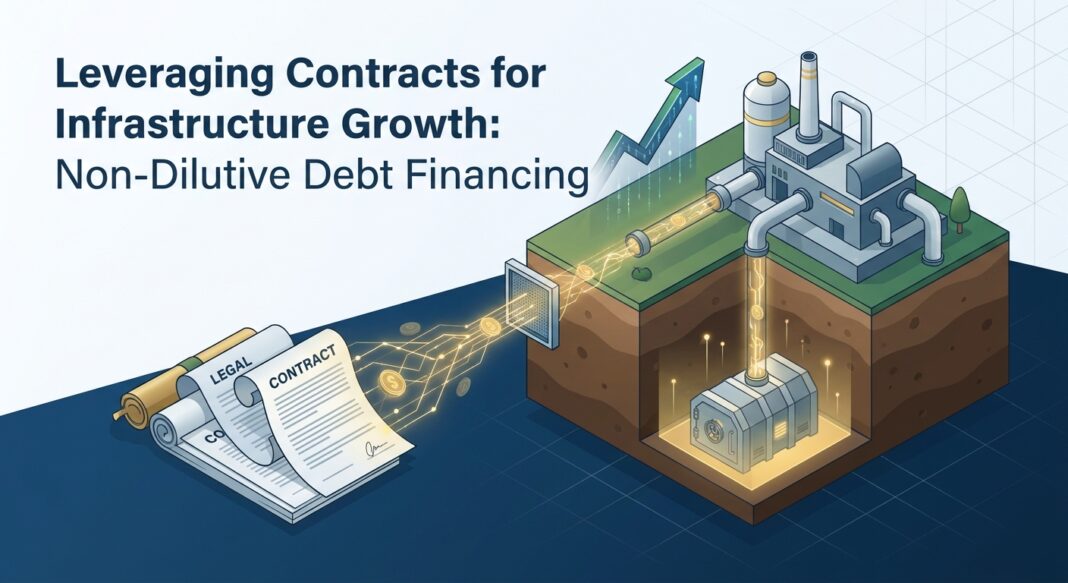
Angle: Growth funded with non-dilutive capital. This is a real financing, but its operating results remain ahead of it. Vaulted Deep’s $35 million facility is a useful case in how contracted revenue can support debt for infrastructure growth, and in what the public record does not yet show.
The Story
Vaulted Deep was built around a physical problem: municipalities, farms, and industrial operators need reliable ways to handle organic waste. The Houston-based company converts waste such as biosolids and agricultural byproducts into a slurry, then injects it deep underground. That process is intended to store organic carbon permanently while providing a waste-disposal service. The company’s leadership page identifies Julia Reichelstein, a former climate-tech investor and early-stage operator, as co-founder and CEO.
The business needed more than software or sales hires to grow. Each new site requires discovery, permitting, equipment, and operating capacity before it can accept waste and produce revenue. That creates a familiar infrastructure financing gap: capital must be spent ahead of operating cash flow, while investors need evidence that future activity will pay for the buildout.
Vaulted had evidence on both sides of its business. Waste service agreements represented customer demand for disposal. Long-term carbon removal purchase agreements, including contracts with buyers participating in Frontier, offered another revenue source. The Axios report published September 21, 2026 described more than 27,000 metric tons of carbon removal delivered to Frontier buyers during 2026 up to that report date, 39% more than the full-year 2025 total. That was a progress measure, not proof that every planned site would meet its schedule or budget.
The financing question was therefore specific: could Vaulted turn contracted demand into borrowing capacity, rather than fund every new site by issuing more equity? The answer would depend on contracts, counterparties, project execution, and the cash available to service debt.
The Decision
On September 21, 2026, Vaulted announced a $35 million debt facility from Mediobanca, arranged by CFP Energy. The company said the money would support new waste-disposal sites across the United States and further investment in its site-development technology. Its financing announcement says the facility is supported by waste service agreements and contracted carbon-removal revenue, including Frontier offtakes. A law firm advising on the transaction described it as a $35 million debt financing for national expansion.
The company did not publicly disclose the interest rate, maturity, amortization schedule, collateral package, covenants, or draw conditions in that announcement. Those terms matter. A headline facility size is not the same as cash drawn at closing, and a contracted revenue stream does not eliminate permitting, construction, production, or collection risk. The public information supports describing the transaction as contract-supported debt, not assigning it a particular loan structure or cost.
The alternative was additional equity. To make the trade-off concrete, consider an explicitly hypothetical comparison, not an offer Vaulted received: if a company raised $35 million at a $140 million pre-money valuation, the new investor would own 20% after the financing, before considering any other securities or deal terms. Debt avoids that immediate ownership transfer. In exchange, it creates scheduled repayment obligations and lender rights. Vaulted’s choice was to fund specific infrastructure expansion with debt while retaining equity ownership, rather than sell a new stake to finance the same use of proceeds. The announcement does not publish enough terms to compare the actual cost of debt with an actual equity proposal.
The Outcome
The confirmed outcome at announcement was capital access, not completed expansion. Vaulted secured a $35 million facility intended to move more projects toward development and invest in tools for faster site evaluation. The company also reported that it delivered more than 20,000 tons of carbon removal to Frontier buyers during the first half of 2026, exceeding its total deliveries to those buyers in 2025. The two data points show operating progress and financing capacity, but they do not establish the eventual return on the new debt.
For owners, the immediate capital-structure effect is clear in principle: borrowing does not issue new shares, so existing equity is not diluted by the debt transaction itself. There is no public disclosure of a founder liquidity payment or a dividend recap here. This is growth financing, not owner cash-out. The economic benefit to shareholders depends on whether the sites generate enough durable cash flow after operating costs, maintenance, interest, and principal repayment.
Compare that with the hypothetical $35 million equity raise above. A 20% new stake would give the investor a corresponding share of future equity value, but would not impose scheduled debt service. If Vaulted’s expansion succeeds, debt could preserve more of the owners’ upside. If expansion is delayed, revenues disappoint, or site costs overrun, debt service could constrain the company and magnify losses. Equity would be more expensive in a successful outcome, but it would absorb risk without a fixed repayment schedule.
As of the September 21, 2026 announcement, the actual test was still ahead: develop sites, bring them into operation, and convert customer and offtake commitments into cash that can service the facility. No later operating outcome is asserted here.
The Lessons
Vaulted’s case is not simply “debt beats dilution.” The financing appears to match debt to identifiable infrastructure uses and contracted revenue. That fit is the central lesson. Debt is most defensible when a company can trace proceeds to productive assets or projects, forecast cash receipts with reasonable confidence, and preserve headroom for setbacks. A long-term purchase contract can help a lender underwrite revenue, but the quality of the buyer, delivery conditions, termination rights, and timing of payment still matter.
Before comparing debt with equity, operators can work through four questions. First, what will the capital fund, and when should each project begin producing cash? Second, which revenues are contracted, what conditions could prevent collection, and how concentrated are the counterparties? Third, can the business cover debt service under a slower-build, lower-volume case, not only the base plan? Fourth, what are the full borrowing terms, including covenants, security, amortization, and restrictions on future financing?
Use debt when cash generation is sufficiently visible and the downside case still leaves room to pay lenders while maintaining operations. Consider equity when the business is still proving its model, cash flows are distant or volatile, or the investment requires large upfront spending with uncertain timing. A blended capital plan can also be more resilient than either extreme. The public Vaulted disclosures do not reveal the facility’s pricing or covenants, so they cannot establish that this financing would suit another operator.
The broader principle is simple: preserve equity only when the company can carry the obligations that replace it. Contracted demand helped Vaulted make its expansion financeable. Execution will determine whether that debt created durable owner value.
Key Insights
- Vaulted Deep announced a $35 million Mediobanca debt facility on September 21, 2026, to support site expansion and development technology.
- The financing was supported by waste service agreements and contracted carbon-removal revenue, including Frontier offtakes.
- Debt preserves ownership at issuance, but adds repayment obligations and lender protections.
- Public terms do not disclose pricing, maturity, amortization, covenants, or draw conditions, so the facility’s cost cannot be fairly compared with equity.
- For operators, the deciding test is stressed cash flow after debt service, not dilution avoided in isolation.


