
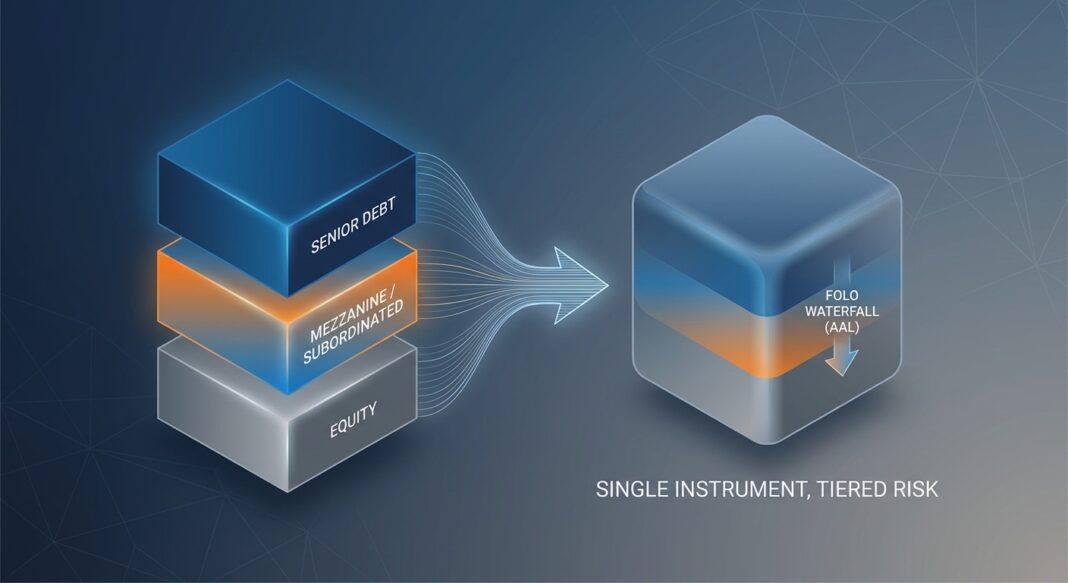
One Loan. One Rate. Two Very Different Risk Positions.
Walk into a bank to finance a middle-market buyout and you will leave with a stack of documents: a senior secured term loan, a revolving credit facility, and — if you need more leverage — a separate mezzanine or second-lien facility governed by an intercreditor agreement that took weeks to negotiate. Now walk into a direct lender and you may leave with a single credit agreement, a single interest rate, and a single counterparty. That instrument is the unitranche loan, and it has quietly become the defining structure of the private credit era.
Understanding how unitranche works — and specifically what happens behind the scenes that borrowers never see — is one of the most practically useful concepts in private credit for both the investor evaluating an allocation and the business owner deciding how to finance a transaction. The structure elegantly solves a coordination problem, but it also embeds risk that is easy to miss if you only read the borrower’s credit agreement.
What a Unitranche Loan Actually Is
At its simplest, a unitranche loan collapses what would traditionally be separate senior and subordinated debt layers into one instrument with one document, one interest rate, and one lender relationship. Pipeline Road (2026) defines it as “a single-tranche debt facility that blends senior and subordinated debt into one instrument with a single set of terms, one interest rate, and one lender group.” The borrower signs one credit agreement. There is no intercreditor agreement to negotiate. The entire capital structure below equity collapses into a single instrument.
But here is the critical nuance: simple on the outside does not mean simple on the inside. When multiple lenders participate, they typically bifurcate the economics among themselves through a private contract called an Agreement Among Lenders (AAL). Pipeline Road (2026) explains that the unitranche is “privately divided into a ‘first-out’ tranche and a ‘last-out’ tranche” — a structure the market calls FOLO (First-Out/Last-Out). The borrower makes one payment, but behind the curtain, the economics are allocated according to the AAL waterfall.
The first-out lender receives priority of payment and lower risk, similar to a traditional senior lender. The last-out lender absorbs losses first and earns a meaningfully higher spread to compensate. As Angel Investors Network (2026) notes, the last-out lender “absorbs losses first if collateral doesn’t cover the full debt, in exchange for a meaningfully higher rate.” The borrower never sees the split — they deal with one counterparty and pay one blended rate.
How the Numbers Work: A Concrete Example
Consider a private equity sponsor acquiring a manufacturing company with $20 million of EBITDA at a 6x enterprise value multiple — a $120 million deal. The sponsor contributes $48 million in equity (40% of enterprise value) and finances the remaining $72 million with a unitranche loan at 4.5x EBITDA leverage.
The borrower sees one facility: $72 million at SOFR + 525 basis points, with a five-year maturity, 1% annual amortization, and a single net leverage maintenance covenant tested quarterly. With three-month SOFR at approximately 3.7% in mid-2026, the all-in coupon lands near 9.2% — roughly $6.6 million in annual interest. One document. One wire each quarter.
Behind the scenes, the AAL splits the $72 million into a $50 million first-out tranche (priced at SOFR + 380 bps) and a $22 million last-out tranche (priced at SOFR + 800 bps). The blended math produces the single rate the borrower pays. If the company defaults and the collateral realizes only $55 million, the first-out lender is repaid in full; the last-out lender recovers just $5 million of its $22 million — a loss rate exceeding 77%. As InvestInMe Club (2026) illustrates with a comparable example, “the subordinated tranche absorbs losses first” and the senior tranche is “paid in full” before last-out lenders see any recovery.
This structure also explains why Jones Day’s analysis cited by Stirling Capital Group notes that most unitranche deals are “covenant loose” — typically just a single net leverage covenant tested quarterly, with maturities running five to seven years and mandatory amortization of roughly 1% annually.
Current Market Relevance
Unitranche has become the default deal structure for middle-market buyouts. CTA Acquisitions (June 2026) notes that “the unitranche facility is now the default structure for LBOs under $500 million in enterprise value.” The broader market context makes this dominance easier to understand.
| Metric | Reading | Source |
|---|---|---|
| Global Private Credit AUM | ~$1.7 trillion (2026) | Preqin via CTA Acquisitions, June 2026 |
| Unitranche Spread (July 2026) | S+522 bps (widest in 12+ months) | Houlihan Lokey / KBRA DLD, Summer 2026 |
| Traditional MM Unitranche Spread Range (Q3 2026) | SOFR + 500–575 bps | Valuation Research Corp, Q3 2026 |
| Total Leverage on New Issuance | 4.5x EBITDA (lowest in trailing 12 months) | Houlihan Lokey / KBRA DLD, Summer 2026 |
| Fed SLOOS: C&I Lending Standards (Q2 2026) | Basically unchanged; easier than historical midpoints | Federal Reserve SLOOS, July 2026 |
| Institutional LPs Planning to Hold or Increase Allocations | 81% of surveyed LPs | Preqin LP Survey, November 2025 |
| Cliffwater CDLI 20-Year Avg. Annual Loss Rate | 1.01% (across ~21,000 loans, $549B AUM) | Cliffwater CDLI via Angel Investors Network, 2026 |
The spread environment tells an important story. Houlihan Lokey’s Summer 2026 newsletter reports that unitranche spreads widened to S+522 in July — the widest level in more than a year and roughly 30 basis points above the February trough. Valuation Research Corp’s Q3 2026 update confirmed that spreads stabilized between SOFR + 500 and 575 basis points for traditional middle-market deals, though “stress remains concentrated among highly leveraged issuers” and borrowers needing amendments or PIK conversions.
Meanwhile, the Federal Reserve’s July 2026 SLOOS — covering 56 domestic banks — found C&I lending standards basically unchanged and easier than their historical midpoints. That matters for unitranche: when bank standards are loose, sponsors weigh the relative execution certainty and flexibility of direct lending against tighter bank pricing. When banks tighten, the gap closes and unitranche demand accelerates.
Decision Framework
For Investors Evaluating Unitranche Exposure
- Understand which tranche you hold. If you invest through a BDC or direct lending fund, determine whether the manager typically holds first-out or last-out positions. The label “senior secured” can describe both, but the recovery profiles differ substantially.
- Evaluate leverage against the current 4.5x average. Houlihan Lokey reports total leverage on new issuance declined to 4.5x EBITDA in mid-2026 — the lowest in the trailing twelve months. Portfolios originated at the 4.9x January peak may carry more subordination risk.
- Scrutinize covenant protections. A single maintenance covenant is standard, but the threshold matters. Investors consider whether the manager negotiates a leverage covenant set tight enough to trigger intervention before the equity cushion is exhausted.
- Watch the private-versus-public premium. Houlihan Lokey reports the private spread premium over broadly syndicated loans narrowed to 178 basis points in July 2026. Investors consider whether that premium adequately compensates for illiquidity and the opacity of the AAL structure.
For Operators and Sponsors Considering Unitranche Financing
- Price the simplicity premium honestly. Coyote Wealth (2026) estimates median all-in spreads of SOFR + 537 bps on lower-middle-market unitranche facilities, plus 1–2 points of OID, a 1–2% closing fee, and 25–50 basis points on undrawn revolver commitments. That is meaningfully more expensive than bank debt, though bank debt often cannot deliver the leverage quantum or execution certainty a sponsor requires.
- Use unitranche when certainty and speed matter most. In competitive auction processes, the ability to offer a signed commitment without syndication risk is a material advantage. InvestInMe Club (2026) notes that “the lender has already committed its capital before the borrower signs, which is what provides the certainty of execution.”
- Negotiate covenant headroom at origination. The covenant package at signing is almost always easier to negotiate than a waiver after the fact. Operators should evaluate the initial leverage covenant threshold against downside cash-flow scenarios, not just the base case.
Key Takeaways
- One loan, two risk profiles: A unitranche presents a single rate to the borrower but privately allocates first-loss risk to last-out lenders through an Agreement Among Lenders the borrower typically never sees.
- Dominant but not cheap: Unitranche is now the default structure for sub-$500M LBOs, yet as of Q3 2026 it prices at SOFR + 500–575 bps in the traditional middle market — a meaningfully higher cost than bank financing.
- Spreads are widening into uncertainty: July 2026 unitranche spreads hit S+522, the widest in over a year per KBRA DLD, while total deal leverage declined to 4.5x — a sign lenders are repricing risk, not withdrawing from the market.
- Bank competition is stabilizing, not surging: The Federal Reserve’s July 2026 SLOOS shows C&I standards basically unchanged and easier than historical midpoints, meaning banks are not tightening dramatically — a moderate tailwind for unitranche volume rather than a crisis-driven surge.
- Investor due diligence must pierce the single-document simplicity: A fund described as holding “senior secured unitranche” debt may actually carry last-out exposure with junior economics. Understanding the AAL waterfall is not optional for investors evaluating actual downside risk.


