
The Capital Gap That Kills Good Deals
A founder-owned services company generating $4M in EBITDA has identified a bolt-on acquisition at a $28M enterprise value. The bank will lend to 3.5x EBITDA — roughly $14M. The buyer has $6M in equity capacity. That leaves an $8M gap. Without a solution, the deal dies. With the right structure, it closes.
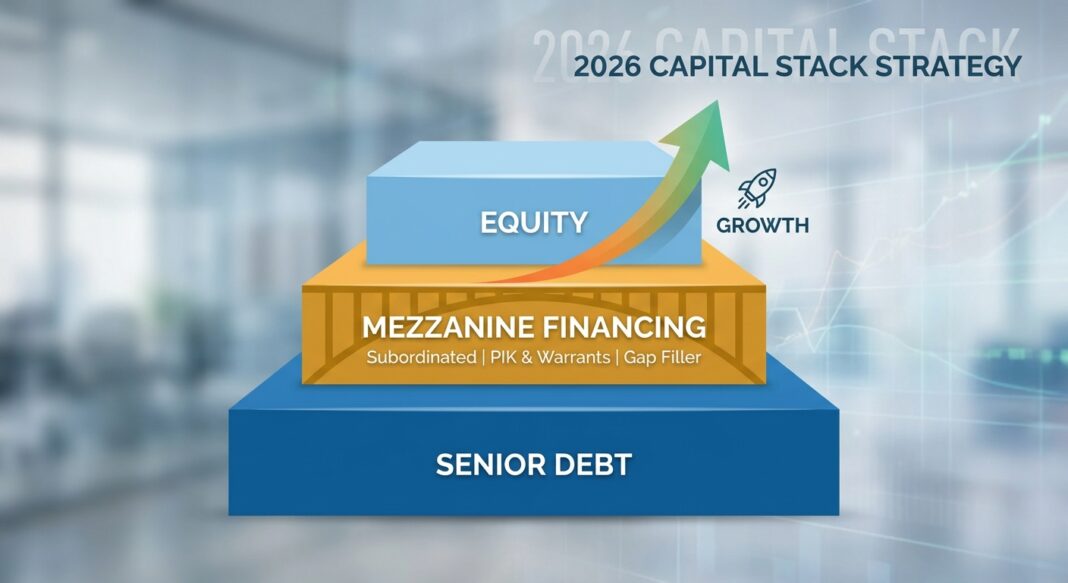
This is the mezzanine moment: the point in a growth-stage acquisition where senior debt capacity is exhausted, equity dilution is prohibitively expensive, and a subordinated capital layer becomes the decisive variable in whether a transaction gets done.
Mezzanine financing is subordinated capital that sits between senior debt and equity in the capital stack. It is not a last resort. Used deliberately, it is a precision instrument — one that extends leverage, preserves equity, and can be priced against the deal’s return profile in ways that both borrower and lender can model with confidence. Understanding when to deploy it, what it costs today, and how to negotiate its terms is essential for any operator or advisor navigating a growth-stage capital event in 2026.
Structure Breakdown: Subordination, PIK, and Equity Kickers
Mezzanine debt sits between senior debt and equity in the capital structure, carrying higher interest rates — typically 12–20% total yield — in exchange for subordinated priority. That subordination is the defining characteristic. In a liquidation waterfall, mezz lenders are repaid after senior creditors and before equity holders, which means their risk profile — and their required return — sits above both.
The instrument has three economic components that work together to build the lender’s return:
- Cash coupon: The base interest payment, paid periodically. In 2026, mezzanine debt is priced at roughly 11% to 14% cash coupon for lower-middle-market transactions.
- PIK (Payment-in-Kind) interest: Interest that accrues to principal rather than paying out in cash. Mezzanine debt typically features PIK interest — paid in additional debt rather than cash — and equity kickers such as warrants giving 1–5% ownership. PIK is valuable to borrowers during growth phases when cash is being reinvested rather than distributed.
- Equity kicker (warrants): Nearly every mezzanine deal includes equity warrants — options to purchase common stock at a nominal strike price. The warrant compensates the lender for subordination risk that the cash coupon alone does not fully price.
Worked Example: $28M Acquisition, $4M EBITDA Services Business
Consider the deal introduced above. The capital stack could be structured as follows:
- Senior secured term loan: $14M at ~7.5% (3.5x EBITDA), bank or private credit lender
- Mezzanine tranche: $8M at 12% cash + 2% PIK + 3% equity warrant coverage — total blended IRR target of approximately 17%
- Sponsor equity: $6M (21% of enterprise value)
The mezz tranche fills the gap structurally. Mezzanine fills the gap between senior bank debt, typically 3–4x EBITDA, and equity, allowing total leverage of 5–7x EBITDA on quality lower-middle-market businesses. Here, total leverage reaches 5.5x — achievable precisely because mezz absorbs the subordinated layer without requiring more equity.
On the PIK compounding risk: a common modeling mistake is forgetting to include accumulated PIK interest in exit waterfalls. On a $50M mezzanine note with 5% PIK over five years, the actual payoff is approximately $63.8M, not $50M. Operators must model PIK accrual forward to the expected exit or refinancing date before committing to the structure.
The warrant mechanics matter equally. If the company exits at a high multiple, the warrants convert into meaningful equity proceeds, lifting the lender’s blended IRR from the coupon range of 10–16% into the target range of 15–20%. The warrant is how mezz funds justify subordination; it is also how borrowers should negotiate — by pushing on coverage percentage and strike terms before the cash coupon.
Mezzanine vs. Alternatives: Where It Wins and Where It Loses
Mezzanine does not exist in a vacuum. Growth-stage operators evaluating a capital gap should price every alternative before committing to a subordinated structure.
Versus unitranche: The unitranche structure, which combines senior and subordinated debt into a single facility with a blended interest rate, has become the dominant form, with the majority of surveyed GPs originating primarily cash-flow-based unitranche loans. For a single-lender execution with clean documentation, unitranche is simpler. However, unitranche lenders underwrite to a unified credit standard — if a deal cannot clear that bar, mezz with a separate senior lender is often the path. The private credit market in 2025–2026 has shifted the landscape, with direct lenders offering unitranche facilities that compete with and often replace traditional senior-plus-mezzanine structures. But mezz retains relevance in specific contexts.
Where mezz still wins: Mezzanine remains relevant in several contexts: very large transactions where unitranche lenders cannot provide the full quantum of debt needed; situations where the borrower wants to minimize total cost by maximizing cheap senior debt separately; deals where the sponsor or management team wants equity kickers to align lender incentives; and portfolio company add-on financings where existing credit agreements restrict additional senior debt.
Versus equity: This is the most important comparison for growth-stage operators. At current rates, the fully-loaded cost of a dilutive round for a growth-stage company with contracted revenue is often materially higher than the cost of a senior secured facility. Mezzanine costs real cash — but it does not permanently dilute ownership. If the business exits at 8–10x EBITDA, the equity given up in a growth round at compressed multiples costs far more than a 13% mezz coupon over a five-year hold.
Versus preferred equity: Preferred equity sits below mezzanine but above common equity, with fixed dividend rights and liquidation preference. Preferred is appropriate when cash debt service is genuinely unsustainable, but it carries no tax deduction benefit and typically implies higher total cost than mezz on a risk-adjusted basis.
Current Market Terms: What Mezzanine Costs in H2 2026
The mezzanine market has repriced meaningfully across 2025–2026. Operators planning capital events should anchor their models to current data, not prior-cycle benchmarks.
Key Market Data Points (H2 2026)
- Cash coupon range: Mezzanine debt financing sits between senior credit and equity, priced today at roughly 11% to 14% cash coupon plus 1% to 4% PIK plus warrants of 1% to 5% of the fully diluted cap table.
- Rate compression: Rate compression through the first half of 2026 has pulled median mezz cash coupons down roughly 50 to 100 basis points from the 2024 peak, per Lincoln International’s Senior Debt Facility survey.
- Blended IRR target: A blended cost of capital of 15% to 18% is normal for mezz plus warrants; the equity kicker is the reason funds accept a subordinated position without a board vote.
- Tranche sizing: Typical lower-middle-market tranche sizes run $5M to $75M, with SBIC-licensed funds like Plexus Capital and Falcon Investment Advisors handling smaller checks down to $2M.
- Covenant environment: In 2025–2026, mezzanine funds have seen renewed interest as investors seek strategies with built-in cash yields in a higher-rate environment. However, borrowers should note that private credit mezz typically retains maintenance covenants — in contrast to broadly syndicated markets, where more than 85% of new institutional term loans are issued as covenant-lite, with no ongoing financial maintenance tests.
The distinction between maintenance and incurrence covenants carries operational weight. Covenant-lite loans provide borrower companies more freedom to negatively impact lenders because their covenants are incurrence-based, which means they are only tested and can only be breached following an affirmative action of the borrower, rather than by a deterioration in the borrower’s financial condition. Mezz lenders, by contrast, typically require quarterly leverage ratio maintenance — which creates an early-warning mechanism but also means that a business downturn can trigger a technical default before a payment is missed. Negotiate headroom cushions carefully.
The Gap Capital Playbook: Structuring, Running the Process, and Negotiating the Terms
Step 1 — Quantify the Gap
Before approaching any lender, the operator must know three numbers precisely: (a) maximum senior debt capacity based on lender appetite at current EBITDA, (b) available equity, and (c) the residual financing requirement. Model PIK compounding at exit. Stress-test cash debt service at the cash coupon before adding PIK — the business must be able to service the cash component through a downturn scenario.
Step 2 — Prepare the Package
Mezz lenders underwrite to a different standard than senior lenders. They are underwriting the equity cushion below them as much as the cash flow coverage above. Prepare a management presentation that explicitly maps the exit scenario: what the business is worth at 5x, 6x, and 7x EBITDA at exit, and what that implies for mezz recovery and equity residual. The right advisor runs a competitive process across 8 to 12 mezz funds, models the debt against a minority equity alternative, and negotiates intercreditor terms in parallel with senior.
Step 3 — Run a Competitive Process
Do not approach a single mezz fund. The market is deep enough to generate genuine competition. Named institutional players include Audax Mezzanine, NewSpring Mezzanine, Peninsula Capital Partners, Northstar Mezzanine, Star Mountain Capital, and Twin Brook Capital Partners. Running a competitive process compresses pricing by 50–100 bps and shifts warrant coverage from 5% toward 2–3% for quality credits.
Step 4 — Negotiate the Key Deal Points
The negotiation hierarchy for borrowers should be: warrant coverage first, PIK toggle second, call protection third, covenant headroom fourth, cash coupon last. Lenders will move more on the first four than on coupon. Specifically:
- Warrant coverage: Push for 1–3% on a strong-cash-flow credit. Above 5% significantly impairs equity economics at exit.
- PIK toggle: Negotiate the ability to elect PIK in years where free cash flow is constrained — this is a liquidity lever, not a distress signal if structured correctly.
- Call protection: Mezz funds typically request 2–3 year no-call with a declining premium thereafter. If refinancing is likely at year 3, push the call window to 18–24 months.
- Maintenance covenant headroom: Request at least 25–30% cushion to the maximum leverage covenant versus projected operating performance at signing. Model the covenant level against a 15% EBITDA decline scenario before agreeing.
Successful execution on a timely refinancing can save 8–12% per year on the mezz tranche — a strong incentive to structure the call window and covenant package to preserve that refinancing optionality.
Key Takeaways
- Mezz fills the capital gap senior lenders won’t cross. It allows total leverage of 5–7x EBITDA on quality lower-middle-market businesses, extending deal capacity without requiring incremental equity.
- The 2026 cost is 11–14% cash + 1–4% PIK + 1–5% warrant coverage, with blended IRR targets of 15–18%. Rate compression in H1 2026 has pulled coupons 50–100 bps below 2024 peaks — borrowers with strong credits should be pricing against current benchmarks, not prior-cycle terms.
- PIK compounding is a real exit-day liability. Model accrual forward to exit, not just to the next fiscal year. A $8M mezz note at 3% PIK over five years becomes approximately $9.27M at payoff — that delta must be stress-tested against exit multiple scenarios.
- Negotiate warrants before coupon. The equity kicker is where mezz economics are made or destroyed at exit. A 1% difference in warrant coverage on a $28M EV deal exiting at 7x EBITDA ($28M) is worth more to both sides than 50 bps on the coupon.
- Maintenance covenants are standard in mezz — negotiate headroom, not absence. Unlike the broadly syndicated market where over 85% of loans are covenant-lite, private mezz facilities typically carry quarterly maintenance tests. Build 25–30% cushion into the leverage covenant at signing and negotiate a cure mechanism before execution.


