
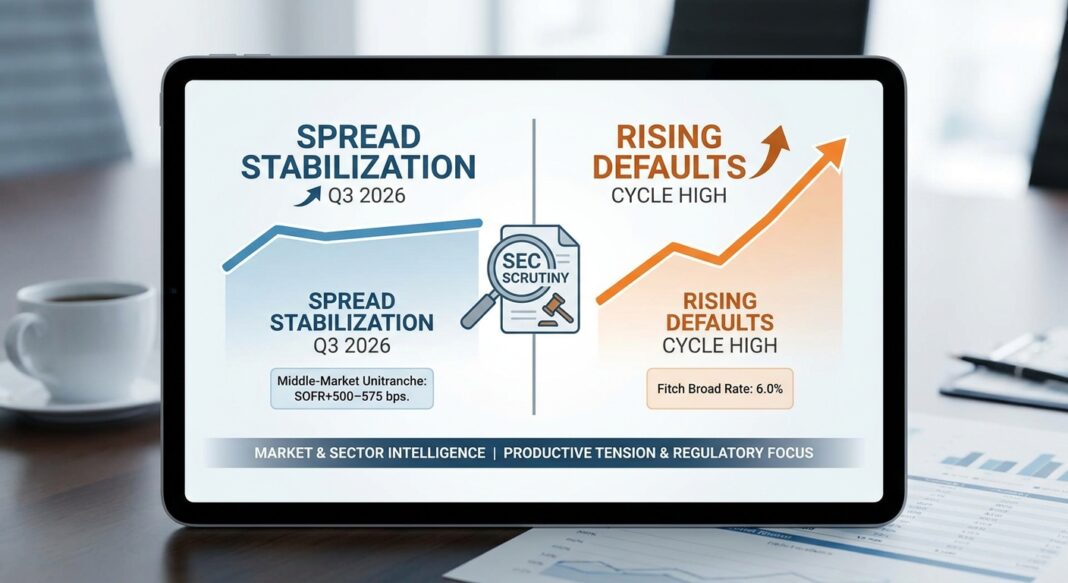
Private Credit at the Inflection Point: Spread Stabilization, Rising Defaults, and the SEC’s New Scrutiny
Bond Capital | Market & Sector Intelligence · October 22, 2026
The private credit market enters Q4 2026 in a state of productive tension. After a sharp spread-widening event in March — driven by geopolitical volatility, AI-disruption fears, and concentrated BDC redemption pressure — middle-market unitranche spreads stabilized through Q3 at SOFR+500–575 bps, leaving new issuance pricing approximately 25–50 bps above year-end 2025 levels. That stability is constructive but masks a bifurcated market: investment-grade corporate bond spreads sit near historic tights while CCC-rated high-yield OAS has blown out to 1,215 bps, the widest in the series since late 2023. The structural premium private lenders earn over public credit remains intact — and in the lower middle market, is actually widening.
Yet three forces are compressing the margin for error heading into the final quarter: (1) default rates, though partially retreating from Q1’s cycle high, remain nearly 37% above where they stood a year ago; (2) BDC redemption queues continue to run well above contractual 5% caps; and (3) the SEC’s September 28, 2026 joint staff statement on fair value measurement has injected immediate compliance pressure on every fund manager, BDC board, and valuation committee in the market. The macro credit cycle has shifted from late-expansion to early-deterioration in the weakest credits — but remains firmly mid-cycle for quality-screened, covenant-protected direct lending.
Quantitative Market Snapshot — Q3 2026
Data as of September 30, 2026 unless otherwise noted.
| Metric | Current Value (Q3 2026) | Prior Period | Change | Source |
|---|---|---|---|---|
| MM Unitranche Coupon Spread | SOFR + 500–575 bps | SOFR + 475–550 bps (YE 2025) | +25 bps (stabilized Q3) | VRC Q3 2026 |
| MM All-In Unitranche Yield (unlevered) | High single digits (~8.5–9.5%) | ~8.1–9.0% (Q2 2026) | +35 bps (Q-o-Q, SOFR uplift) | VRC Q3 2026 |
| HY Composite OAS (Public) | 324 bps (single-B: 329 bps; CCC: 1,215 bps) | 259 bps (Jan 2025 low) | Widening at CCC tier; BB/B broadly stable | ICE BofA / investmentgrade.com |
| IG Corporate OAS (Public) | 86 bps (BBB: 106 bps) | ~73 bps (Jan 2026 low) | +13 bps YTD; near 1st percentile 20-yr | Breckinridge / ICE BofA Q2 2026 |
| Private Credit Default Rate (narrow) | 2.51% Q2 2026 (Proskauer); 3.3% KBRA count | 2.73% Q1 2026; 1.84% Q3 2025 | Q2 modest easing; +37% vs. year-ago | Proskauer July 2026 |
| Private Credit Default Rate (broad / Fitch) | 6.0% (incl. distressed exchanges & maturity extensions) | Record high as of Q2 2026 | Series record; driven by LMEs & extensions | Fitch / Kaden Wood Capital |
| Fed SLOOS — C&I Standards (Large & Mid-Market) | 0.0% net tightening (Q3 2026) | +8.1% Q2 2026; +9.5% Q3 2025 | Full easing to neutral — two-year low | FRED / Fed SLOOS Aug 2026 |
| Median Portfolio Company Leverage (new issuance) | 5.0x–6.0x Debt/EBITDA (competitive deals) | 6.5x–6.8x (2021–22 vintages) | More conservative underwriting since March | VRC Q2 2026 |
| Median Interest Coverage Ratio (2021–22 vintages) | ~1.7x–1.8x EBITDA/Interest | ~2.2x at underwriting | ~0.4x compression vs. close | VRC Q3 2026 |
| Direct Lending LBO Volume (Q3 2026) | ~$10.7B (Q3 alone) | Higher in Q2 2026 and Q3 2025 | Declining; BSL recapturing buyout share | Sikich / LCD Q3 2026 |
The Macro Credit Cycle Context
The Federal Reserve’s July 2026 SLOOS — the most current survey covering Q2 lending conditions — delivered a notable signal: the net percentage of banks tightening C&I standards for large and middle-market firms fell to exactly 0.0% in Q3 2026, down from 8.1% in Q2 and a sustained tightening run that began in 2022. Stronger C&I loan demand from large and middle-market firms simultaneously surged to +16.1%, matching Q1 2026 — the strongest two-quarter demand reading since pre-2023. This convergence of easing standards and strengthening demand at the bank level is the most meaningful late-cycle loosening signal in two years, and it directly competes with private lenders for the highest-quality sponsor-backed credits.
The broader public credit picture is bifurcated. IG corporate spreads ended Q2 2026 at an OAS of +74 bps — near the first percentile of a 20-year lookback, with yields above 5% drawing strong institutional demand. Meanwhile, the spread differential between CCC-and-lower US high-yield bonds and single-B bonds now exceeds 600 bps, having widened roughly 200 bps year-to-date — a clear market signal of credit discrimination favoring quality. The private credit illiquidity premium over comparable public alternatives remains substantial, supporting continued institutional allocation, but it is narrowing at the large-cap end of the market.
Sector-Specific Lender Appetite & Structural Shifts
🔴 Software & Technology: Elevated Caution, Spread Premium Embedded
New issuance in the software sector remained limited through Q3 2026, with many lenders either overexposed, risk-off, or limiting incremental commitments. New software-related direct lending transactions are pricing at premiums of approximately 75–100 bps above standard yield matrix ranges. The driver is structural: AI-related disruption continues to pressure operating fundamentals in software and healthcare technology, compressing revenue visibility and increasing borrower refinancing risk. Rating agencies and VRC report elevated defaults, restructurings, and amendment activity concentrated within healthcare technology, software, and AI-exposed investments. Technology remains the largest sector exposure across the 20 major US private credit funds tracked by Credit Benchmark — creating concentration risk that amplifies headline default figures.
Lender posture: Selective. Lenders demand stronger documentation, covenant protection, and a meaningful spread premium. Incumbent lenders managing workout situations in existing portfolios have limited appetite for new software commitments.
🟢 Healthcare: Structurally Favored, Complexity-Premium Required
Healthcare led private credit deal flow in 2025, accounting for 19% of all direct lending transactions, and remains a top allocation target heading into Q4 2026. Private credit has evolved from a niche capital source for a select few US healthcare borrowers into a first port of call for sponsors and companies across all market segments. However, healthcare technology sub-sectors face elevated refinancing costs compared to more resilient healthcare services businesses. Lenders with genuine sector expertise — able to underwrite reimbursement risk, regulatory change, and site-of-care dynamics — are commanding better structures.
Lender posture: Actively competitive for healthcare services, pharma services, and medtech. Cautious on healthcare IT and tech-enabled care models with AI exposure.
🟡 Industrials & Business Services: Rotation Destination
Industrial-focused lenders are actively competing for quality credits as the market bifurcation tilts capital away from software-heavy portfolios. Business Services has gained share year-on-year in median sector exposure across major private credit funds, partly at the expense of Industrials, suggesting lender appetite is rotating toward recurring-revenue, asset-light services with predictable EBITDA. The PwC Global Private Credit Survey 2026 finds that managers expect the most acute stress in consumer and retail (56%), automotive (42%), and hospitality and leisure (27%) — meaning lenders are actively avoiding cyclical exposure while hunting for industrial and services stability.
Lender posture: Constructive. Spreads for high-quality industrials are tighter than software, leverage multiples supported at 5.0–5.5x, and covenant packages are stronger relative to 2021–22 vintages.
🟠 Lower Middle Market: The Structural Outlier
The most counterintuitive dynamic in the current market is in the lower middle market. While over half of sponsor-backed direct lending deals at the large-cap tier priced below 500 bps, the LMM spread premium over large-cap actually widened — the capital wave that compressed upper-market spreads has not fully reached the $5M–$25M EBITDA segment. The lower middle market offers higher relative spreads, more conservative leverage, stronger covenant packages, and greater lender influence over transaction structure versus the crowded core and upper middle market.
Lender posture: Structurally attractive for specialists. Deal flow is supplemented by boomer-succession-driven M&A, creating a pipeline of new credits not dependent on PE buyout activity.
Implications for Institutional Investors & Operators
For Borrowers & Operators
The spread stabilization in Q3 is meaningful but not a return to borrower-friendly conditions. The March 2026 widening reset pricing expectations, and lenders are holding that line. More importantly, the coverage ratio conversation has shifted: 2021–22 vintage loans are reporting median interest coverage ratios of approximately 1.7x–1.8x, down from ~2.2x at underwriting — dangerously close to the 1.5x threshold that typically triggers covenant dialogue. Operators in those vintage cohorts must proactively model debt-service sensitivity against the elevated base rate environment, with forward SOFR implying an average of ~3.5% over the remainder of 2026–2028. Refinancing into new unitranche paper at SOFR+500+ means a meaningful step-up in cash interest for overleveraged credits.
For operators seeking new capital: demonstrate FCCR above 1.25x on a forward basis at current rates, present clear de-leveraging trajectory within 24 months, and expect lenders to scrutinize PIK provisions and EBITDA addbacks more aggressively than in 2021–22. Lenders are increasingly demanding fewer PIK requests, less aggressive leverage, more covenants, and stronger documentation as early signals before any spread widening appears.
For Institutional Investors & Fund Allocators
The SEC’s September 28, 2026 joint staff statement is the single most operationally significant regulatory development of the year for institutional investors. The SEC’s Chief Accountant and Director of Investment Management issued the statement reminding management, boards, valuation designees, and auditors of existing fair value measurement and disclosure requirements — with explicit focus on BDCs, interval funds, and tender offer funds. The statement signals that private credit valuation and disclosure practices are squarely on the staff’s radar, with the expectation that valuations be calibrated to transaction prices, reassessed against market data, and supported by tailored, entity-specific disclosures.
For allocators, this creates a due diligence imperative: SEC Chairman Atkins’ March 2026 endorsement of “responsible retailization” of private markets means the regulatory framework will tighten around semi-liquid vehicles — exactly the structures where redemption queues are running 11–14% against 5% caps. Average redemption requests among the 11 largest non-traded BDCs declined slightly from 13.9% in Q2 to 13.0% in Q3, but remain structurally elevated. Allocators should map fund-level liquidity provisions against their own redemption rights and stress-test NAV accuracy.
On the opportunity side: North American private credit dry powder exceeds $280 billion, and approximately $464.6 billion in private equity capital was deployed through Q3 2026, up 18.1% year-over-year, with fewer but larger deals — a pipeline dynamic that favors scaled, well-capitalized direct lenders with origination infrastructure.
Forward View: Q4 2026 – Q2 2027 Liquidity & Lending Dynamics
Maturity wall risk intensifies. KBRA data shows approximately 10% of its direct lending index matures by 2027, with an additional 17% and 16% scheduled in 2028 and 2029 respectively. Loans originated in 2021 at sub-400 bps spreads and 6.5x leverage must refinance into a market pricing at SOFR+500+ bps — materially higher cash debt-service. Borrowers with stagnant EBITDA and limited sponsor support are the primary restructuring candidates for 2027.
BSL market competition re-emerges. The broadly syndicated loan market is winning back share in both buyout volume and the refinancing of direct lending debt. Nearly half of all M&A loan volume went to BB- or higher-rated borrowers in Q3 — the largest share since the Global Financial Crisis — compressing available deal flow for private lenders who target that upper tier. Private credit’s long-term competitive moat is in speed, structure flexibility, and middle-market relationships that BSL cannot efficiently serve.
Default rate trajectory remains uncertain. The Proskauer narrow-definition default rate eased from 2.73% to 2.51% in Q2, but the Fitch broad-definition rate hit a series record at 6.0% in Q2. The key variable is whether maturity extensions count as defaults — and as 2021–22 maturities arrive, the answer to that question will directly determine how visible the stress becomes in reported figures. Fund managers should stress-test portfolio classifications now against both definitions.
Regulatory compliance is now a return driver. Funds with rigorous, independently supportable valuation processes, transparent PIK and non-accrual disclosure, and governance structures that can withstand SEC examination will carry a reputational premium in institutional fundraising. 93% of private credit managers surveyed by PwC expect flat or lower returns in 2026; differentiation will come from portfolio construction discipline and governance quality — not leverage or spread compression.
Key Market Insights — Actionable Takeaways
- Spreads have stabilized, not tightened. Middle-market unitranche spreads held at SOFR+500–575 bps in Q3, with all-in yields rising 35 bps quarter-over-quarter on SOFR uplift. This is a lender-favorable setup — income is elevated, but the era of spread compression from peak competition is behind us. Lenders originating new paper today are doing so at the best risk-adjusted entry points since 2022–23.
- FCCR and interest coverage are the underwriting battlegrounds. 2021–22 vintage borrowers are operating at 1.7x–1.8x EBITDA/interest — materially below historical 2.0x+ thresholds. New underwriting should target minimum 1.25x FCCR on a contractual basis at current SOFR, with stress-test scenarios at SOFR +100 bps. Lenders insisting on tight covenant packages today are positioning defensively for a 2027 maturity-wall event.
- The SEC’s September 28 statement is not guidance — it is an enforcement signal. The joint staff statement on fair value for private credit assets explicitly flagged NAV practical expedient reliance, PIK income quality, and consistency between disclosed and applied methodologies. Every BDC board, interval fund manager, and private fund adviser should treat this as a pre-examination warning and pressure-test valuation governance immediately.
- Default rate methodology defines your risk view. The 2.51% narrow Proskauer rate and the 6.0% broad Fitch rate are both correct — they measure different things. The operative question for allocators is whether maturity extensions and distressed exchanges in their fund are being disclosed in a manner consistent with both definitions. Divergent marks across managers create systemic opacity risk that the DOJ and SEC are actively scrutinizing.
- Sector rotation is creating exploitable asymmetry. The retreat of capital from software-heavy funds is structurally benefiting industrial-services, healthcare-services, and lower middle-market lenders. The LMM spread premium over large-cap has widened rather than compressed. Allocators willing to accept less liquid, higher-complexity origination in the $5M–$25M EBITDA segment are being compensated with wider spreads, stronger covenants, and less competition from large-scale BDC platforms.


