
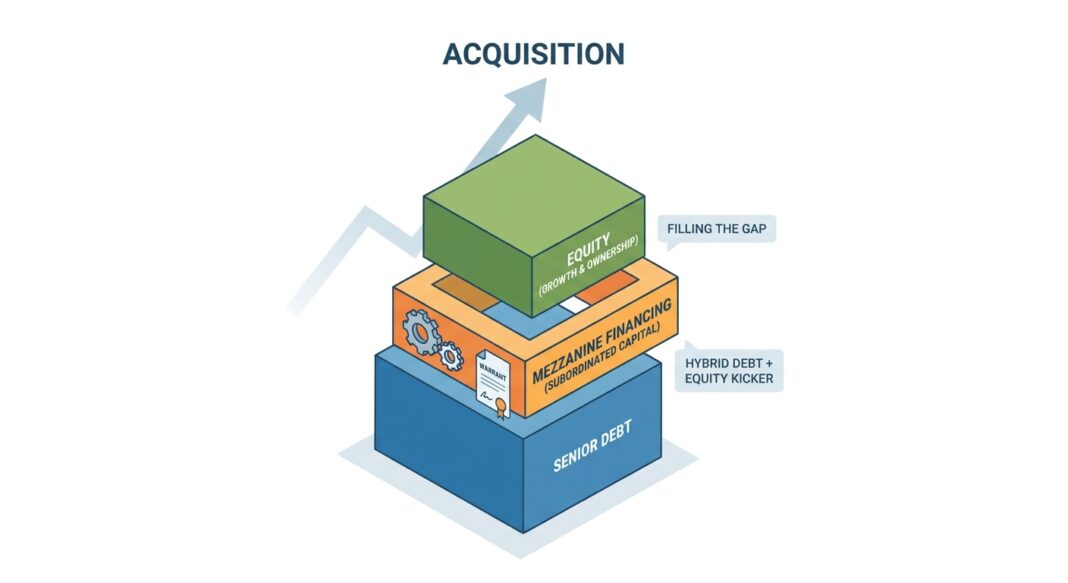
The Gap Every Growth-Stage Acquirer Hits
You have found the acquisition target. The price is right, the strategic fit is clear, and the seller is motivated. But when you lay the capital stack out on paper, the arithmetic exposes a structural problem: your bank will lend you 3×–3.5× EBITDA at Prime plus a spread, your equity check takes you to a certain ownership ceiling, and somewhere between those two lines sits a funding gap of $5–$25 million that neither instrument can cleanly fill without unacceptable trade-offs.
This is the operating reality for growth-stage companies — those with $3M–$20M in EBITDA making their first or second platform acquisition — and it is precisely the scenario mezzanine financing was designed to solve. Mezzanine capital sits between senior debt and common equity in the repayment hierarchy, filling the gap with subordinated debt priced to reflect that risk, and almost always carrying an equity participation feature that lets the lender share in your upside.
The 2026 market has made this conversation more urgent. According to Yanne Capital, private credit AUM crossed $1.7 trillion in H1 2026, up from $875 billion in 2020, while equity dilution for growth-stage rounds ran 18–22% in H1 2026 versus 12–15% in H2 2021. The cost of giving up equity has risen materially. Understanding how to engineer the layer below equity — and how to negotiate every term inside it — is now a core competency for any growth-stage CFO or sponsor.
Capital Strategy by Stage: Where Mezzanine Enters the Picture
Before examining the instrument itself, it is worth mapping where mezzanine belongs on the full business-stage spectrum. Different stages have different capital needs, and selecting the wrong instrument at the wrong stage is how operators destroy optionality.
| Stage | Primary Use of Proceeds | Typical Instrument | Cost of Capital |
|---|---|---|---|
| Seed & Early | Product, team, market validation | Founder equity, angels, pre-seed VC | 25%–40%+ target IRR |
| Growth (Series A/B) | Go-to-market, hiring, ARR expansion | Venture equity, venture debt, RBF | 18%–30% diluted cost |
| Growth-to-Scale ★ | Acquisitions, platform builds, international expansion | Senior bank / unitranche + mezzanine | 12%–20% all-in (cash + PIK + kicker) |
| Mature / Cash-Flowing | Dividends, recaps, bolt-ons | Senior secured, unitranche, preferred equity | 8%–12% senior; 14%–18% mezz |
| Succession / Exit | Management buyout, PE transition, recapitalization | Full sponsor LBO stack: TLA/TLB + mezz + equity | Blended 10%–15% debt cost; 20%+ equity IRR target |
★ This article focuses on the Growth-to-Scale stage: a $5M–$15M EBITDA company executing an acquisition that exceeds what senior debt alone can finance.
The Cost-of-Capital Spectrum: From Banks to Equity
Understanding mezzanine requires understanding what sits above and below it in the stack. Every decision is a trade-off between access, cost, and control. Here is the full spectrum for a growth-stage acquirer in 2026:
1. Senior Bank Debt (Cheapest, Most Constrained)
Community and regional banks typically lend 2.5×–3.5× EBITDA for acquisition transactions, secured by all business assets. Pricing runs Prime + 1%–2.5%, with full amortization and quarterly maintenance covenant testing. For a $10M EBITDA company, that is $25M–$35M in senior debt — useful, but rarely sufficient to fund a meaningful acquisition at market multiples.
2. Direct Lending / Unitranche (Mid-Tier: Leverage + Speed)
The unitranche market bridges much of this gap on its own. This structure has become the financing standard for acquisitions valued between $25M and $200M enterprise value, with roughly 70–80% of deals in that range using at least partial unitranche funding. Blended pricing in 2026 runs SOFR + 500–700bps, plus a 2–3% OID and a 2–3% prepayment fee declining over the first 24 months, for an all-in cost of 9.5–11%.
3. Mezzanine / Subordinated Debt (Gap Capital)
In 2026, the all-in cost of mezzanine runs 10–14%, composed of a cash coupon of 8–11% plus PIK of 2–4% plus warrant coverage. It is subordinated to all senior debt, usually unsecured beyond an equity pledge, and prices for that risk accordingly. The critical advantage: it unlocks leverage that no senior lender will provide.
4. Preferred and Growth Equity (Most Expensive on a Dilution Basis)
Equity is always available — but the cost is measured in permanent ownership, not coupon payments. Equity dilution to raise $25M in growth-stage rounds ran 18–22% in H1 2026, and that dilution compounds across future rounds and exit multiples. Mezzanine looks expensive on coupon but is usually far cheaper than equity, which targets 18–25%+ IRR and dilutes permanently.
Structure Breakdown: The Mechanics of Mezzanine Capital
Component 1: Subordination
The mezzanine note sits behind every senior creditor in both payment priority and collateral recovery. The mezzanine lender ranks below senior debt, and payments can be blocked during senior covenant breaches under a subordination agreement running in favor of the senior lender. This structural subordination is the source of the higher cost — and the reason mezzanine lenders insist on equity participation to compensate for last-money-out risk.
Component 2: PIK Interest (Payment-in-Kind)
PIK interest is the mezzanine lender’s concession to the borrower’s near-term cash flow. Rather than requiring full cash payment on the entire coupon, part of the interest accrues and capitalizes into the outstanding principal balance. Cash interest is paid periodically (typically quarterly) and ranges from 10–13% annually. PIK interest is added to the principal balance instead of being paid in cash, commonly running at 2–4% per year.
The mechanics compound against the borrower over time: if $50M of mezzanine carries a 4% PIK feature, the outstanding balance in Year 1 grows to $52M, Year 2 to $54.08M, and so on — which is why buyers must model PIK accretion carefully against projected exit multiples and refinancing timelines.
Component 3: Equity Kicker (Warrants)
In mezzanine financing, warrants act as an equity kicker, letting lenders share in the company’s upside value if it grows. The warrant typically entitles the lender to 1–5% of equity on a fully diluted basis, potentially adding 200–300+ basis points to total yield.
If the company exits at a high multiple, the warrant converts into meaningful equity proceeds, lifting the blended IRR from the coupon range (10%–16%) into the target range (15%–20%). This is why mezzanine lenders accept a subordinated, unsecured position — the equity participation is the asymmetric upside that justifies the risk.
Component 4: Bullet Maturity and Call Protection
The mezzanine note usually has a five-to-seven-year bullet maturity, a non-call period of one to two years, and step-down call premiums after that. Payment terms typically require quarterly cash interest, with PIK interest capitalizing into the outstanding balance and paid at maturity or refinance.
Worked Example: A $60M Acquisition Stack for a $10M EBITDA Specialty Services Business
A growth-stage specialty services company with $10M EBITDA and $70M enterprise value is acquiring a bolt-on target for $60M (6× EV/EBITDA). The buyer needs to close in 60 days. Here is how the stack is structured:
| Layer | Instrument | Amount | Rate / Terms | Security |
|---|---|---|---|---|
| 1 (Senior) | Unitranche Term Loan | $35M (3.5× EBITDA) | SOFR + 575bps (~9.8% all-in); 1% annual amortization; 5-year bullet; 2% OID; 2% prepay Y1, 1% Y2 | First lien, all assets |
| 2 (Mezz) | Mezzanine Note + Warrants | $15M (1.5× EBITDA) | 12% cash coupon + 3% PIK; 6-year bullet; warrants for 3% of fully diluted equity at $0.01 strike; 2-year non-call; step-down 3/2/1 thereafter | Unsecured; equity pledge; subordinated to unitranche |
| 3 (Equity) | Sponsor / Management Equity | $10M (equity contribution) | Common equity; no coupon; residual upside | Last in priority |
- Total Deal Size: $60M | Total Leverage: 5.0× EBITDA (3.5× senior + 1.5× mezz)
- Blended Debt Cost: ~11.2% all-in (weighted average of unitranche + mezz coupon)
- Cash Interest Year 1: ~$3.43M (unitranche) + $1.80M (mezz cash pay) = $5.23M; DSCR ~1.9× on $10M EBITDA
- PIK Accretion Year 1: $450K capitalized into mezz balance → $15.45M outstanding
- Warrant Dilution: 3% of fully diluted equity; value crystallized only at exit or liquidity event
- Without Mezz: Buyer needs $25M equity check vs. $10M — a $15M improvement in equity efficiency
This structure reflects current 2026 market terms. A typical 2026 mezzanine rate for a healthy $5M–$15M EBITDA lower-middle-market company runs 11–14% cash coupon plus 1–4% PIK, with warrant coverage of roughly 1–5% of fully diluted equity.
Mezzanine vs. the Alternatives: When Each Structure Wins
Mezz vs. Unitranche Only
Unitranche financing combines senior and mezzanine debt into a single instrument, eliminating the need for separate tranches — and that simplicity has value. Unitranche agreements often include leverage ratios ranging from 4–6× a company’s EBITDA. If your deal fits within a 5× unitranche — and your lender will stretch there — skip the mezz layer. You save negotiation time and eliminate the subordination complexity. Use mezz when the leverage you need exceeds what a single unitranche lender will provide, or when the cost of pushing a unitranche to 6× becomes prohibitive.
Mezz vs. Seller Note
Seller notes are functionally mezzanine capital at a lower negotiated rate (often 5–8%), but they create counterparty risk with someone who just sold you a business. Seller notes are typically limited to 5–20% of deal value, lack the structural flexibility of institutional mezz, and complicate post-close relationship management. Use seller notes for small gap-fills (<10% of deal value) or when the seller is exiting and has no ongoing role.
Mezz vs. Growth Equity
The typical cost difference: mezzanine runs 12–20% all-in (cash + PIK), while equity targets 25–40%+ IRR and dilutes ownership permanently. For a $15M gap, the equity cost at a 6× exit multiple is $90M in exit proceeds given up versus approximately $25M in total debt service on a mezzanine note. The math almost always favors mezz unless the business requires capital far in excess of what any debt instrument can responsibly support.
When Mezz Is the Wrong Call
Mezzanine is the wrong instrument when EBITDA is too thin to cover the PIK accretion and cash interest simultaneously, when the business is pre-EBITDA or highly seasonal, when covenant flexibility is more valuable than cost savings, or when the exit timeline is uncertain and call protection creates a refinancing trap. In these cases, preferred equity with a defined dividend and no acceleration feature is often structurally superior.
Current Market Terms: What the 2026 Mezzanine Market Looks Like
Market conditions have shifted materially in the past 18 months. Here are five data-point benchmarks drawn from current market sources:
- Pricing Floor Has Risen. A typical 2026 mezzanine rate for a healthy $5M–$15M EBITDA lower-middle-market company runs 11–14% cash coupon plus 1–4% PIK, with a blended all-in cost of capital of 15–18% including warrant value.
- Warrant Coverage Has Stabilized. Equity kickers in current mezzanine structures typically entitle the lender to 1–5% of equity on a fully diluted basis, potentially adding 200–300+ basis points to total yield. Market convention has narrowed to 2–4% for investment-grade quality borrowers.
- Private Credit AUM Is Reshaping Supply. Private credit AUM crossed $1.7 trillion in H1 2026, up from $875 billion in 2020, while direct lenders now hold 84% of sponsored middle-market loans. Increased supply of mezz capital has modestly compressed pricing at the upper end of the quality spectrum.
- Covenant Architecture Is Bifurcated. Middle-market unitranche and mezzanine deals retain maintenance covenants — quarterly leverage tests with 25–35% cushion over base case. Approximately 85% of the broadly syndicated market is covenant-lite (incurrence-only), while private credit middle-market deals retain maintenance tests. Understanding this distinction matters: a maintenance covenant breach can be triggered by EBITDA softness alone, not just an affirmative borrower action.
- Hybrid and Structured Credit Is Growing Fast. Hybrid and structured private credit reached approximately $240 billion in H1 2026, up from $60 billion in 2020, and is projected to approach $400 billion by end of 2027. This expansion is creating new mezz-like instruments — preferred equity with PIK dividends, structured secondaries — that are filling the same gap with different documentation.
Covenant Design: The Most Negotiated Term in Any Mezz Deal
Borrowers consistently underweight covenant negotiation relative to rate negotiation, which is a strategic mistake. The covenant package determines how much operating flexibility you retain and when your lender can force a conversation.
Maintenance vs. Incurrence: The Core Distinction
Maintenance covenants are typically tested quarterly and reported through compliance certificates delivered to the lenders with a company’s financial statements. Incurrence covenants, by contrast, are tested only when a borrower seeks to undertake a specified action, such as incurring additional indebtedness, making an acquisition, or paying a dividend.
For mezzanine borrowers, the maintenance covenant is the key risk point. The financial covenant is typically a single net leverage covenant with an initial cushion of 25–35% over the base case plan, stepping down as cash flow grows. A 25% cushion sounds comfortable — until EBITDA softens 20% in a down year and the covenant test suddenly sits at 1.04× headroom.
Negotiation Points on Covenants
- Headroom Width: Push for 35% initial cushion over base case, not 25%. The extra 10 points buys meaningful protection against integration risk in the first 12 months post-acquisition.
- Equity Cure Rights: Negotiate the ability to cure a covenant breach with an equity injection for up to two consecutive quarters without triggering a formal default. Most mezzanine lenders will grant two cures per loan life.
- Add-Back Definitions: The definition of EBITDA — specifically which costs are addable back for covenant testing purposes — is often more valuable to negotiate than the headline rate. Integration costs, one-time restructuring charges, and management fees should all be explicitly enumerated and capped.
- Incurrence Tests for M&A: Credit agreements commonly include a “limited condition transaction” election permitting covenant testing at signing of a transaction rather than the closing, provided that specified fundamental conditions are satisfied at closing. Negotiate this provision explicitly if you anticipate future add-on acquisitions.
The Gap Capital Playbook: Quantify, Prepare, Process, Negotiate
Knowing what mezzanine is worth theoretically is different from executing a process efficiently. Here is the four-step playbook for operators and sponsors running a real mezzanine raise alongside an acquisition close.
Step 1 — Quantify the Gap Precisely
Build a clean sources-and-uses table before approaching any capital provider. Define: (a) the total acquisition cost including fees; (b) the maximum senior debt your bank or direct lender will provide, tested at 3.5×, 4×, and 4.5× EBITDA scenarios; (c) the maximum equity you are willing to contribute given your return target; (d) the residual gap that requires a gap capital solution. A precise gap size drives efficient process — you are not selling equity broadly, you are filling a defined hole with the cheapest instrument that can do so.
Direct lenders in 2026 require 1.3× debt service coverage on a trailing 12-month basis and 1.5× on a forward 12-month projection. Run your coverage ratios at each leverage scenario before you engage lenders, so you can anchor the conversation on borrower-favored terms rather than react to lender proposals.
Step 2 — Prepare the Mezz Package
Mezzanine lenders underwrite to a different framework than senior lenders. They are not focused primarily on asset coverage (there is none — mezz is unsecured) but on enterprise value at exit, sponsor quality, management depth, and the equity cushion below them. Your information package should include: a clean 3-year EBITDA bridge showing historical and projected performance; a capitalization table showing pre- and post-transaction ownership; a detailed sources-and-uses with assumptions; a business plan for the combined entity; and — critically — a scenario analysis showing the mezz lender their recovery in a downside case.
Step 3 — Run the Process in Parallel with Senior
The most common structuring mistake is sequencing: closing the senior credit agreement first, then approaching mezz lenders with terms that cannot be changed. Run both processes simultaneously. Mezzanine lenders need to review the senior credit agreement to understand subordination terms, restricted payment permissions, and the definition of permitted indebtedness — which determines how much mezz they can legally hold ahead of senior enforcement. Unitranche financing can close in 45–90 days versus 90–150 days for traditional senior-plus-mezzanine syndication, so your timeline should be built around the longer parallel track.
Step 4 — Stage the Capital Draw
Where the deal structure allows it, negotiate a delayed draw feature on the mezz commitment — the ability to draw up to $X within 12 months of closing for specified purposes (add-on acquisitions, capex, working capital). Delayed draw commitments carry a commitment fee (typically 50–100bps on undrawn amounts) but preserve optionality and avoid over-capitalization at close. Stack capital sequentially — close one facility, deploy it, hit milestones, then raise the next layer where possible. Only deploy the mezz drawer when the use of proceeds is concrete and the coverage ratios remain healthy.
Structuring Guidance: What to Negotiate and What to Concede
For Operators and CFOs
Mezzanine lenders have a defined return target. Cash-pay interest (typically 11–14%), PIK interest that compounds onto principal, upfront fees, and an equity kicker through warrants or conversion combine to a blended target IRR of roughly 15–20%. Your negotiation strategy should focus on how that return is delivered, not whether the lender achieves it — because they will not compromise on total return. Instead, shift the composition toward: (a) less warrant coverage in exchange for a higher cash coupon if you are confident in a strong exit; (b) more PIK and less cash pay if near-term DSCR is tight; (c) a tighter EBITDA add-back definition (favorable to you) in exchange for more headroom on the leverage covenant.
The highest-value negotiation point most operators miss: The prepayment premium schedule. A 3/2/1% declining prepay fee over three years sounds minor but can cost $750K–$2M on a $25M facility if market conditions improve and you want to refinance to cheaper senior debt in Year 2.
For Investors and Analysts Reviewing a Structure
Smart CFOs think in terms of blended cost of capital rather than individual instrument cost — even when equity is available, the all-in cost of debt is often dramatically lower for companies with strong revenue growth. When reviewing a deal structure, test: (a) Does the PIK accretion remain below exit multiple expansion? (b) Is warrant dilution modeled at exit, not ignored? (c) Does the maintenance covenant cushion survive a 15% EBITDA miss scenario? (d) Is the mezz maturity staggered behind senior debt maturity to avoid a wall of maturities?
Key Takeaways
- ☑ Mezzanine fills the leverage gap between senior debt capacity and required equity contribution — it is not a substitute for senior debt, but an additive layer that unlocks deals that would otherwise require an unacceptable equity check.
- ☑ In 2026, the all-in mezzanine cost for lower-middle-market borrowers runs 15–18% (11–14% cash + 1–4% PIK + warrant value), compared to a growth equity cost of 18–25%+ IRR with permanent dilution. The math favors mezz for cash-flowing businesses.
- ☑ PIK interest is a cash-flow benefit but a balance-sheet liability — every dollar of PIK that accrues compounds at the full mezz rate and is paid at maturity or refinancing. Model the accretion against exit scenario assumptions before accepting a high PIK split.
- ☑ Covenant design is the highest-value negotiation point after rate — push for 35%+ headroom on maintenance leverage covenants, equity cure rights for two periods per loan life, and a limited condition transaction election if future acquisitions are anticipated.
- ☑ Run senior and mezzanine processes in parallel, not in sequence — mezzanine lenders need to review the senior credit agreement before they can finalize subordination terms, and compressing the parallel timeline is the single biggest source of unnecessary deal risk in growth-stage acquisition financing.


