
Why the Middle Market No Longer Needs Two Lenders
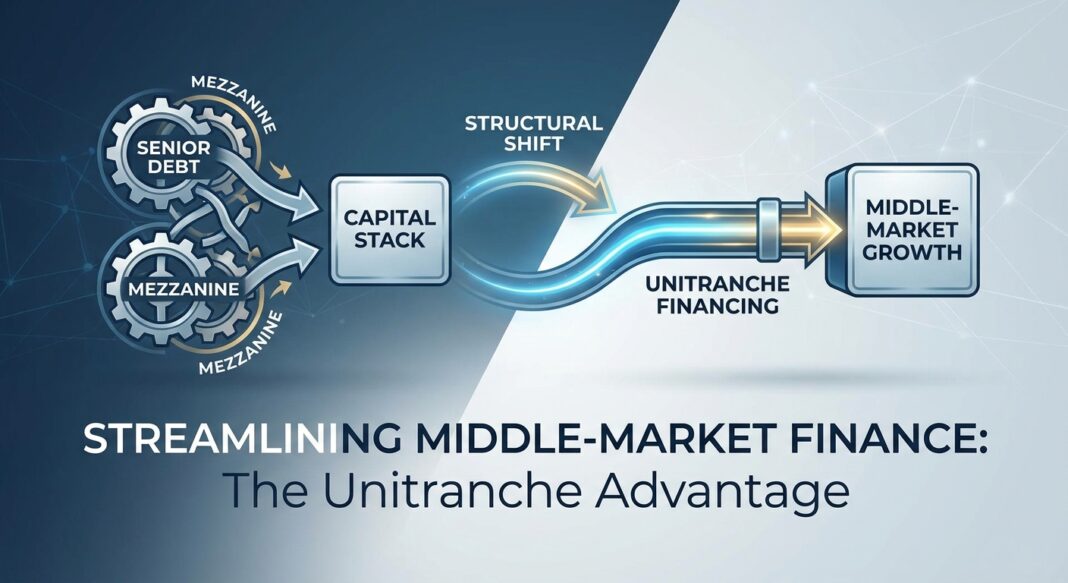
There was a time when a growing company seeking $50 million to fund an acquisition had to run two simultaneous negotiations: one with a senior lender fighting for the first-lien position, and another with a mezzanine lender demanding warrants and a seat at the table. The process was slow, expensive to document, and vulnerable to intercreditor disputes the moment anything went wrong. Today, most of those deals close with a single phone call to a private credit manager. That structural shift has a name: unitranche financing.
Unitranche has become the dominant instrument in U.S. middle-market private credit, not because it is cheaper than traditional structures, but because it collapses complexity in ways that create real value for both the borrower and the lender. Understanding how it works, what it costs, and when it makes sense is foundational knowledge for anyone operating in private markets in 2026.
What Is a Unitranche Loan?
A unitranche loan is a single credit facility that blends what would traditionally be separate senior and subordinated tranches into one instrument, one interest rate, one credit agreement, and one lender relationship. The borrower sees a straightforward term loan. Behind the scenes, lenders may divide economic exposure between a first-out tranche (which absorbs losses last and earns a lower return) and a last-out tranche (which earns more and takes first-loss risk), governed internally by an Agreement Among Lenders (AAL) that the borrower never touches.
The pricing reflects that blended risk. As Commercial Finance Partners notes, senior debt carries the lowest cost and first-lien priority, while unitranche sits at a blended rate between senior and mezzanine pricing, capturing the economics of both layers in one facility. Mezzanine debt, by contrast, is a structurally separate, subordinated instrument that sits behind a senior lender and typically layers in a cash coupon, payment-in-kind (PIK) interest, and equity warrants on top.
The critical distinction: unitranche eliminates the intercreditor agreement between a senior and subordinated lender: the most time-consuming, contentious document in traditional leveraged finance. Unitranche deals can close 30 to 45 days faster than syndicated alternatives, a decisive advantage in competitive M&A processes.
How It Works: A Concrete Example With Numbers
Consider a private equity sponsor acquiring a manufacturing business with $10 million of EBITDA at a 6x multiple, a $60 million enterprise value. The sponsor contributes $30 million of equity (50% of purchase price) and needs $30 million of debt.
Traditional Two-Tranche Structure:
- Senior term loan: $20M at SOFR + 375 bps (~7.1% all-in at current SOFR of ~3.6%)
- Mezzanine tranche: $10M at a 13% cash coupon plus warrants representing 3% of equity
- Two credit agreements, two lender relationships, intercreditor negotiation: adds 6–10 weeks and $150,000–$250,000 in additional legal fees
- Weighted blended cost of the $30M: approximately 9.1% cash + equity dilution
Unitranche Alternative:
- Single unitranche facility: $30M at SOFR + 575 bps (~9.35% all-in)
- Original issue discount (OID): 1 point (~$300K, or ~33 bps annualized over 3 years)
- One credit agreement, one lender, one maintenance covenant (maximum leverage)
- True all-in cost: ~9.7%, modestly higher in cash terms, but no equity dilution and no intercreditor friction
The operator pays a slight cash premium for the unitranche but retains full equity ownership and closes faster. The investor (lender) receives a single-instrument return without needing to source and coordinate a mezzanine co-lender. Both sides gain from simplicity.
Current Market Reality: Where Unitranche Pricing Stands in 2026
Unitranche has not only survived the rate cycle; it has matured into the backbone of private credit. As of Q3 2026, the structure dominates new issuance across the middle market. Here is what the data shows:
| Metric | Value (2026) | Source |
|---|---|---|
| Unitranche spread (upper middle market, July 2026) | SOFR + 522 bps | Houlihan Lokey / KBRA DLD, Summer 2026 |
| Traditional middle-market unitranche spread range (Q3 2026) | SOFR + 500–575 bps | Valuation Research Corp (VRC), Q3 2026 |
| Spot unitranche all-in yield range (Q3 2026) | 9.33%–10.08% | Valuation Research Corp (VRC), Q3 2026 |
| Private vs. public (BSL) spread premium | 178 bps (July 2026) | Houlihan Lokey, Summer 2026 |
| Average total leverage on new unitranche issuance | 4.5x EBITDA (July 2026) | Houlihan Lokey, Summer 2026 |
| Global private credit AUM (2026) | >$2.2 trillion | PwC / Preqin, Mid-Year 2026 |
Context matters: VRC’s Q2 2026 update noted that unitranche yields have declined roughly 250 basis points from late 2023 peak levels of approximately 11.5%–12.5%, but remain above pre-2022 historical ranges of approximately 7%–8%. The rate compression reflects both Fed policy easing, the FOMC held its target range at 3.50%–3.75% in July 2026, and competitive pressure as capital has accumulated across direct lenders.
Notably, the Federal Reserve’s July 2026 SLOOS reported that bank C&I lending standards are currently at the easier end of their historical range for large and middle-market firms. That bank re-entry is one reason unitranche spreads have compressed from their 2023 peaks, private credit managers are competing harder for quality borrowers.
Decision Framework: Investors and Operators
For Investors (Lenders) Evaluating Unitranche Opportunities
- Understand your tranche position. If you are investing in a fund that participates in last-out unitranche exposures, your actual risk profile is closer to mezzanine than the senior-sounding label suggests. Verify whether the fund holds first-out or last-out paper, and at what blended LTV.
- Assess covenant strength. Yanne Capital’s Q1 2026 analysis found that maintenance covenants were present in 62% of new-issue unitranche deals, a meaningful protection. Investors should consider whether a given deal includes at least one financial maintenance covenant stepping down annually.
- Price the premium honestly. The private-versus-public spread premium of 178 bps (July 2026) still compensates for illiquidity, but has narrowed from prior-year averages. Investors should weigh whether that premium is sufficient for the hold period, given declining leverage multiples and a more competitive origination environment.
For Operators (Borrowers) Evaluating Unitranche vs. Traditional Structures
- Speed has a dollar value. In a competitive M&A process, the ability to close financing 30–45 days faster than a bank syndication can be the difference between winning and losing a deal. Unitranche’s execution certainty is a strategic asset, not just a convenience.
- Model the true all-in cost. The headline spread understates total cost. A complete analysis should include OID (typically 1–2 points), undrawn revolver commitment fees (25–50 bps), and prepayment penalties (often declining from 2%–3% over the first 24 months).
- Weigh equity dilution against cash cost. When the alternative to unitranche involves mezzanine debt with warrants, the unitranche’s modestly higher cash coupon may preserve significantly more equity value at exit, particularly in high-growth businesses where the warrant strike price represents meaningful dilution.
Key Takeaways
- Unitranche is now the default structure for U.S. middle-market M&A financing under $500M enterprise value, having displaced the traditional senior-plus-mezzanine stack in most sponsor-backed deals.
- Pricing in Q3 2026 sits at SOFR + 500–575 bps for traditional middle-market borrowers, translating to all-in yields of roughly 9.33%–10.08%, meaningfully below 2023 peaks but above pre-rate-cycle norms.
- The real value proposition is structural simplicity: one lender, one document, no intercreditor risk, and faster execution, advantages that matter most in time-sensitive transactions.
- Investors must look through the label: a unitranche fund’s actual risk exposure depends on whether it holds first-out or last-out positions, the covenant package, and the underlying leverage multiple (now averaging 4.5x EBITDA on new issuance).
- Bank re-entry is compressing spreads: the Federal Reserve’s July 2026 SLOOS confirms C&I lending standards are easier than historical midpoints, meaning competition between banks and private lenders is intensifying, a dynamic operators can use to negotiate better terms.


