
The Loan That Changed Middle-Market Finance
Walk into most middle-market acquisitions today and you will encounter a structure that barely existed two decades ago: the unitranche loan. It has quietly become the workhorse of private credit, reshaping how companies between $25 million and $200 million in enterprise value get financed, and why private credit firms now collectively manage over $1.7 trillion in global assets under management, according to Preqin’s 2026 Global Alternatives Report.
For investors evaluating private credit funds, the unitranche is the structure underpinning the majority of direct lending returns. For business owners and operators, it is often the most efficient path to acquisition capital. Understanding how it works (and where its advantages end) is foundational to navigating private credit in 2026.
What a Unitranche Loan Actually Is
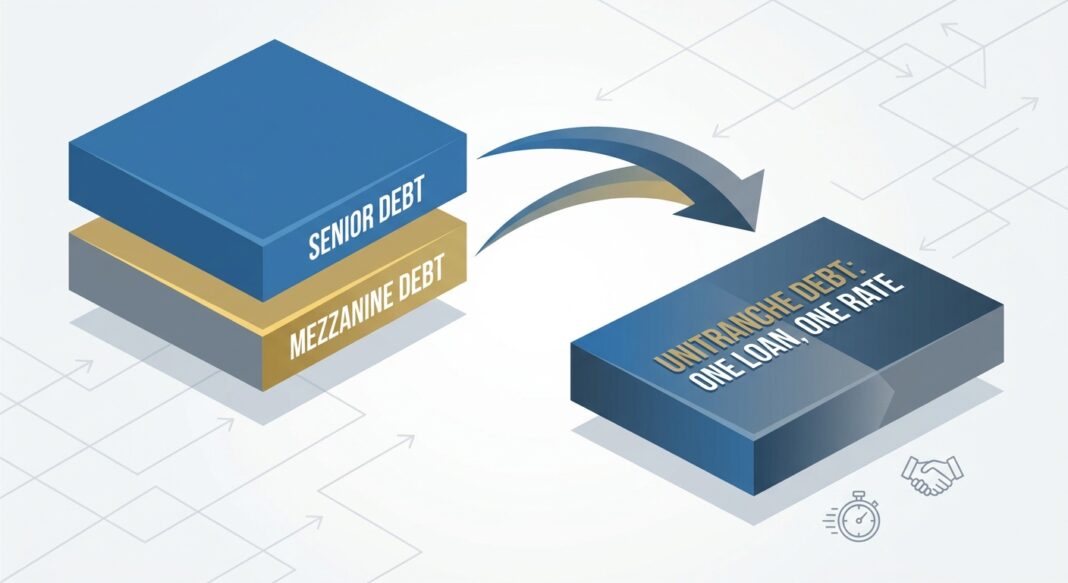
Unitranche debt is a single credit facility that combines what would traditionally be separate senior secured debt and subordinated (mezzanine) debt into one unified loan, governed by one credit agreement, one interest rate, and one lender relationship. As Goldman Sachs’s publicly filed BDC disclosures describe, unitranche loans are first-lien instruments that extend deeper into a borrower’s capital structure than traditional senior debt, with the lender holding a claim on company assets that ranks ahead of equity holders in any default scenario.
The name is telling: uni (single) + tranche (layer). The entire debt capital structure below equity collapses into one instrument. There is no intercreditor agreement to negotiate between a senior lender and a mezzanine lender. There is no competing priority waterfall to manage during a restructuring, at least not one visible to the borrower.
Inside many unitranche facilities, however, lenders privately split their exposure into two tiers via an Agreement Among Lenders (AAL): a first-out tranche that receives priority repayment and carries a lower yield, and a last-out tranche that absorbs first loss and demands a higher spread in return. Crucially, the borrower sees only one rate and one counterparty, the internal risk allocation is invisible to them.
How It Works: A Concrete Example With Numbers
Consider a private equity sponsor acquiring a manufacturing business with $10 million of EBITDA at a 6x purchase multiple, a $60 million enterprise value. The sponsor contributes 40% equity ($24 million) and needs $36 million in debt financing.
Traditional Structure (Two-Layer)
- Senior Secured Loan: $22M at SOFR + 400 bps (approx. 8.1% all-in)
- Mezzanine Loan: $14M at 12.5% cash + 2% PIK
- Two separate credit agreements, two lender relationships, one intercreditor negotiation
- Blended all-in cost on $36M: approximately 9.9%
- Time to close: 10–14 weeks
Unitranche Structure (Single-Layer)
- Unitranche Loan: $36M at SOFR + 525 bps (approx. 9.1% all-in at current SOFR of ~3.63%)
- One credit agreement, one lender, one covenant package
- Blended all-in cost: approximately 9.1%
- Time to close: 6–8 weeks
The borrower pays a modest rate premium of roughly 50–100 basis points versus a finely optimized two-layer structure, but gains meaningfully faster execution and dramatically reduced legal and documentation complexity. As one market practitioner reference notes, on a 50/50 senior-to-sub split, the traditional structure prices only marginally cheaper all-in than unitranche, with materially more execution complexity.
Current Market Relevance: Where Unitranche Sits in 2026
Unitranche is not a niche product; it is the default structure for middle-market private credit. Several converging forces in 2026 make understanding its pricing dynamics especially important.
Pricing Environment. According to Valuation Research Corporation’s Q2 2026 Private Markets Update, unitranche coupon spreads for standard middle-market transactions generally range from 4.75% to 5.50%, approximately 25 basis points higher than year-end 2025 levels, with original issue discounts holding steady between 98.75 and 99.25. By Q3 2026, VRC reported spot unitranche yields in the range of 9.33% to 10.08%, reflecting the upward shift in forward SOFR expectations.
Spread Compression from Peak. McKinsey’s Global Private Markets Report (June 2026) documents that direct lending new-issue median spreads compressed to 544 basis points at year-end 2025, down from 716 basis points in March 2023, a significant tightening as competition among lenders intensified.
Bank Lending Context. The backdrop for unitranche dominance remains favorable. The Federal Reserve’s July 2026 SLOOS found that, while C&I bank lending standards are broadly unchanged and easier than their historical midpoints, standards across most other loan categories remain at the tighter end of historical ranges, keeping private credit structurally advantaged for borrowers who need flexibility and speed over the lowest possible headline rate.
Market Scale. Preqin’s 2026 Private Markets in North America report confirms that private credit AUM continues to expand, with the asset class projected to reach $4.5 trillion globally by 2030. Direct lending, overwhelmingly unitranche-driven, accounts for approximately 45% of total private credit AUM, per Preqin data.
| Metric | Data Point | Source |
|---|---|---|
| Unitranche coupon spread (mid-market) | SOFR + 500–575 bps | VRC Q3 2026 |
| Spot unitranche all-in yield | 9.33%–10.08% | VRC Q3 2026 |
| Private credit global AUM | ~$1.7 trillion | Preqin via CTA, 2026 |
| Direct lending share of private credit AUM | ~45% | Preqin via CTA, 2026 |
| Typical LMM unitranche leverage | 4.0x–5.5x EBITDA | Coyote Wealth, 2026 |
| C&I bank lending standards vs. historical range | Easier than midpoint | Federal Reserve SLOOS, July 2026 |
Decision Framework: Investors and Operators
For Investors Evaluating Private Credit Funds: Unitranche positions are the core earnings engine of most direct lending BDCs and closed-end funds. Investors consider several factors when assessing quality. First, first-lien positioning: a true unitranche holds a first-priority lien on substantially all company assets, providing structural seniority over equity in a recovery scenario. Second, maintenance covenants: the typical middle-market unitranche carries one or two maintenance covenants, giving lenders early warning and renegotiation rights before a borrower deteriorates materially. Third, spread-versus-risk calibration: investors examine whether current spreads of SOFR + 475–575 bps are adequate compensation for underlying leverage levels, which Lincoln International Q4 2025 data shows averaging 5.2x EBITDA across new buyout transactions, approaching 2021–2022 cycle highs.
For Business Owners and Operators: Unitranche financing is most compelling when speed and simplicity matter more than achieving the absolute lowest borrowing cost. Operators evaluate this structure when: (1) they are executing a time-sensitive acquisition where a bank syndication process would risk losing the deal; (2) their business has $10–$100 million of EBITDA but lacks the scale or investment-grade profile to access the broadly syndicated loan market; or (3) they want a single lender relationship with the flexibility to negotiate covenant amendments without convening a creditor committee. The trade-off is real, unitranche all-in costs of 9–10% in the current environment are higher than bank senior debt for well-qualified borrowers, but the execution certainty and structural simplicity carry genuine economic value in competitive M&A processes.
Key Takeaways
- One loan, one rate, one relationship: Unitranche collapses the traditional senior-plus-mezzanine stack into a single first-lien instrument, eliminating intercreditor complexity for the borrower.
- Hidden architecture: Behind the borrower’s single rate, lenders often split exposure into first-out and last-out tranches via a private Agreement Among Lenders (AAL), allocating risk and return internally without the borrower’s involvement.
- 2026 pricing reality: Middle-market unitranche spreads range from SOFR + 500 to 575 bps, translating to all-in yields of approximately 9.33%–10.08%, meaningfully higher than peak-cycle lows but well below the distress-era peaks of 2023.
- Investors examine covenant quality: Maintenance covenants embedded in unitranche agreements are a critical protection layer; their presence and stringency are a key differentiator when evaluating direct lending fund portfolios.
- Bank lending context matters: The Federal Reserve’s July 2026 SLOOS confirms C&I bank standards remain broadly accommodative for large firms, but private credit’s speed, flexibility, and higher leverage capacity continue to make unitranche the preferred structure for middle-market sponsors and operators who cannot wait for syndicated processes.


