
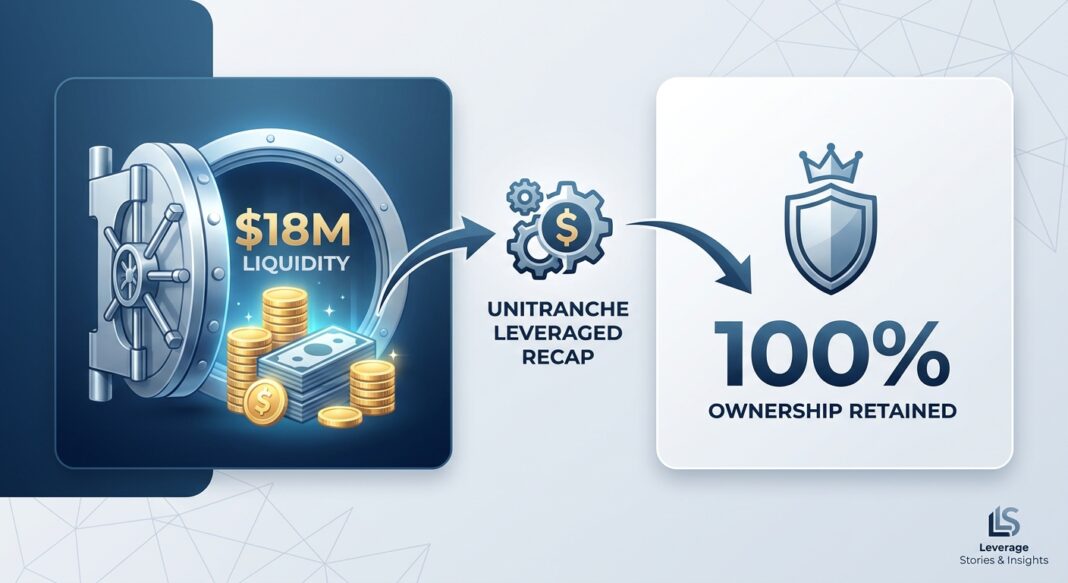
The Story: All the Value, Locked in a Box
Marcus had built something most founders only dream about. Over eleven years, he had grown his regional environmental compliance services firm — call it Clearfield Compliance Group — from a two-person consultancy in Ohio into a 120-employee business with $6.2 million in EBITDA and a customer list that read like a manufacturing industry hall of fame. The business threw off cash, carried no debt, and had never once needed outside capital to grow.
The problem wasn’t the company. The problem was the balance sheet of one Marcus Healy, sole owner. Ninety-one percent of his net worth sat inside a single, illiquid private business. He was 54. His youngest was starting college. His financial advisor kept calling. And every time he opened a proposal from a private equity firm — which happened about twice a month — it said essentially the same thing: sell us a majority, step into a minority role, earn out over three years, then ride along for the second bite.
Marcus didn’t want a second bite on someone else’s terms. He wasn’t ready to hand over his customer relationships, his culture, or his seat at the head of the table. But he needed liquidity — real, meaningful, diversifying liquidity — without surrendering the company he had spent more than a decade building. The full-sale proposals assumed the only answer was an exit. Marcus suspected there was another way.
He was right. The tool was a unitranche leveraged recapitalization — and it would change everything about how he thought about capital, ownership, and wealth.
The Decision: Three Paths, One Right Answer
Note: The Clearfield Compliance Group scenario is a Hypothetical Case Study constructed to reflect real market structures, terms, and outcomes common to lower middle market leveraged recapitalizations in 2025–2026. All mechanics, structures, and market data cited are drawn from real public sources.
Marcus’s advisors laid out three options at a whiteboard session in early 2025:
- Option A — Full Sale: Sell to a strategic buyer or PE firm at a projected 7.0x–7.5x EBITDA multiple (consistent with GF Data’s 2025 lower middle market average of 7.2x for the $10M–$500M universe). At $6.2M EBITDA, that implied a $43.4M–$46.5M enterprise value. After taxes, deal fees, and rollover equity requirements, Marcus might net $28M–$32M in cash — but he’d be out of the business, or working for someone else within 18 months.
- Option B — Minority Equity Recap: Sell 30%–40% of the business to a growth PE firm or family office. A minority equity recap at that level would deliver $13M–$18M in personal liquidity — but would mean 25%–45% dilution, a board seat for the new partner, and an implicit exit clock. As PitchBook data shows, minority equity recaps in the sub-$50M EBITDA segment grew faster than control buyouts through 2024–2025, but they come with alignment strings attached.
- Option C — Unitranche Leveraged Recapitalization: Use private credit to raise new senior secured debt against the business’s cash flows, then distribute the proceeds to himself as a one-time special dividend — while retaining 100% ownership and operational control.
The structure of Option C, built with a direct lender, looked like this:
| Structure Element | Detail |
|---|---|
| EBITDA | $6.2M |
| Leverage Multiple (Unitranche) | 4.5x EBITDA |
| Total New Debt | $27.9M |
| Debt Pricing | SOFR + 450 bps (all-in ~9.8%) |
| Annual Debt Service | ~$2.7M |
| Post-Recap DSCR | ~2.3x |
| Dividend to Marcus | $18M (net of fees and reserves) |
| Equity Dilution | 0% |
| Board Seats Given Up | 0 |
| Ownership Retained | 100% |
The leverage multiple was conservative relative to what the market was then offering. Per Lincoln International’s Q4 2025 private market data, unitranche spreads for borrowers with $40M–$100M EBITDA were clearing at approximately S+4.50%, with new issue OIDs around 1%. For a smaller borrower like Clearfield at $6.2M EBITDA, a modest premium was appropriate — but the structure was entirely executable in the then-current market.
The critical insight: Marcus would walk away with $18M in after-tax liquidity while keeping his name on the door, his equity intact, and his future upside uncapped.
The Outcome: What the Numbers Actually Mean
Fast forward 30 months. Clearfield’s revenues had grown organically by 14%, pushing EBITDA from $6.2M toward $7.1M. The debt service — approximately $2.7M annually — was well-covered at a 2.6x coverage ratio. Marcus had accelerated a bolt-on acquisition of a smaller competitor, funded through incremental cash flow, which added two new metro markets to the firm’s footprint.
Now consider the counterfactual. Had Marcus taken Option A — the full sale at 7.0x — he would have received approximately $30M in net proceeds, paid capital gains tax, and been working as a minority consultant in his own company within a year. The PE buyer would be driving toward a re-sale at a higher multiple, making decisions Marcus disagreed with about pricing, staffing, and market expansion.
With the leveraged recap, the ownership math looked like this:
| Scenario | Immediate Cash | % Ownership Retained | Value at 7.5x Exit (Year 4) | Total Value Created |
|---|---|---|---|---|
| Full Sale (Year 0) | ~$30M (net) | 0% | — | ~$30M |
| Minority Equity Recap (35%) | ~$16M | 65% | ~$34.6M (65% of $53M EV) | ~$50.6M |
| Leveraged Recap (0% dilution) | $18M | 100% | ~$53.3M (100% of $53.3M EV, net debt) | ~$71.3M |
The leveraged recap produced the highest total wealth outcome — not because debt is magic, but because time, compounding, and full equity ownership are magic. The debt was an accelerant for personal liquidity, not a tax on future value. As the Pepperdine Private Capital Markets Report has noted, lower middle market leveraged recapitalizations typically close at 3x to 5x EBITDA in total debt — Marcus’s 4.5x was within the standard range for a business with strong, recurring cash flows.
This is not an isolated phenomenon. Across the broader market, the mechanics proved out at scale: over $70 billion in leveraged loans were used for dividend recapitalizations in 2025, a post-financial-crisis record, as both PE-owned companies and founder-led businesses sought to extract liquidity without surrendering ownership.
The Lessons: A Framework for Founders Facing the Same Decision
The story of Clearfield Compliance Group — hypothetical in its specifics, but entirely real in its mechanics — surfaces several durable principles about capital structure and founder wealth.
1. Liquidity and ownership are not mutually exclusive.
The most persistent myth in middle market finance is that the only way to monetize a private business is to sell it. A well-structured leveraged recapitalization breaks that assumption entirely. It creates a clear separation between personal liquidity (what you need now) and business ownership (what you want long-term). Founders are increasingly recognizing this — choosing to raise one structural financing event and scale on cash flow, bypassing dilutive equity that forces an exit timeline they didn’t choose.
2. Debt doesn’t cost you equity — equity costs you equity.
The true cost of giving up 35% of a growing business is not just the immediate discount at which you sell those shares. It is every dollar of future enterprise value appreciation that now accrues to someone else. Debt financing at 9.5%–11.5% all-in in 2026 is cheaper than equity at an implied cost of 22%–28% when you account for the permanent loss of upside participation. The arithmetic strongly favors debt in scenarios where cash flow coverage is reliable.
3. This structure works best when cash flows are predictable and leverage is conservative.
Not every business is a candidate for a leveraged recap. Ideal candidates share a common profile: steady, recurring revenue; low capital expenditure requirements; meaningful EBITDA margins; and low to no existing debt. Businesses with cyclical revenue, heavy reinvestment needs, or customer concentration risk will find lenders unwilling to extend the leverage required to generate meaningful liquidity. The right question is not “can I do a recap?” but “can my cash flows comfortably service the debt in a stress scenario?”
4. The market is structurally open for founder recaps right now.
Private credit has evolved into a $2 trillion asset class, with direct lenders actively competing on founder-friendly structures. Venture debt reached a record $62.4 billion in 2025, surpassing the prior record of $61.1 billion set in 2024. More non-bank lenders have entered the market since Silicon Valley Bank’s collapse, and structures have loosened considerably. For lower middle market founders, this means more lender options, more competitive pricing, and better terms than at any point in the past five years. The window is open.
5. The VC model has a built-in misalignment that debt avoids entirely.
Equity investors invest based on the goal of companies being acquired or going public within a defined time horizon. Founders are therefore subject to forced liquidity timelines — a structural problem of the equity model from an entrepreneur’s perspective. Board seats, protective provisions, and shareholder agreement clauses can cede de facto control even when a founder nominally retains majority ownership. Debt has no such ambitions. When the loan is repaid, the relationship ends — and there is no permanent claim on the company’s upside.
Key Insights
- A unitranche leveraged recap at 4.5x EBITDA can deliver meaningful personal liquidity with zero equity dilution — the structure works because debt service is predictable, business ownership is preserved, and future value creation accrues entirely to the founder.
- The full-sale impulse is often the wrong default. In the hypothetical example, the leveraged recap produced ~$71M in total wealth versus ~$30M from an immediate full exit — a 2.4x difference driven purely by retained ownership and continued EBITDA growth.
- 2025–2026 market conditions favor founder borrowers. Over $70 billion in leveraged loan volume was deployed for dividend recapitalizations in 2025 alone, and private credit now finances more than 70% of mid-market transactions — giving founders real choice between lenders and structures.
- Debt’s implied cost is structurally lower than equity’s in cash-generative businesses. All-in debt pricing of 9.5%–11.5% in 2026 compares favorably to the 22%–28% implied equity cost when future upside participation is priced in — the math is decisive for profitable, stable-cash-flow businesses.
- The best time to recap is before you need to. A leveraged recapitalization executed from a position of strength — low existing leverage, strong coverage, growing EBITDA — commands better terms, more lender competition, and a cleaner structure than one executed under distress or deadline pressure.


