
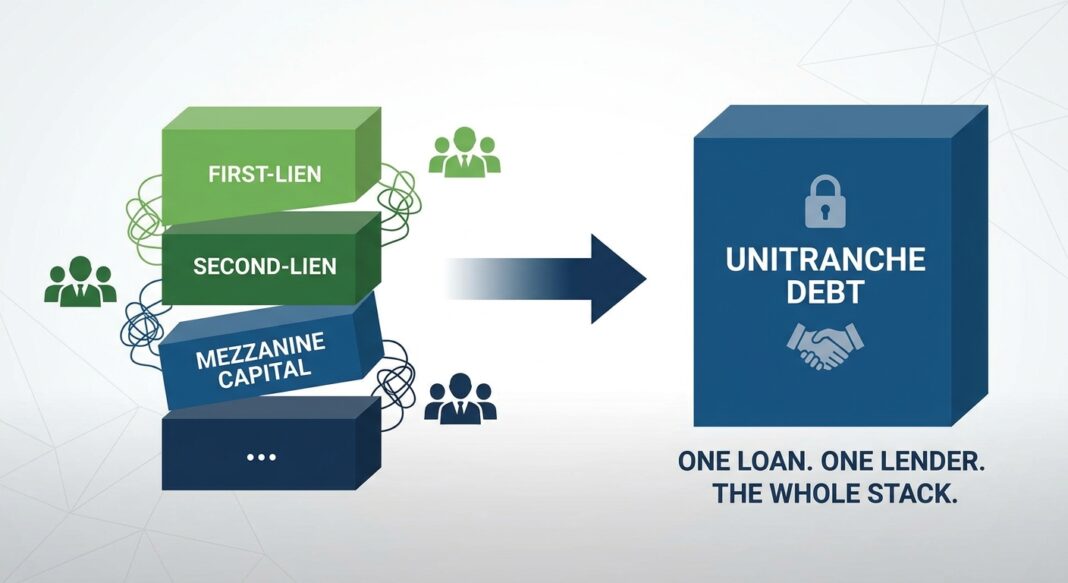
One Loan. One Lender. The Whole Stack.
In traditional leveraged finance, a borrower assembles multiple layers of debt — a first-lien term loan from one lender group, a second-lien from another, and sometimes mezzanine capital from a third. Each layer carries its own pricing, its own documentation, and its own negotiating table. For a middle-market company trying to close an acquisition in six weeks, this fragmentation is a real operational problem.
The unitranche loan solves that problem by collapsing the entire debt capital stack into a single facility with a single lender — or a tightly coordinated club of lenders — at one blended interest rate. It is the dominant structure in private credit today, and understanding how it is priced, structured, and used is foundational knowledge for any operator seeking growth capital or any investor evaluating a direct lending fund.
As of Q2 2026, Valuation Research Corporation (Q2 2026) confirms that unitranche structures continue to dominate new private credit issuance. This article explains exactly what that means — and what it costs.
What Is a Unitranche Loan?
A unitranche facility is a hybrid debt instrument that combines the economic characteristics of first-lien senior debt and subordinated debt into a single loan agreement. Structurally, it sits at the top of the capital stack, senior to all equity, and is secured by a first-priority lien on the borrower’s assets. The lender — typically a private credit fund or a small club of direct lenders — receives a single blended rate that compensates for the risk profile of the combined exposure.
Internally, large unitranche facilities often involve an Agreement Among Lenders (AAL): a confidential side agreement between the lenders that splits the economics between a “first-out” tranche (lower risk, lower yield) and a “last-out” tranche (higher risk, higher yield). The borrower sees none of this complexity. They sign one credit agreement, make one interest payment, and deal with one agent bank.
The mechanics matter because the blended rate a borrower pays will sit between what pure first-lien debt and pure mezzanine debt would cost separately. The lender earns a premium for providing certainty and simplicity; the borrower pays for convenience and speed.
How Unitranche Pricing Works: A Concrete Example
Consider a lower-middle-market software company with $12 million of EBITDA seeking $60 million in debt financing to fund a sponsor-backed buyout — a 5.0x leverage multiple. Here is how the financing alternatives compare:
- Bank syndicated loan: Available only if the deal is large enough (~$300M+) for banks to efficiently syndicate. At this size, not an option.
- Traditional two-tranche structure: $45M first-lien at SOFR + 400 bps, plus $15M second-lien at SOFR + 800 bps. Blended rate approximately SOFR + 500 bps — but two sets of documentation, two lender groups, and two intercreditor negotiations.
- Unitranche: $60M at a single rate of SOFR + 537 bps. One document. One lender. Closing in as little as four to six weeks.
With 3-month Term SOFR at approximately 3.69% as of June 2026 (per Valuation Research Corporation, Q2 2026), the unitranche all-in coupon lands near 9.26%. Add a 1.5% closing fee amortized over a three-year hold and a 0.375% undrawn revolver commitment fee, and the true cost of capital approaches 10%–10.5% on a cash basis.
That is real money. On $60 million of debt, a 100-basis-point difference in spread costs the borrower $600,000 per year. Operators must weigh that premium against the value of execution certainty and structural flexibility — particularly the ability to amend the loan bilaterally rather than building consensus across a syndicate.
Current Market Reality: What the Data Shows
The unitranche market in 2026 is large, competitive — and repricing upward after years of spread compression.
PitchBook LCD data (September 2026) show new-issue US private credit spreads averaging 502 basis points over SOFR in the three months ending August 31, 2026, up from 475 basis points in Q1 2026. The premium a borrower pays for a private credit loan over a comparable broadly syndicated loan has widened to 162 basis points — approximately 39 basis points wider than Q1 — as competition from the syndicated market intensified and private lenders repriced for selectivity.
That spread widening is visible in the distribution of new deals: PitchBook LCD (September 2026) reports that 52% of sponsor-backed direct lending deals priced between 500 and 549 basis points in the three months through August — up sharply from 25% in Q1 2026. The middle of the market moved an entire pricing band in two quarters.
Despite higher spreads, asset quality remains sound. The Cliffwater Direct Lending Index (CDLI, August 2026) reported a 7.7% trailing 12-month return ending June 30, 2026, with non-accruals and realized losses remaining stable and well below long-term averages. Realized losses from defaults remained at roughly one-half their 1.0% long-term average — a meaningful data point in assessing credit quality at this stage of the cycle.
From the bank lending side, the Federal Reserve July 2026 SLOOS found that standards for most loan categories remain at the tighter end of their historical ranges — reinforcing the structural case for private credit as a bridge over bank retrenchment. The one exception: C&I loans, where standards are currently easier than historical midpoints, creating genuine competition for larger, investment-grade-adjacent borrowers.
| Metric | Value | Source |
|---|---|---|
| Avg. new-issue private credit spread (Aug 2026) | SOFR + 502 bps | PitchBook LCD, Sep 2026 |
| Premium over syndicated loans | +162 bps | PitchBook LCD, Sep 2026 |
| 3-month Term SOFR (June 2026) | 3.69% | VRC Private Markets, Q2 2026 |
| CDLI trailing 12-month return (June 2026) | 7.7% | Cliffwater CDLI, Aug 2026 |
| Global private credit AUM | ~$1.7 trillion | Preqin via CTA Acquisitions, 2026 |
| Institutional investors in private credit | 94% of surveyed LPs | Nuveen Survey via Creative Planning, 2026 |
Decision Framework: Investors and Operators
For investors evaluating a direct lending fund: Unitranche exposure means the fund is primarily holding first-priority, floating-rate debt on companies that are typically too small or too complex for the syndicated market. Investors consider several factors when assessing this risk. First, leverage multiple at origination — most 2026 middle-market unitranche loans are sized at 4.0x–5.5x EBITDA; deals above 5.5x warrant additional scrutiny on downside protection. Second, maintenance covenants — unlike broadly syndicated “cov-lite” loans, quality unitranche facilities include at least one financial maintenance covenant (typically a leverage test), giving lenders early warning and renegotiation rights if a borrower deteriorates. Third, structural seniority — even in a first-out/last-out AAL structure, the lender holds a first-priority lien, which means recovery in default scenarios is materially better than in unsecured or subordinated positions. The CDLI’s realized loss data — running at roughly half its long-term 1.0% average — reflects this structural protection in practice.
For business operators evaluating a unitranche facility: The core trade-off is cost versus control. Operators typically consider unitranche when: (1) transaction speed matters — private credit can close in four to six weeks versus twelve or more for a syndicated deal; (2) confidentiality is valued — private credit documentation is not publicly disclosed; (3) the borrower anticipates needing amendments — bilateral lender relationships are far easier to renegotiate than syndicated facilities requiring majority-lender consent; and (4) the business is below the size threshold for the broadly syndicated market, where minimum deal sizes typically start at $300 million or more. When evaluating term sheets, operators focus on the all-in yield (spread plus OID plus fees), prepayment flexibility (soft-call protection is standard at 102/101 in years one and two), and the tightness of the leverage covenant — the single most important early-warning mechanism in the relationship.
Key Takeaways
- Unitranche is the market standard: The structure dominates middle-market private credit issuance in 2026, offering borrowers a single facility that replaces multiple debt tranches with one lender relationship and one set of documents.
- All-in cost is rising: Average new-issue private credit spreads reached SOFR + 502 bps as of August 2026, up from SOFR + 475 bps in Q1 — and the premium over syndicated loans has widened to 162 basis points. Operators must model total cost including OID and fees, not just the headline spread.
- Covenants are the structural differentiator: Unlike cov-lite syndicated loans, unitranche facilities typically include financial maintenance tests. For investors, this is a feature — it creates early intervention rights. For operators, it is a discipline mechanism that requires careful cash flow forecasting.
- Bank standards remain mixed: The July 2026 Federal Reserve SLOOS shows C&I lending standards easier than historical midpoints for large firms — but tighter for most other loan categories, sustaining the structural demand for private credit in the middle market.
- Credit quality holds: The Cliffwater CDLI’s mid-2026 data shows realized losses at approximately half their long-term average, non-accruals stable, and interest coverage ratios increasing — providing investors with evidence that the unitranche asset class has weathered the current rate environment without significant deterioration.


