
The Financing Inflection Point Every Growing Business Hits
At some point, every middle-market operator faces the same fork: the business is generating real cash flow, the pipeline is full, and the next move — whether organic growth, a platform add-on, or a full-scale acquisition — requires more capital than the bank will extend alone. The question is never simply how much capital. It is always what kind, from where in the stack, and at what cost to ownership and flexibility.
The error most operators make is treating this as a single financing question. It is not. Growth capital and acquisition financing are structurally distinct instruments designed to solve structurally distinct problems. Conflating them — or defaulting to the most familiar option — results in either over-dilution, over-leverage, or a structure that restricts the very growth it was meant to fund.
This article maps both use-of-proceeds scenarios across the full cost-of-capital spectrum, walks through the mechanics and current market terms for each structure, and delivers a practical playbook for operators who need to quantify the gap, prepare materials, run a competitive process, and negotiate the final structure.
Context matters: in early 2026, the middle market faced increased lender selectivity and pressure on deal structures to hold up under scrutiny, making preparation and structural clarity more important than at any point in the prior cycle.
Structure Breakdown: Two Distinct Capital Problems, Two Distinct Stacks
Growth Capital: Funding Organic Expansion Without an Acquisition Trigger
Growth capital addresses a specific use-of-proceeds: hiring, technology investment, geographic expansion, working capital scaling, or capex to support a revenue plan. It is not acquisition-triggered. The business is not changing hands — it is accelerating. The capital provider’s underwrite is therefore forward-looking, anchored on projected EBITDA or ARR growth rather than trailing asset coverage.
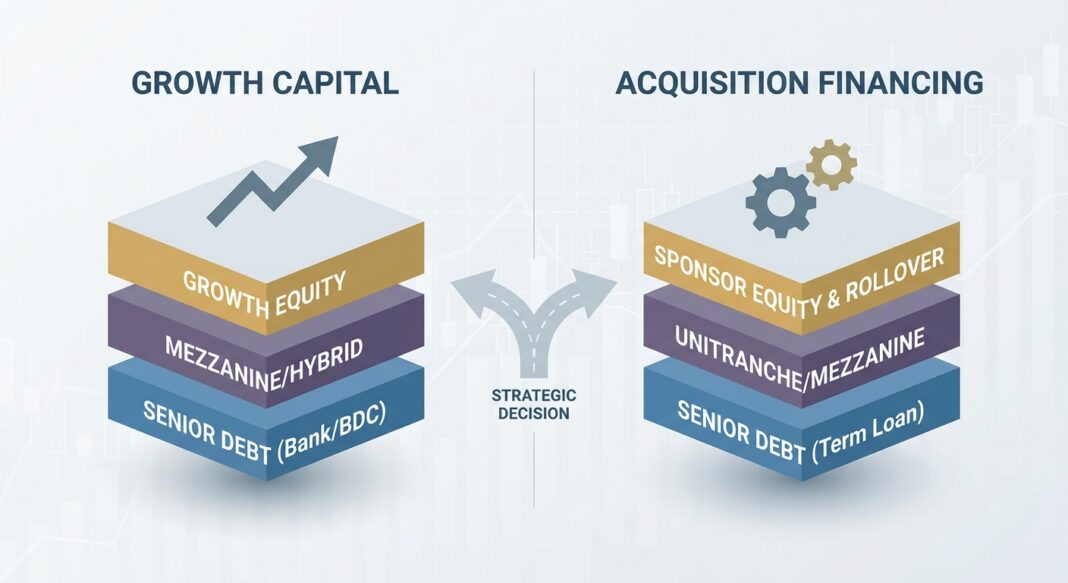
The capital stack for organic growth typically runs:
- Senior revolving credit facility or term loan (banks / BDCs): Senior debt from a bank runs SOFR plus 250 to 400 basis points as of the July 2026 FOMC minutes, sized to 2.5x–3.5x EBITDA. This is the cheapest layer, but the least flexible — drawdowns are constrained by borrowing base or cash flow tests, and growth capex often sits outside traditional collateral.
- Hybrid / mezzanine layer: In the middle sits hybrid capital: mezzanine debt, subordinated notes, preferred equity, and convertible notes — each with a different cost, control, and dilution profile.
- Growth equity (minority): Growth equity from a lower-middle-market sponsor typically prices at a 4.0x to 8.0x forward-EBITDA valuation, taking 20 to 40 percent of the company for a five-to-seven-year hold. This is the most flexible capital but the most dilutive.
The dominant growth-capital structure in 2024–2026 combines layers to limit dilution: LMM growth capital raises have increasingly stacked minority equity with a senior credit facility and sometimes a mezzanine layer to keep dilution below 30 percent while still funding the acquisition or growth plan.
Acquisition Financing: Funding a Control or Add-On Transaction
Acquisition financing is deal-triggered and closes at signing. Merger and acquisition financing is the layered capital stack — typically a mix of senior debt, mezzanine or unitranche, sponsor equity, and rollover equity — that funds the purchase of an operating business. Each tranche has a defined function and a defined cost.
Illustrated example — a $60M enterprise value manufacturing add-on:
- Senior first-lien term loan: Senior leverage multiples on middle market deals averaged 3.7x in Q1 2026 per GF Data, with total leverage at 4.6x on average across the LMM — at SOFR + 350–450 bps, this covers roughly $22M–$25M.
- Mezzanine or unitranche (gap layer): For an LMM buyer at 6.0x to 8.0x EBITDA, the stack typically layers senior debt from a bank or BDC at 3.0x to 3.5x, mezzanine or unitranche at another 1.0x to 1.5x, and equity from a family office or growth fund covering the balance. The mezz tranche on this deal would represent roughly $6M–$9M at a cost of 11% to 14% cash coupon plus 1% to 4% PIK plus warrant coverage of 1% to 5% of the fully diluted cap table.
- Sponsor / operator equity: Equity contribution across the LMM in H1 2026 averaged 51.7%, up from 40% in 2019, driven by SOFR at 4.33% and tighter senior lender covenants.
- Seller note / rollover: Deferred consideration of 5%–15% of purchase price at subordinated rates, bridges valuation gaps and keeps the seller aligned post-close.
The total cost of capital on a blended LBO stack is meaningful. Total all-in cost: 12–15% for cash plus PIK; 16–22% IRR including warrant value. That hurdle must be covered by the target’s projected free cash flow — before growth capex.
Growth Capital vs. Acquisition Financing: The Core Trade-offs
These two structures are often discussed as interchangeable paths to the same destination. They are not. The table below frames the key decision variables:
| Variable | Growth Capital | Acquisition Financing |
|---|---|---|
| Trigger | Milestone or expansion need | Signing of a purchase agreement |
| Underwrite basis | Forward ARR / EBITDA growth | Trailing EBITDA + pro-forma synergies |
| Ownership impact | 20%–40% dilution (equity-led) | Leverage-led; equity typically 30%–50% of stack |
| Covenant intensity | Lighter; milestone-based | Heavier; quarterly maintenance tests common |
| Cash flow requirement | Low at close; grows into debt service | Immediate; must cover debt service from day one |
| Optimal for | High-growth, asset-light businesses | Profitable businesses with stable cash flows |
Growth remains the primary reason companies pursue private capital, with funding growth initiatives ranked first at 28%, followed closely by investments in technology, automation, and AI at 26%. Acquisitions accounted for 18% of use-of-proceeds, underscoring that the capital agenda is rarely one-dimensional.
The critical inflection: acquisition financing is deal-triggered and closes in tranches at signing; growth equity funds ongoing expansion of an existing business and does not require an M&A trigger. Using acquisition financing for a growth-only use case creates unnecessary leverage and restrictive covenants on a business that has not yet generated the cash flow to support them.
Unitranche occupies an important middle ground. The most effective structure typically involves a meticulously layered capital stack that balances the low cost of senior debt with the flexibility of mezzanine finance or unitranche solutions. For mid-market deals, a unitranche model is often preferred as it simplifies the inter-creditor landscape and provides the agility required for rapid post-acquisition integration.
Current Market Terms (Q3 2026)
Understanding where the market sits today is prerequisite to running any capital raise process. Here are five data points that anchor current structures:
- Senior debt pricing: Senior first-lien term loans from banks price at SOFR plus 350 to 500 basis points, with typical leverage of 2.5x to 3.5x EBITDA, representing the cheapest layer of the stack.
- Unitranche pricing (middle market): Current middle-market unitranche spreads run approximately S+4.75% to S+5.50% for deals in the $40M–$100M EBITDA range, according to Lincoln International’s Q1 2026 private market data. The lender provides total leverage that can reach 5–6x EBITDA in a single facility, compared to 3–4x that a senior-only lender would typically provide.
- Mezzanine pricing (LMM, 2026): Mezzanine debt financing in the second half of 2026 costs roughly 11% to 14% cash coupon plus 1% to 4% PIK plus 1% to 5% warrant coverage of the fully diluted cap table, with a 2% to 3% closing fee.
- Growth equity minority check terms: The most common growth-capital structure is convertible participating preferred, with the LMM norm in 2024–2026 drifting toward 1x non-participating preferred with a coupon of 6% to 8% PIK, plus broad-based weighted-average anti-dilution and a minority board seat with standard protective provisions.
- Covenant design divergence: The distinction between maintenance and incurrence covenants is one of the most significant structural differences between private credit and the broadly syndicated loan market. In the syndicated market, covenant-lite structures that include only incurrence covenants have become dominant. In direct lending and private credit, maintenance covenants remain the standard — a core selling point for private credit fund managers when pitching to limited partners. Borrowers in private credit should expect quarterly leverage ratio tests with cushions of 25%–40% above closing levels.
The wider market backdrop: capital is widely available in the middle market — the harder problem is assembling the right capital at the right moment on the right terms, especially for companies carrying acquisition agendas or technology investment plans requiring staged commitments.
The Gap Capital Playbook: From Quantification to Close
Whether the use-of-proceeds is growth or acquisition, the same four-step execution discipline applies. Skip a step, and the process stalls or prices badly.
Step 1 — Quantify the Gap
Start with a bottoms-up uses-and-sources table. On the acquisition side: total consideration, transaction costs (legal, advisory, QoE), working capital normalisation, and a minimum cash buffer (typically 3–6 months of fixed charges). On the growth side: capital deployment timeline, expected EBITDA inflection point, and the cash flow available for debt service before the growth plan matures. The gap between what the senior lender will extend and what the deal requires is the exact quantum of mezzanine, unitranche, or equity needed — no more.
Step 2 — Prepare Materials
A credible CIM or financing memorandum must include: (a) three years of audited or reviewed financials with a clean quality-of-earnings narrative; (b) a management-prepared 3-year model with clearly labelled assumptions; (c) a proposed capital structure with sources and uses; (d) a customer concentration and retention analysis; and (e) an articulation of the specific use-of-proceeds and expected return on invested capital. The gating question every lender asks: does the pro-forma capital stack meet debt-service coverage at conservative assumptions? Regional banks generally underwrite to FCCR of 1.25x to 1.35x on a trailing 12-month adjusted EBITDA basis.
Step 3 — Run a Competitive Process
Contact a minimum of 8–12 capital providers across at least two tiers of the stack simultaneously. For a growth raise, that means 3–4 banks for the senior revolver, 2–3 mezz funds or BDCs for the junior layer, and 2–3 growth equity funds if minority equity is on the table. Top providers cluster across BDCs (Ares Capital, Blue Owl, Main Street, FS KKR, Hercules), specialty mezz funds (Audax Mezzanine, Madison Capital, Twin Brook, Maranon, Antares), and family offices. A parallel process creates real pricing tension and reveals which providers have genuine conviction.
Step 4 — Negotiate the Structure
Term sheet negotiation has three high-leverage areas for borrowers:
- Covenant headroom: Push for leverage covenant cushions of 35%–40% above closing leverage, not 20%–25%. Total leverage ratios with 30% or higher cushions to model are now standard, with 40% headroom common in aggressive large-cap documentation. Secure EBITDA addback definitions that capture genuine run-rate performance.
- PIK optionality: PIK interest options mean companies can defer cash payments during growth phases, using capital for operations rather than debt service. Negotiate PIK toggle rights — the ability to elect PIK vs. cash pay quarterly — as a liquidity buffer, especially in the first 18 months post-close when integration costs are highest.
- Prepayment economics: OID and early call terms make the first two years the most expensive period, which shapes refinancing windows. Negotiate soft call protection (101 callable after year 1) rather than hard no-call periods. On acquisition debt, this preserves the option to refinance if base rates decline or the business exceeds its model.
For growth equity, the single most consequential negotiation point is the liquidation preference structure. A 1x non-participating liquidation preference is founder-friendly; a 1x participating preference with a 3x cap is the middle ground; participating uncapped is aggressive and rare in growth rounds — this provision alone can swing exit economics by 15% to 40%.
Key Takeaways
- Match capital to use-of-proceeds first, lender relationship second. Growth capital (forward-looking, milestone-anchored) and acquisition financing (trailing-EBITDA-anchored, immediate debt service) are structurally incompatible instruments. Using the wrong one for the wrong use case is a structural error, not just a pricing inefficiency.
- The full stack in 2026 runs from SOFR+350 bps at the bank layer to 16–22% all-in IRR at the equity layer. Every instrument between those endpoints — unitranche, mezzanine, preferred equity — is a direct trade-off between cost, control, and covenant flexibility.
- Mezzanine remains the most tactical gap-fill tool in the LMM. At 11%–14% cash coupon plus PIK and warrants, it extends total leverage to 5–7x EBITDA without the inter-creditor complexity of a full senior/sub split — and preserves more equity than going straight to a minority growth fund.
- Covenant design is a risk management tool, not a formality. Private credit lenders maintain quarterly maintenance tests even as the syndicated market stays covenant-lite. Borrowers should model all covenants at conservative EBITDA assumptions and negotiate for 35%–40% headroom, not minimum compliance.
- The gap capital playbook — quantify, prepare, process, negotiate — is a repeatable discipline. Companies that treat capital raising as a reactive event consistently pay more and accept worse terms than those who run structured, competitive, advisor-supported processes with clean materials prepared in advance.


