
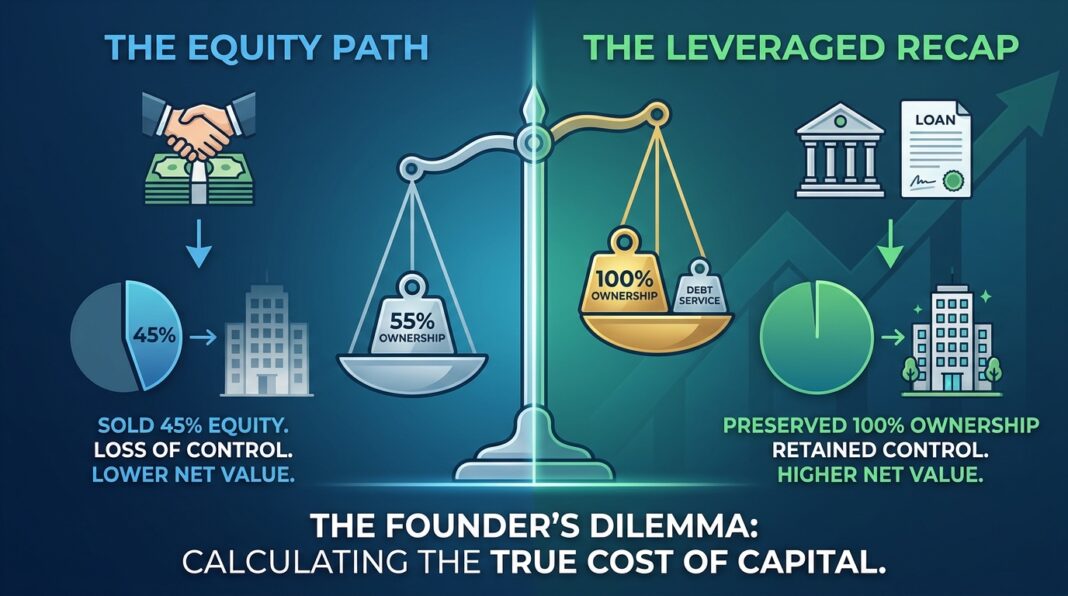
Two Founders, One Decision: How a Leveraged Recap Preserved 100% Ownership While the Equity Path Gave Half the Company Away
⚠️ Case Study Note: The individual founders and company names below are hypothetical scenarios constructed to illustrate real structural principles. All market data points — deal volumes, leverage multiples, credit statistics — are drawn from publicly reported sources and cited throughout.
The Story: Same Business, Same Moment, Different Instincts
In early 2022, two founders — call them Marcus and Diane — ran nearly identical businesses. Both operated regional B2B services platforms generating approximately $4 million in EBITDA on roughly $22 million in annual revenue. Both had spent a decade building with no outside capital. Both faced the same inflection point: they needed $8 million to fund an acquisition that would, if executed well, nearly double the size of their platforms.
They were friends. They’d met at an industry conference, stayed in touch over the years, and now found themselves at the same fork in the road — at almost exactly the same time. They even used the same M&A advisor to evaluate their options.
The difference was in what happened next.
Marcus had spent years hearing the VC playbook from the startup world. He was comfortable with the idea of a capital partner, energized by the prospect of institutional validation, and, frankly, a little fatigued from carrying all the risk himself. When a growth equity firm offered him $10 million for a 45% stake, he signed within 60 days.
Diane was skeptical. She’d built her company slowly and deliberately. She had no desire to explain her quarterly strategy to a board she didn’t control. She hired a debt advisor, explored the private credit market, and structured a leveraged recapitalization using a unitranche facility from a direct lender. She closed in 90 days. She signed no equity away.
Four years later, the gap between their outcomes tells one of the clearest stories in middle-market finance.
The Decision: What Each Structure Actually Looked Like
Marcus’s Equity Round: The growth equity firm invested $10 million at a post-money valuation of approximately $22 million (roughly 5.5x EBITDA at the time). Marcus received $2 million in secondary proceeds — partial personal liquidity — and the company received $8 million in primary capital for the acquisition. In exchange, Marcus gave up 45% of the equity, a board seat, and agreed to standard drag-along provisions that would govern any future sale.
Diane’s Leveraged Recap: Diane’s advisor structured a unitranche term loan of $9 million from a private credit direct lender — approximately 2.25x her trailing EBITDA, well within the 3x–5x range typical for lower middle market transactions. The debt carried an all-in rate of approximately SOFR + 525 basis points (roughly 10.5% at close), with a five-year term and modest amortization. Of the proceeds, $8 million funded the acquisition target; $1 million supplemented working capital. Diane retained 100% of her equity. She had no new board members. No drag-along clauses. No GP with a five-year exit mandate. Her annual debt service was approximately $950,000 — covered comfortably by her existing EBITDA before the acquired business contributed a single dollar of earnings.
The structures, in plain terms:
| Metric | Marcus (Equity) | Diane (Leveraged Recap) |
|---|---|---|
| Capital Raised | $10M | $9M |
| Equity Given Up | 45% | 0% |
| Cost of Capital | 45% of all future upside | ~10.5% annual interest |
| Board Control | Shared (1 seat to investor) | Full founder control |
| Exit Mandate | Yes (3–5 year GP horizon) | None |
| Annual Debt Service | None | ~$950K |
The Outcome: Where the Compounding Happens
The acquisition worked for both of them. By 2025, both companies had grown their combined EBITDA to approximately $7.5 million — a near doubling of the original base. The industry multiple at which comparable businesses were changing hands had also expanded, moving from 5.5x to approximately 7x, reflecting continued consolidation interest and multiple expansion in their sector.
At a 7x EBITDA multiple, both companies were worth approximately $52.5 million.
Now look at what each founder actually owned:
- Marcus, at 55% ownership post-investment, held a stake worth approximately $28.9 million. His debt was minimal — the equity structure left the company clean. But his equity partner was now four years into a typical five-year hold, actively engineering a sale. Marcus wanted to keep operating. The investor wanted liquidity. That tension was real, and costly.
- Diane, at 100% ownership, held a stake worth approximately $52.5 million. She had paid down roughly $3.2 million in principal over four years, leaving a debt balance of approximately $5.8 million. Her net equity value: approximately $46.7 million. She decided when — and whether — to sell. No one was pushing her to the table.
The equity gap: ~$17.8 million in favor of Diane, on an identical business performing identically. The debt cost Diane approximately $3.8 million in total interest over four years. The equity cost Marcus a permanently surrendered claim on $23.6 million in value creation — more than six times the interest cost of the debt path.
This is the compounding math that most founders never see modeled when they’re sitting across from a term sheet.
The Lessons: When Debt Is the Smarter Equity Play
The Diane-versus-Marcus comparison is not an argument against equity as a category. It is an argument for pricing equity honestly. Most founders are never shown the long-run dilution math at the moment they are asked to sign. Here is what the story teaches:
1. Debt Has a Fixed Cost; Equity Has an Infinite One
Interest is a known, finite obligation. Equity is a permanent share of every dollar of future value — including upside you haven’t built yet. When the business performs, equity given away in year one is your most expensive capital by a wide margin. As one private credit executive has noted, “not every founder wants, or can afford, another dilutive equity round” — and the math increasingly supports that instinct.
2. The Leveraged Recap Is Not Just for PE Sponsors
The market narrative around dividend recapitalizations has long focused on private equity sponsors extracting cash from portfolio companies. But the structure is equally — arguably more powerfully — available to founder-operators. A leveraged recapitalization allows the existing owner to extract cash or fund growth without selling to a third party, while retaining control and accepting a known debt service burden. The founder who uses this tool is doing exactly what a PE sponsor does — just without surrendering the equity to get there.
3. Market Conditions Favor Qualified Founders Right Now — With a Caveat
The macro backdrop for this strategy has been broadly supportive. Leveraged loan issuance tied to sponsored dividend recaps grew to $74.3 billion in 2025 — up 11% year-over-year — after a historic surge in 2024. Private credit lenders have been flush with dry powder and actively competing for quality deals. However, early 2026 has brought selective spread widening and greater lender bifurcation. Founders with strong, clean cash flows remain well-positioned; those with irregular earnings or higher operating risk will find terms tightening.
4. The PE Overleverage Cautionary Tale Is Real — But It’s a Warning About Structure, Not Debt Itself
It would be incomplete to celebrate leverage without acknowledging its dangers. PE-backed company bankruptcies hit a record 110 filings in 2024, according to S&P Global Market Intelligence — up more than 15% from the prior year. The pattern is almost always the same: debt placed on a company’s balance sheet not to fund operations, but to fund the sponsor’s distribution. The lesson isn’t that debt destroys companies. It’s that debt placed in service of financial engineering rather than operational growth destroys companies. Diane’s structure funded an acquisition that grew EBITDA. That is the difference.
5. Control Is a Capital Asset — Price It That Way
Marcus lost more than equity percentage. He lost timing optionality, strategic control, and the right to decide his own exit horizon. Control — the ability to choose when to sell, to whom, and on what terms — has measurable economic value. Founders who surrender it cheaply in a growth equity round often discover its worth only when they’re sitting in a board meeting being told it’s time to sell a company they’re not ready to leave.
Framework: Is a Leveraged Recap Right for You?
The leveraged recap is not a universal solution. But it is systematically under-considered by founders who default to equity because it’s familiar. Use this filter:
- ✅ Use a leveraged recap if: You have predictable, recurring EBITDA; your debt service is covered at 1.5x or better; you have a specific capital use (acquisition, buyout of a co-founder, partial personal liquidity); and you want to retain control and timing optionality.
- ⚠️ Be cautious if: Your cash flows are seasonal or cyclical; the acquisition thesis is unproven; or you are taking on debt primarily to fund distributions rather than earnings-accretive investment.
- ❌ Avoid if: The business cannot service debt at a 1.0x coverage ratio in a conservative case; you are pre-EBITDA; or the debt is being placed on the balance sheet by a sponsor who intends to exit and leave you holding the leverage.
The lower middle market typically supports total leverage of 3x to 5x EBITDA in a leveraged recap structure, with pricing tied to prevailing senior secured rates plus a risk margin. At current spreads for well-qualified borrowers, this remains an accessible and structurally elegant alternative to equity dilution.
Key Insights
- 📌 Debt has a fixed, finite cost; equity surrenders a permanent share of infinite future upside. On a growing business, early equity is always your most expensive capital — often by a multiple of 5x or more versus the interest cost of equivalent debt.
- 📌 A leveraged recapitalization is not just a PE tool. Founder-operators can use the same structure to extract personal liquidity, fund acquisitions, or buy out co-founders — without giving up a single share of equity or losing board control.
- 📌 The dividend recap market is large and active. Leveraged loan issuance tied to dividend recaps reached $74.3 billion in 2025, reflecting deep lender appetite — though early 2026 signals some bifurcation favoring clean-cash-flow borrowers.
- 📌 PE overleverage is a structural warning, not an indictment of debt. The record 110 PE-backed bankruptcies in 2024 were driven by debt placed in service of sponsor distributions, not operational growth — a fundamentally different structure from a founder-driven recap tied to value creation.
- 📌 Control is a capital asset with quantifiable economic value. The right to choose your exit timing, counterparty, and terms is worth millions. Founders who price it as zero when signing a term sheet often realize its value only when they’ve already given it away.


