
One Loan, One Rate, But Not One Risk Level
Walk into most leveraged buyout negotiations in today’s middle market and you will encounter the same instrument: the unitranche loan. It has become the default financing tool for private equity sponsors acquiring companies, and it now funds the overwhelming majority of private credit transactions. Yet for all its dominance, the unitranche is genuinely misunderstood: by borrowers who sign it, by investors who fund it, and by financial commentary that treats its prevalence as a simple measure of market health.
The unitranche is not a single, uniform instrument. It is a structural innovation that packages what would otherwise be two separate debt layers (senior and subordinated) into a single credit agreement with a single blended interest rate. That simplicity is its commercial appeal. The complexity lives beneath it, in a private contract that the borrower typically never sees.
Understanding how a unitranche actually works (mechanically, economically, and legally) is foundational to evaluating private credit as either an investor or a business owner seeking capital. This article builds that foundation from first principles and connects it to where the market stands today.
The Core Mechanism: What a Unitranche Actually Is
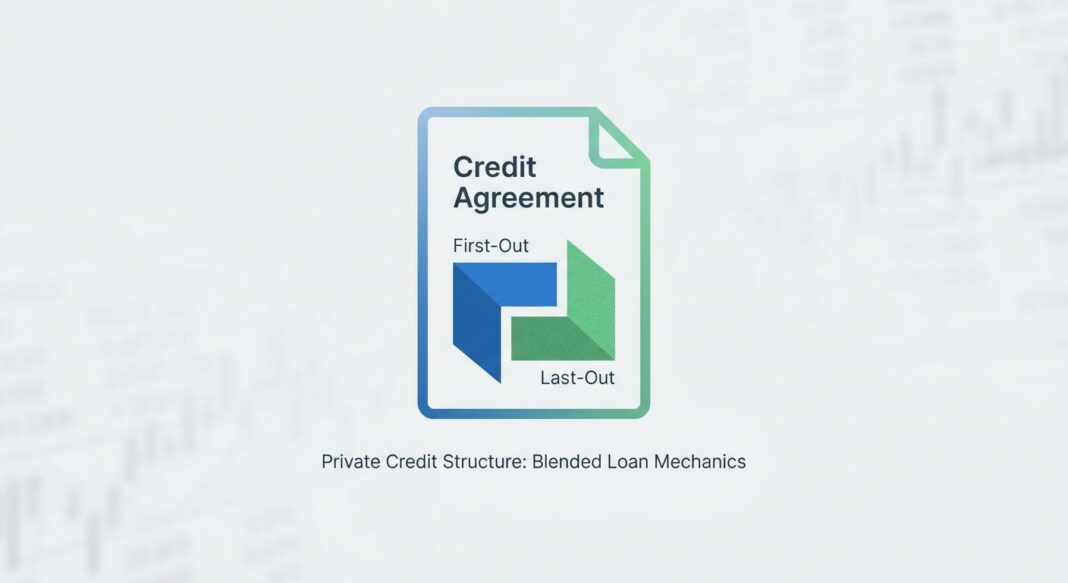
At its simplest, a unitranche merges senior and subordinated debt into a single credit agreement carrying one blended interest rate. The borrower sees one lender (or a club of lenders acting as one), one loan document, one agent, and one all-in coupon. There is no intercreditor negotiation between a first-lien lender and a second-lien lender, because legally there is only one lien.
The risk differentiation that would normally live between those two lenders instead lives inside a separate private document called the Agreement Among Lenders (AAL). As Mayer Brown summarized in its July 2026 analysis of unitranche mechanics, the structure involves “a single secured credit facility in which two or more groups of lenders share in the same security interest on the borrower’s collateral but agree among themselves to a payment priority.”
That internal priority split produces two positions:
- First-Out (FO): Gets repaid first in any cash waterfall or enforcement scenario. Lower risk, lower rate. Often structured as a revolving credit facility or a smaller term portion.
- Last-Out (LO): Absorbs losses first if collateral recovery falls short of total debt. Higher risk, compensated with a materially higher interest rate spread above the blended facility rate.
Critically, the borrower is generally not a party to the AAL. As one practitioner analysis noted, this internal subordination is “governed by an agreement among lenders that the borrower typically never sees and has no say in.” The blended rate the borrower pays is a weighted average of what the first-out and last-out lenders actually receive, but the borrower only ever sees the blended number.
How It Works: A Concrete Example With Numbers
Consider a straightforward middle-market acquisition scenario. A private equity firm is buying a manufacturing business with $10 million in EBITDA for a purchase price of $60 million (6.0x EBITDA). The sponsor wants to finance $40 million of that with debt, a 4.0x leverage ratio, and contribute $20 million in equity.
In a traditional structure, that $40 million might split into $30 million of first-lien senior debt at SOFR + 4.25% and $10 million of second-lien or mezzanine at SOFR + 9.00%. Two lenders, two credit agreements, two sets of negotiations, and an intercreditor agreement mediating between them. Total elapsed time from term sheet to close: 10–14 weeks, minimum.
A unitranche lender (say, a direct lending fund) instead offers the full $40 million in a single facility at a blended rate of SOFR + 5.25%. The borrower closes in four to six weeks with one counterparty. No intercreditor friction.
Internally, the unitranche lender may syndicate the first-out $15 million to a bank or a more conservative co-lender at SOFR + 3.75%, and retain the last-out $25 million itself at an effective rate of SOFR + 6.25%, compensating for its subordinated position. The borrower pays one blended coupon. The lender consortium splits the economics privately through the AAL.
With three-month Term SOFR running at approximately 3.69% as of June 2026 per Valuation Research Corporation’s Q2 2026 Private Markets Trends report, that SOFR + 5.25% spread produces an all-in coupon near 9.0%, consistent with current market pricing for core middle-market unitranche loans.
Current Market Reality: Where Unitranche Pricing Stands in 2026
Unitranche structures have moved from innovative to ubiquitous. Per S&P Global Market Intelligence data cited in CTA Acquisitions’ 2026 market overview, roughly 80% of lower-middle-market leveraged buyouts completed in 2025 used a private credit unitranche rather than a syndicated bank loan. That concentration reflects both the flexibility of the structure and the sustained retreat of traditional bank lenders from leveraged middle-market deals.
On pricing, the market has reset meaningfully from its 2023 peaks. The data box below captures where unitranche economics stand today:
| Metric | Current Level (Mid-2026) | Source |
|---|---|---|
| Unitranche spread (new-issue, Q1 2026) | ~SOFR + 525 bps | PitchBook LCD via CTA Acquisitions, July 2026 |
| Unitranche all-in yield range | ~9.00%–9.75% | Valuation Research Corp., Q2 2026 |
| Spread widening since late 2025 | +50 to +100 bps | Lord Abbett / PitchBook, Midyear 2026 |
| Cliffwater CDLI annualized return (inception–Q4 2025) | ~10.1% | Cliffwater via CTA Acquisitions, July 2026 |
| Global private credit AUM (start of 2026) | ~$1.7 trillion | Preqin 2026 Global Alternatives Report |
The spread widening from late 2025 is particularly instructive. After years of borrower-friendly compression, spreads fell from the 650–700 bps range in 2023 to a trough near 475–500 bps in mid-2025, the market has begun to reset. According to Lord Abbett’s 2026 Midyear Investment Outlook, new loans are increasingly structured with “less leverage, more covenants, fewer PIK requests, and tighter documentation”, improvements that matter as much as pricing for long-term credit quality.
On the bank lending side, the Federal Reserve’s July 2026 SLOOS showed that C&I lending standards were broadly unchanged in Q2 2026, with banks reporting stronger loan demand from large and middle-market firms. However, the same survey’s April 2026 edition noted that banks had tightened standards and terms on loans to non-depository financial institutions, the category that includes private credit funds, over the prior year. That subtle constraint on bank funding for private credit managers is a structural factor supporting spreads.
Decision Framework: Investors and Operators
For Investors Evaluating Unitranche Exposure
When assessing any private credit vehicle with unitranche exposure, investors consider the following:
- First-out vs. last-out position: A fund holding last-out tranches carries subordinated risk at what appears to be a senior secured yield. The blended rate obscures the true risk layer. Investors seek disclosure of what percentage of a portfolio is last-out versus first-out.
- Vintage timing: Loans originated in 2022–2023 at peak spreads carry different economics than loans written today at SOFR + 475–525 bps. Portfolio vintage mix matters for projecting forward yield.
- Covenant package: The mid-2026 lender-friendly reset has brought back maintenance covenants on many new deals, a structural protection that eroded during the competitive 2024–2025 environment. Investors evaluate whether newer originations reflect this improvement.
- Manager scale and selectivity: PitchBook’s 2026 US Private Credit Outlook notes that larger asset managers are increasingly advantaged in competing for the best deal flow, a concentration dynamic that investors in smaller funds weigh carefully.
For Business Owners and Operators Evaluating Unitranche Financing
Operators considering a unitranche consider the following trade-offs versus traditional bank financing:
- Speed and certainty: A unitranche typically closes in four to six weeks with a single decision-maker. This can be decisive in competitive acquisitions where sellers favor deal certainty over price.
- Cost premium: The convenience carries a cost. Unitranche all-in rates of 9–10% compare to bank term loans, where available, at 7–8%. Operators model whether the transaction economics justify the premium, particularly in add-on acquisitions or recapitalizations.
- Covenant flexibility: Private credit lenders historically offered more covenant flexibility than banks, though the 2026 reset has tightened this. Operators review maintenance covenants carefully (particularly leverage and interest coverage triggers) before signing.
- Prepayment terms: Soft-call premiums on early prepayment have shortened from 24 months in 2023 to shorter windows in current deals, per CTA Acquisitions’ 2026 market analysis, giving operators more refinancing optionality as conditions evolve.
Key Takeaways
- A unitranche is a packaging innovation, not a simpler instrument. The complexity of a traditional senior/subordinated structure does not disappear; it migrates into the AAL, a private lender contract the borrower does not typically see or negotiate.
- First-out and last-out carry materially different risk profiles even within a single credit agreement. Investors in private credit funds evaluate what percentage of a portfolio sits in last-out positions, since these absorb losses first despite appearing as senior secured on fund schedules.
- Spreads have widened 50–100 basis points since late 2025, and new loan documentation has tightened. This represents a lender-friendly reset after years of borrower-favorable conditions, improving the structural quality of recent vintages.
- Operators pay a premium for speed and certainty. All-in unitranche coupons near 9–10% exceed typical bank pricing, but the single-counterparty, rapid-close structure has made unitranche the instrument of choice for sponsor-backed middle-market transactions, now representing roughly 80% of lower-middle-market LBO financing.
- The AAL governs the real economics. Whether analyzing a deal as a borrower, a co-lender, or a fund investor, the Agreement Among Lenders is the document that determines who gets paid, in what order, and under what conditions. Understanding it (or ensuring your manager does) is not optional.


