
One Loan to Rule Them All
When a private equity sponsor acquires a mid-market company, the first financing question is almost always the same: how do we structure the debt? Traditionally, that meant negotiating with multiple lenders across multiple tiers (a senior secured bank facility, a second-lien term loan, and sometimes mezzanine debt) each with separate interest rates, covenants, and intercreditor agreements that could take months to finalize and weeks to close.
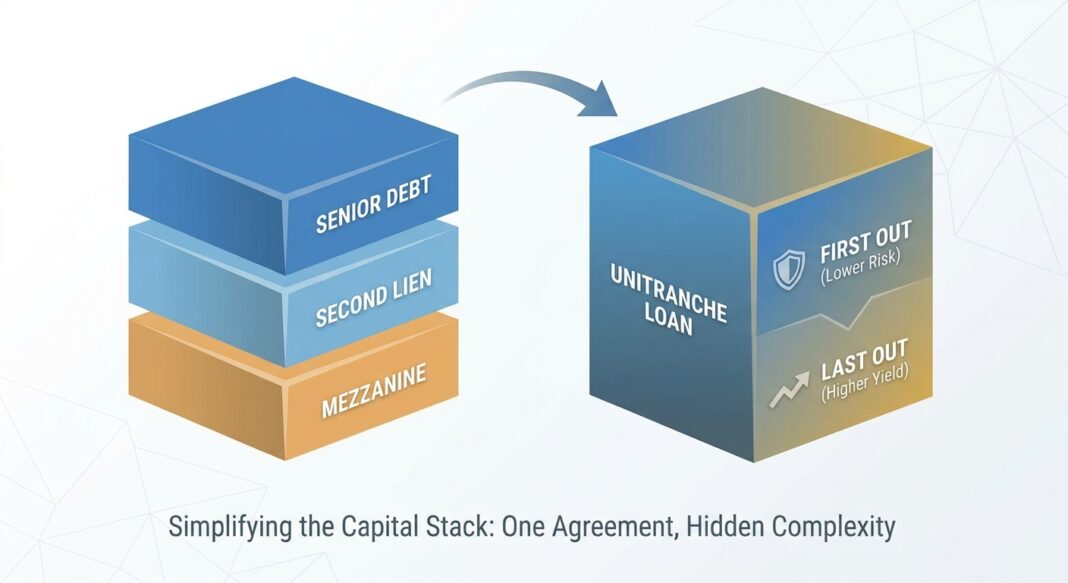
Enter the unitranche loan: arguably the most consequential structural innovation in private credit over the past decade. Rather than assembling several layers of the capital stack separately, a unitranche facility collapses them into a single credit agreement, a single interest rate, and a single set of collateral documents. The borrower deals with one lender (or one coordinated group of lenders). The complexity still exists; it simply moves behind the curtain, among the lenders themselves.
Understanding how unitranche works is essential for any investor evaluating private credit funds and for any business owner or CFO considering debt financing for a transaction. The structure directly affects yield, risk, speed of execution, and covenant flexibility. And in 2026, with deal volume accelerating and unitranche facilities reaching multi-billion-dollar sizes, it is the dominant financing format in the U.S. middle market.
What Is a Unitranche Loan?
A unitranche facility is a single secured credit facility in which two or more groups of lenders share the same security interest on the borrower’s collateral but privately agree among themselves to a payment priority and economic allocation. From the borrower’s perspective, there is one loan with one blended interest rate. From the lenders’ perspective, the economics are divided into a First Out tranche and a Last Out tranche.
This internal division is governed by a document called the Agreement Among Lenders (AAL): not the primary credit agreement. As Mayer Brown (July 2026) explains, the AAL is a highly bespoke document that determines how payments flow between First Out and Last Out lenders, who controls enforcement remedies, and how the payment waterfall operates in a stress scenario. Because there is only one lien, an intercreditor agreement is not needed, the AAL handles what would otherwise require two separate collateral packages.
The blended interest rate a borrower pays sits between what pure senior debt would cost and what traditional subordinated debt would demand. According to CPG Vintage Access Fund V’s 2026 SEC filing, the unitranche rate is “often higher than, or about the same as, the interest rate of traditional senior debt, but lower than the interest rate for traditional second lien or subordinated debt”, a genuine cost-of-capital advantage for many borrowers compared to a fully bifurcated structure.
How It Works: A Concrete Example
Imagine a private equity firm acquires a technology services company for $100 million. The capital structure looks like this:
- Equity (sponsor): $46 million (46% of total capitalization)
- Unitranche facility (debt): $54 million at a blended rate of SOFR + 525 bps
Within that $54 million unitranche, the AAL silently divides the lenders:
- First Out lender (e.g., a bank providing the revolving facility): $14 million at SOFR + 350 bps: lower risk, lower return, paid first in any distribution
- Last Out lender (e.g., a direct lending fund): $40 million at SOFR + 625 bps: higher risk, higher return, paid after First Out in stress scenarios
The borrower sees only the blended rate of SOFR + 525 bps and negotiates with a single agent. The Last Out lender earns a yield premium for accepting junior priority, while the First Out lender accepts lower yield for reduced risk. Per the American Bar Association (2025), in normal operating conditions both lender groups receive scheduled payments, but if the borrower becomes distressed, the AAL dictates that First Out lenders are made whole before Last Out lenders receive principal recovery.
The result for the borrower: faster closing (no intercreditor negotiations), one relationship to manage, and a blended all-in cost that is often competitive with (or cheaper than) assembling a traditional first-lien and second-lien stack separately. Mayer Brown notes that the structure can deliver quicker execution and, in some cases, a lower cost of capital for borrowers.
Current Market Relevance: Data Box
The unitranche format is no longer a niche innovation; it is the backbone of private credit deal flow. Current market data paints a clear picture:
| Metric | Data Point | Source |
|---|---|---|
| Unitranche / direct lending all-in yield (2025) | ~9.3% new-issue all-in | McKinsey / Kroll StepStone, June 2026 |
| Median direct lending spread at year-end 2025 | 544 bps (down from 716 bps peak in Mar 2023) | McKinsey / Kroll StepStone, June 2026 |
| Direct lending LBO debt pricing (Q4 2025) | SOFR + 507 bps | Octus, May 2026 |
| Direct lending share of LBO financings (Q4 2025) | 57% of all buyout transactions | Octus, May 2026 |
| Covenant-lite share of private credit deals (2025) | 21% (up from 4% in 2023) | Proskauer 15th Annual Private Credit Insights Report, Feb 2026 |
| Avg. equity contribution in private credit deals (2025) | 46% of total capitalization | Proskauer / PitchBook LCD, Feb 2026 |
| Cliffwater Direct Lending Index (CDLI) return (2025) | 9.3% for the year; 9.5% 20-year average | Cliffwater / Morningstar, March 2026 |
Two structural forces are reinforcing demand for unitranche specifically. First, the Federal Reserve’s April 2026 SLOOS reported tighter bank lending standards for C&I loans in Q1 2026, with banks also reporting tighter standards across all non-depository financial institution (NDFI) loan categories over the past year, pushing more borrowers toward private credit alternatives. Second, Octus data shows LBO deal volume above $500 million hit a record 189 transactions in Q4 2025, and larger deals demand exactly the kind of one-stop, certainty-of-execution financing that unitranche provides. A recent marquee example: a $3 billion unitranche facility to refinance animal health technology company Covetrus was among the defining large-cap private credit transactions of early 2026.
Decision Framework
For Investors Evaluating Private Credit Funds
- First Out vs. Last Out positioning matters: Investors should understand whether a fund predominantly takes First Out (lower yield, lower risk) or Last Out (higher yield, higher risk) exposure within unitranche structures. This distinction is not always visible in fund marketing materials.
- Covenant quality is shifting: With covenant-lite deals rising to 21% of the market in 2025 per Proskauer’s 15th Annual Report, investors should assess whether a manager retains meaningful financial maintenance covenants, particularly for smaller borrowers where covenants remain the primary early-warning mechanism.
- Track record through stress: The Cliffwater Corporate Lending Fund’s annual report (March 2026) showed a net annualized return of 9.34% since inception and a realized loss rate of just -0.04% annually, illustrating what disciplined credit selection within senior-secured unitranche structures can deliver over time.
- Spread compression is real: All-in yields on new-issue direct loans fell from 10.5% in 2024 to approximately 9.3% in 2025 per McKinsey/Kroll StepStone data. Investors entering today are accepting lower absolute yields than vintages from 2022–2023.
For Operators and CFOs Considering Unitranche Financing
- Speed and certainty: Unitranche typically closes faster than bifurcated structures because there is no intercreditor negotiation between two separate lender groups. For time-sensitive M&A transactions, this can be decisive.
- Size threshold: Unitranche is most efficient in the $25–$500 million loan range, the same segment identified by GM Insights (2026) as the zone that bank retrenchment under Basel III proposals has most acutely opened to private credit managers.
- Covenant negotiation leverage: Proskauer’s data confirms that borrowers with EBITDA above $50 million have disproportionate access to covenant-lite terms, 91% of cov-lite deals in 2025 came from that size cohort. Smaller borrowers typically accept full maintenance covenant packages in exchange for access to capital.
- Relationship value: Unlike broadly syndicated loans that are traded among dozens of anonymous holders, unitranche lenders are known, relationship-oriented counterparties. This matters when waivers, amendments, or operational flexibility are needed mid-loan.
Key Takeaways
- One loan, hidden complexity: A unitranche presents a single blended interest rate to the borrower, but the Agreement Among Lenders (AAL) privately allocates First Out and Last Out economics, meaning the risk and return profile for each lender group is fundamentally different beneath the surface.
- Speed is a core competitive advantage: By eliminating intercreditor negotiations, unitranche structures routinely close faster than traditional multi-tranche financing packages, a critical feature in competitive M&A processes.
- Covenants are compressing but not disappearing: While covenant-lite structures rose to 21% of private credit deals in 2025, nearly all cov-lite borrowers had EBITDA above $50 million. Maintenance covenants remain the norm for smaller companies, preserving lenders’ early-warning mechanisms.
- Spread compression demands selectivity: New-issue direct lending spreads fell from a peak of 716 bps in early 2023 to 544 bps by end of 2025. Investors evaluating today’s vintage must weigh whether current yields adequately compensate for credit risk, particularly in a late-cycle environment where default rates have been rising from historical lows.
- Bank retrenchment creates a durable structural tailwind: Ongoing Basel III capital requirements and tighter bank lending standards continue to push middle-market borrowers toward private credit channels, sustaining robust origination pipelines for unitranche lenders in the $25–$250 million loan segment where banks have structurally retreated.


