
The Deal That Closes in 45 Days Instead of 120
Picture a private equity firm racing to close a $75 million acquisition. They have two paths. The first: negotiate a senior bank loan with one lender, then stack a mezzanine tranche on top with a second lender, spend weeks hammering out an intercreditor agreement that governs who gets paid first if the business hits trouble, and hope the syndication markets stay open long enough to get both pieces funded. The second: call one direct lender, agree on a single set of terms, and close in roughly half the time.
That second path is unitranche financing, and it has become the dominant structure for middle-market acquisitions, recapitalizations, and leveraged buyouts in 2026. For investors seeking to understand where private credit sits in the capital structure, and for business owners evaluating how to finance a transaction, few concepts are as practically important to grasp. This article explains the mechanism, walks through a concrete pricing example, connects the structure to current market conditions, and offers a decision framework for both audiences.
What Is Unitranche Debt?
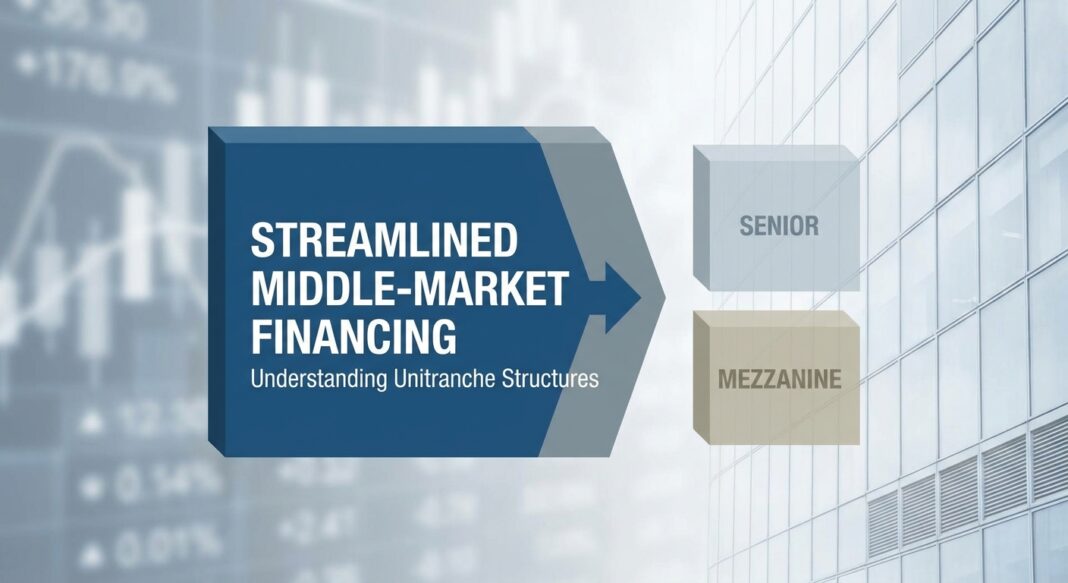
Unitranche financing is a single loan that combines senior secured debt and subordinated debt into one consolidated credit facility, governed by a single interest rate, a single credit agreement, and a single lender relationship. According to Private Credit Hub (2026), the structure eliminates the need for separate senior and mezzanine tranches, and the interest rates of the different debt components are blended into one composite rate that reflects the risk balance between them.
The mechanism works through what is called an Agreement Among Lenders (AAL): a private document, invisible to the borrower, through which the lenders divide the loan internally into a first-out (lower-risk, senior-priority) sleeve and a last-out (higher-risk, subordinated-priority) sleeve. As Goldman Sachs Private Middle Market Credit II described in its SEC Form 10-Q (June 2026), unitranche loans are first-lien loans that extend deeper in a borrower’s capital structure than traditional first-lien debt and may provide for a waterfall of cash-flow priority between different lenders in such a loan.
The borrower sees only simplicity: one loan document, one lender to call for amendments, one covenant package, one closing process. The complexity (and the risk allocation) happens behind the scenes among the lenders themselves.
How It Works: A Concrete Example
Consider a manufacturing business with $10 million in EBITDA being acquired at a 7.0x enterprise value multiple, a $70 million total transaction price. A sponsor wants to finance $45 million of that with debt (4.5x leverage) and put in $25 million of equity (approximately 36% of the capital structure).
Traditional two-tranche structure:
- Senior bank loan: $30M at SOFR + 375 bps ≈ 8.1% all-in
- Mezzanine tranche: $15M at 14–16% (often part PIK)
- Two lenders, two credit agreements, intercreditor negotiation, 90–120 day timeline
- Weighted blended cost of debt: approximately 10.1%
Unitranche alternative:
- Single unitranche loan: $45M at SOFR + 525 bps ≈ 9.6% all-in (using ~4.1% Term SOFR)
- 2% Original Issue Discount (OID): borrower receives $44.1M, owes $45M principal
- Annualized OID cost ≈ 33 bps over a 6-year term
- One lender, one credit agreement, 30–45 day closing timeline
- True all-in cost with OID: approximately 9.9%
The operator pays roughly 100–130 basis points more per year versus the blended two-tranche cost, but gains execution certainty and eliminates syndication risk that could collapse the deal. As IB Interview Questions (March 2026) notes, unitranche deals can close 30–45 days faster than syndicated alternatives, and sponsors often justify 50–100 basis points of additional spread to avoid financing gaps or broken syndications that jeopardize purchase agreements.
On the OID mechanics: according to CT Acquisitions (June 2026), unitranche loans typically carry 2–3% OID at funding. On a $50 million loan, that means the borrower receives $48.5 million but owes $50 million of principal, with the OID functioning as upfront yield to the lender that amortizes over the loan’s life.
Current Market Conditions: What the Data Shows
Unitranche is not just a structural concept; it is a measurable, actively priced market segment with transparent benchmarks in 2026. Here is what current data reveals:
| Metric | Current Reading | Source |
|---|---|---|
| New-issue unitranche spreads (Aug 2026) | SOFR + 502 bps avg | PitchBook LCD via Kadenwood, Sept 2026 |
| All-in unitranche yield range | ~9.00%–9.75% | Valuation Research Corp., Q2 2026 |
| Premium over syndicated loans | 162 bps (Q3 2026) | PitchBook LCD via Kadenwood, Sept 2026 |
| Typical OID on standard deals | 98.75–99.25 (i.e., ~0.75–1.25%) | Valuation Research Corp., Q2 2026 |
| Private credit trailing default rate | ~3.7% (Q1 2026) | PitchBook LCD via CT Acquisitions, June 2026 |
| Bank C&I lending standards (Q2 2026) | Basically unchanged; easier than historic midpoint | Federal Reserve SLOOS, July 2026 |
Two dynamics are shaping unitranche pricing right now. First, spreads on new-issue private credit loans have been widening. According to PitchBook LCD data reported by Kadenwood Group (September 2026), new-issue private credit spreads averaged 502 basis points over the three months to August 31, 2026, up from 475 basis points in the first quarter, with the premium a US borrower pays for private credit over a syndicated loan rising to approximately 162 basis points, about 39 basis points wider than in Q1.
Second, while banks are reporting broadly stable C&I lending standards, they are specifically tightening on non-depository financial institution (NDFI) loans. The Federal Reserve’s April 2026 SLOOS found that banks reported tighter standards for NDFI loans to business credit intermediaries, with higher premiums on riskier loans, stricter covenants, and shorter maximum maturities among the most widely reported changes. This creates a nuanced backdrop: direct access to credit markets is stable for strong borrowers, but the funding stack supporting private credit funds themselves faces tighter bank terms, a dynamic that reinforces the importance of lender financial strength in deal selection.
According to Lord Abbett’s 2026 Midyear Investment Outlook, spreads have widened by roughly 50 to 100 basis points since late 2025, and new loans are increasingly coming with better credit structures, a shift that experienced credit professionals view as a positive reset toward more disciplined lending.
Decision Framework: Investors and Operators
For Investors Evaluating Private Credit Exposure
When assessing a unitranche position as an investment, consider evaluating these dimensions:
- First-out vs. last-out positioning: The blended rate on the loan masks very different risk profiles. A first-out sleeve investor holds senior cash-flow priority; a last-out investor takes higher loss risk in exchange for a higher strip of the blended yield. Understanding which sleeve a fund primarily holds shapes recovery expectations in a stress scenario.
- Spread premium justification: At 162 basis points over syndicated equivalents, investors consider whether the illiquidity premium, execution certainty, and documentation control justify the spread differential relative to comparable broadly syndicated loan (BSL) exposure.
- Default and recovery benchmarks: With trailing 12-month default rates at approximately 3.7% per principal amount (Q1 2026), and Moody’s-tracked first-lien recovery averaging roughly 68 cents on the dollar in the 2022–2025 cohort, investors weigh expected loss against all-in yield when sizing positions.
- Manager discipline in a tightening cycle: As PwC’s Private Credit Survey 2026 notes, private credit is entering its first meaningful credit cycle as a high-profile asset class, making manager underwriting track record more critical than in the prior era of benign conditions.
For Operators Considering Unitranche Financing
Business owners and CFOs evaluating unitranche as a financing option may find it most suitable in specific contexts. According to CT Acquisitions (June 2026), unitranche dominates for businesses with enterprise values between $50 million and $200 million, where direct lenders aggressively compete, terms are most flexible, and leverage is most generous. Operators in this range often encounter:
- When unitranche likely fits: Acquisition timelines requiring committed financing within 2–3 weeks; niche businesses with limited syndicated market demand; buy-and-build strategies requiring delayed-draw facilities for add-on acquisitions; single-sponsor deals where simplicity of one lender relationship has operational value.
- When to consider alternatives: Collateral-rich businesses that can anchor a low-cost asset-based lending (ABL) facility; companies with strong public credit ratings eligible for BSL or bond markets at tighter spreads; businesses with volatile cash flows where a maintenance covenant creates material default risk at current pricing levels.
- The true cost comparison: Operators benefit from comparing the all-in unitranche yield (spread + OID + fees) against a flexed BSL or bank facility that accounts for underwriting fees, syndication risk, timing uncertainty, and material adverse change (MAC) closing conditions, not just the headline rate.
Key Takeaways
- Unitranche is a structural innovation, not just a product: By merging senior and subordinated debt into one instrument, it solves the intercreditor coordination problem that made two-tranche capital stacks slow and fragile, particularly important in competitive M&A environments.
- Current all-in yields sit in the 9.00%–9.75% range (Q2 2026): Down approximately 250 basis points from 2023 peak levels but still 200+ basis points above pre-2022 historical norms, reflecting a market that has compressed but not fully repriced to historical lows.
- The spread premium over syndicated loans has widened in 2026: New-issue private credit spreads averaged SOFR + 502 bps through August 2026, with the premium over syndicated equivalents at approximately 162 basis points: wider than in Q1 and representing the cost of certainty, speed, and documentation control.
- Lender financial strength is a growing differentiator: With banks tightening standards on NDFI loans per the Federal Reserve’s 2026 SLOOS surveys, the capitalization and funding stability of the direct lender matters, not just the loan terms on offer.
- First-out and last-out sleeves carry meaningfully different risk profiles: Investors in unitranche funds evaluate which portion of the blended structure a manager holds, as recovery dynamics in a stress scenario differ significantly between the two sleeves even though the borrower faces one unified loan.


