
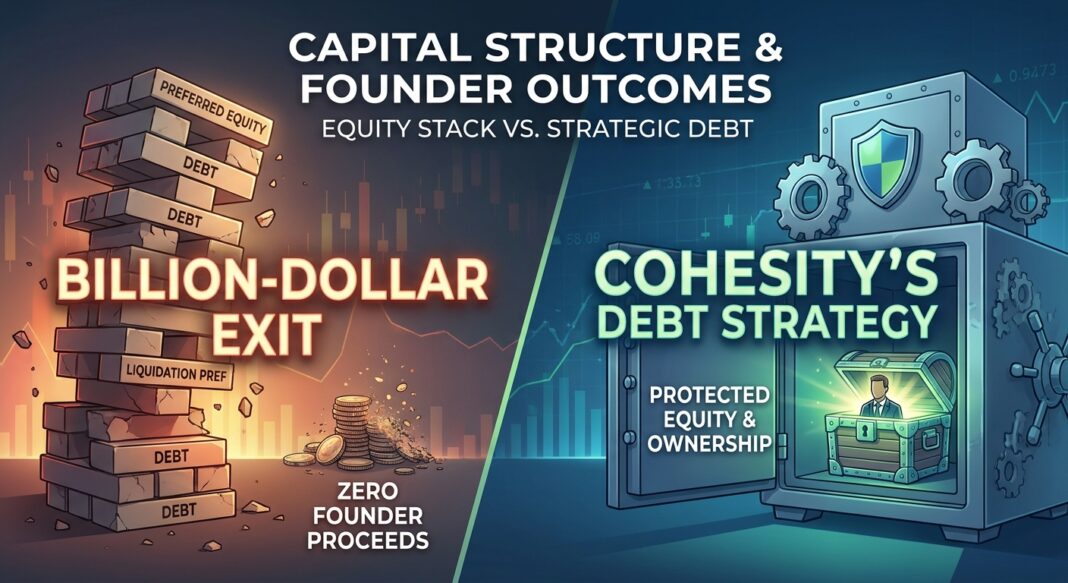
The Story: A Billion-Dollar Number That Meant Nothing
In January 2025, Adena Hefets wrote one of the most quietly devastating letters in recent startup history. Her company, Divvy Homes (a proptech darling that had revolutionized rent-to-own housing and helped more than 2,000 families access homeownership) had just agreed to be acquired by Brookfield Properties for approximately $1 billion. On the surface, that sounds like a win. A billion dollars. Logos from Andreessen Horowitz, Tiger Global, and GGV Capital on the cap table. A product that worked.
But Hefets told her shareholders something that stopped the celebration cold. Common shareholders and holders of Series FF preferred stock, the equity class typically awarded to founders, would receive no proceeds from the sale. Not a reduced payout. Not a nominal return. Nothing.
“While I am not proud of the financial outcome, I am proud of the impact we had on our customers’ lives,” she wrote, in language that made the reality plain.
How does a company sell for $1 billion and leave its founder with zero? The answer is not a mystery. It is a capital structure (one assembled round by round, preferred share by preferred share, debt tranche by debt tranche) that quietly transferred the value of a billion-dollar exit away from the people who built the business and toward the investors and lenders who funded its growth on their terms.
Now hold that story next to a different one. In 2024, a data security company called Cohesity closed a $3.1 billion debt financing, one of the largest venture debt transactions on record, following an equity round of over $1 billion. The purpose was not desperation. It was precision. Cohesity used structured debt to power aggressive growth while its founders and equity holders kept their ownership intact. The capital came with a repayment schedule, not a liquidation waterfall. The contrast with Divvy could not be sharper.
The Decision: Two Stacks, Two Philosophies
Divvy Homes was built on a capital-intensive model. It bought homes, rented them to aspiring owners, and held the real estate on its balance sheet while customers saved toward a purchase. The model required enormous upfront capital, and the company raised it aggressively. Founded in 2016, Divvy raised more than $700 million in combined debt and equity from investors including Tiger Global, GGV Capital, and Andreessen Horowitz. Its last known equity funding was a $200 million Series D in August 2021, led by Tiger Global, just six months after closing a $110 million Series C. In October 2021, the company also took on $735 million in debt financing to fuel its home acquisition engine. At its 2021 peak, Divvy carried a valuation of over $2 billion.
Each equity round came with its own liquidation preferences. Late-stage investors secured protections ensuring they would be paid first in any exit, often at a multiple of their invested capital, before earlier investors, founders, or employees saw a dollar. Stack enough of these preferences across a Series A, B, C, and D, and the arithmetic of an exit becomes unforgiving. When the acquisition price came in at roughly half the peak valuation, there was simply not enough left after $735 million in debt repayment and multiple layers of liquidation preferences to reach the common stock.
Cohesity made different choices. The data security company, valued at $7 billion by early 2024, used its $3.1 billion debt financing not as a substitute for business fundamentals, but as a structural amplifier of them. The debt was sized against durable, subscription-based cash flows and designed to fund the company’s combination with Veritas, a transformative deal that would have required massive equity dilution to execute any other way. As the Runway Growth Capital and PitchBook 2024–2025 Venture Debt Review highlighted, Cohesity’s transaction showcased how debt can power ambitious growth plans without forcing founders to surrender equity. The instrument had a maturity date and a repayment schedule. It did not have a board seat or a liquidation preference.
The structural difference is fundamental. Debt is a claim on cash flow. Equity is a claim on ownership. When you give away equity to grow, you are not just accepting dilution today, you are embedding a priority waterfall into your cap table that can silently consume your exit value years later.
The Outcome: What the Numbers Actually Show
For Divvy, the math of the exit was unambiguous. When Brookfield acquired the company for approximately $1 billion, the proceeds were consumed in order: first by $735 million in outstanding debt, then by transaction costs, then by the liquidation preferences carried by preferred shareholders from Series A through Series D. After those obligations were satisfied, common shareholders, including the founders, received nothing. A company that had once been valued at $2.3 billion and had genuinely changed how thousands of families accessed homeownership ended with its builders uncompensated.
The counterfactual matters here. Suppose Divvy had financed its home acquisition portfolio using a more conservative debt structure, one sized to its free cash flow coverage rather than its growth ambitions, while resisting the temptation to raise Series C and D equity on terms that embedded aggressive liquidation preferences. A smaller, more deliberate balance sheet might have meant slower growth. But it also might have meant that at a $1 billion exit, there was something left for the people who built the business.
For Cohesity, the outcome trajectory runs in the opposite direction. By deploying $3.1 billion in structured debt to execute its combination with Veritas, the company expanded its addressable market and scaled its ARR dramatically (reaching approximately $1.3 billion in 2024, according to public data) while its existing equity holders maintained their positions. The debt came with a cost of capital, yes. But it did not come with a preferred stack that could zero out the common equity at exit. The founders and early investors remained in the game, their ownership meaningful rather than nominal.
The broader market validates the strategic logic. According to PitchBook data released in early 2025, total venture debt deal value hit a record $53 billion in 2024, even as deal count dropped to its lowest level in a decade. Founders are doing fewer, larger, and more deliberate debt transactions. They are choosing capital that comes with a repayment schedule, not a seat at the board table and a preferred liquidation waterfall that quietly erodes everything they built.
The Lessons: What Every Founder Building a Capital Stack Should Understand
The Divvy and Cohesity stories are not about good companies versus bad companies, or smart founders versus reckless ones. Adena Hefets built something real. The lesson is structural, not moral, and it applies to every founder considering their next round.
Liquidation preferences are not hypothetical risks. They are deferred taxes on your exit. Every time you raise a preferred equity round with a 1x or 2x liquidation preference, you are writing a check to your investors that will be cashed before you receive anything. At modest outcomes, outcomes that would still feel like a billion dollars to an outside observer, those preferences can consume the entire proceeds stack.
Debt that matches your business model is not leverage; it is alignment. Cohesity’s $3.1 billion debt financing worked because it was structured against durable, recurring cash flows in a business with high gross retention and long-contract customers. The instrument matched the asset. Divvy’s debt was mismatched: a floating-rate, capital-intensive obligation tied to a portfolio of real estate assets in a rising rate environment. When rates surged in 2022, the model fractured. The debt that was supposed to fund growth became the mechanism of the company’s undoing.
The private credit market in 2026 offers founder-owned companies genuinely competitive access to non-dilutive capital. Full-year 2025 U.S. direct lending volumes reached $380 billion, according to NEPC data, and the private credit market, estimated at $1.5 trillion in early 2024, is projected to reach $2.8 trillion by 2028. Non-sponsor direct lending went mainstream in 2025, with founder-owned companies increasingly accessing bespoke structures including delayed-draw term loans, unitranche facilities, and asset-based facilities. The playing field has changed. The capital is there. The question is whether founders choose to use it strategically, or default to equity because it feels familiar.
Model your exit before your next raise. The single most important question a founder can ask before accepting a term sheet is: at what exit multiple does my common equity become worthless? Running that waterfall analysis (accounting for all outstanding debt, all liquidation preferences, and all transaction costs) before signing is not pessimism. It is the minimum standard of financial hygiene. The founders who ask that question before they raise are the ones who walk away whole.
Key Insights
- A $1 billion exit can produce zero founder proceeds. Divvy Homes sold to Brookfield in January 2025 for approximately $1 billion; after $735 million in debt repayment and preferred equity liquidation preferences, founders and common shareholders received nothing. The structure, not the outcome, was the problem.
- Debt without a liquidation preference is structurally superior to equity with one. Cohesity’s $3.1 billion debt financing, highlighted in the 2024–2025 Runway Growth Capital/PitchBook Venture Debt Review, enabled a transformative acquisition while preserving existing equity holders’ positions, precisely because debt makes no claim on ownership.
- Instrument-to-model fit is the first test of any capital decision. Cohesity’s subscription-based, recurring-revenue model was a natural match for term debt. Divvy’s capital-intensive, rate-sensitive real estate model was not. The mismatch between Divvy’s debt instrument and its business model made the company structurally fragile when the macro environment shifted.
- The private credit market has matured to serve founder-owned companies. U.S. direct lending volumes reached $380 billion in full-year 2025, and non-sponsor direct lending, bespoke structures for founder-owned businesses, went mainstream. Access to non-dilutive, institutional-grade capital is no longer the exclusive domain of PE-sponsored buyouts.
- Founders must run waterfall analysis before every equity round, not after. The liquidation preference stack is a deferred claim on your exit. Understanding at precisely what exit valuation your common equity reaches zero, before you sign a term sheet, is the single most important capital discipline a founder can exercise.
The Framework: Before Your Next Capital Event
Whether you are a SaaS founder approaching a Series B, an operator considering a leveraged recap for personal liquidity, or a family business evaluating succession financing, the same three questions apply:
- Does my business model produce cash flows that service debt predictably? If yes, debt is cheaper than equity and preserves your ownership. If no, equity may be the appropriate instrument, but price it carefully.
- What does my liquidation waterfall look like today, and what will it look like after this round? Model every scenario from a 0.5x to a 3x exit. Know where your common equity becomes worthless. Structure accordingly.
- What is the cheapest capital that achieves my objective? Equity is not free. It is the most expensive form of capital in a successful outcome, because it transfers future value, permanently, to the people who provided it. Use it for the marginal dollar that cannot be funded any other way.
The Divvy story is not a story about a bad company or a bad founder. It is a story about what happens when capital structure is assembled opportunistically, round by round, without a coherent model of the exit waterfall. The Cohesity story is what happens when debt is used with precision: matched to the business, structured to the cash flows, and deployed in service of growth that the founders get to keep.
The difference between those two outcomes is not luck. It is structure.


