
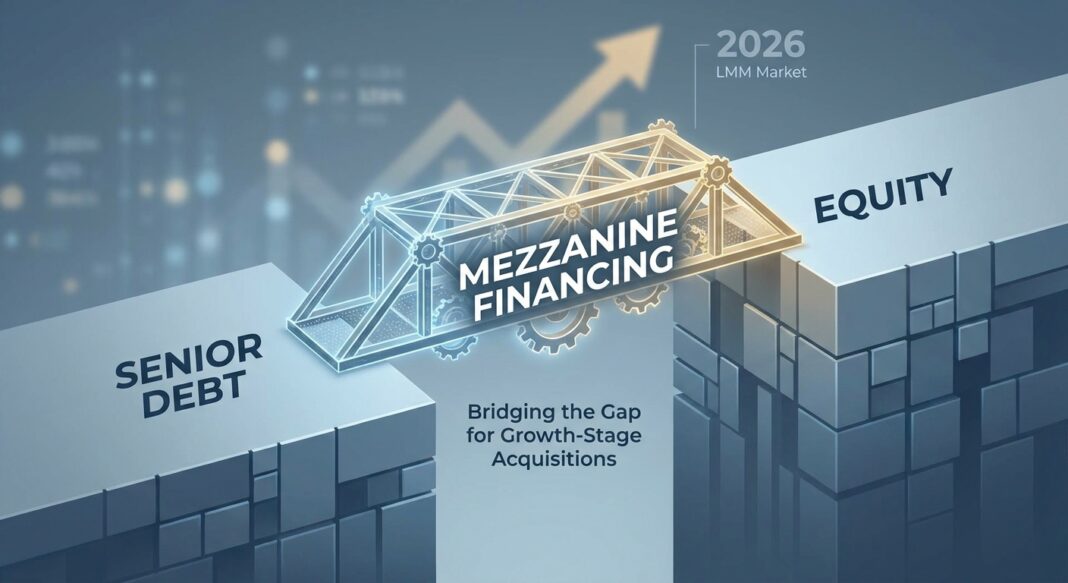
The Capital Gap That Kills Good Acquisitions
Picture this: a growth-stage operator running $6M of EBITDA has identified a bolt-on acquisition that would add $3M in EBITDA, expand geography, and clear a competitive moat. The enterprise value is $50M. The regional bank will lend $20M. The operator can inject $15M in equity. That leaves a $15M gap: too large for the bank, too expensive to fill with equity, and too structured for a venture lender.
This is the defining capital problem of the growth stage, and it is more common than most operators realize. Growth demands more risk financing and more capability than most mid-sized teams hold internally, roughly one in three mid-sized businesses report that available investment capital falls short of their needs. In M&A, that shortfall is structural: senior lenders have limits on how much risk they will accept, and PE sponsors have limits on how much equity they want to contribute. The instruments that fill this gap (with their hybrid features of debt-like priority and equity-like upside participation) create a more complete and flexible capital structure.
Mezzanine financing is that instrument. When used correctly, it is the mechanism that converts a deal that cannot close into one that does, without forcing the operator to surrender control or accept a value-destroying equity haircut. This article walks through exactly how to structure it, what it currently costs, and how to negotiate it in 2026’s lower middle market.
Mezzanine Structure Breakdown: Components, Mechanics, and a Live Example
The Three-Layer Anatomy of a Mezzanine Facility
Mezzanine debt has three defining structural features that distinguish it from senior debt: its subordinated and unsecured position, its option for Payment-in-Kind (PIK) interest, and its equity kicker, almost always in the form of stock warrants. Each component serves a distinct economic function:
- Cash Coupon: The current-pay interest component. A typical 2026 mezzanine debt financing rate for a healthy $5M to $15M EBITDA lower middle market company runs 11% to 14% cash coupon. This is the lender’s baseline yield for taking a subordinated position.
- PIK Interest: PIK stands for payment-in-kind. PIK interest accrues on the principal balance instead of being paid in cash, compounding over the life of the facility and increasing the effective cost of borrowing over time. PIK is not a borrower-friendly concession; it is a structural tool that preserves near-term cash flow while increasing the terminal debt burden. When borrowers elect PIK interest, the outstanding balance compounds, increasing total debt burden. If the anticipated liquidity event is delayed, the growing PIK balance creates a larger refinancing burden at bullet maturity.
- Equity Kicker (Warrants): An equity kicker is the ownership participation component of a mezzanine structure, typically warrants or conversion rights that allow the lender to participate in the company’s upside. This is what makes mezzanine dilutive despite being structured as debt. Warrant coverage in the 2026 lower middle market typically runs 1% to 5% of the fully diluted equity.
A Worked Example: $50M Acquisition, $6M EBITDA Platform
Consider a growth-stage operator acquiring a $50M enterprise value target. In the lower middle market, a typical $50M enterprise value platform in 2026 would be funded with roughly 40% senior debt, 10% mezzanine, 45% sponsor equity, and 5% seller rollover, per GF Data.
Mapping that to dollar amounts:
- Senior Debt: $20M at SOFR + 425–500 bps (≈ 9.0–9.5% all-in). Senior debt would typically cover 3.0x to 3.5x EBITDA; GF Data placed the middle market senior leverage average at 3.7x in Q1 2026.
- Mezzanine: $5M at 12% cash + 2% PIK + 3% warrant coverage. Term: 6 years, bullet maturity.
- Equity (Sponsor + Operator): $22.5M
- Seller Rollover: $2.5M (5%)
The mezzanine tranche in this example carries an all-in cost of approximately 16–18% when the warrant kicker is priced at exit. Mezzanine funds underwrite to a target IRR that assumes the equity piece hits at exit, typically 15% to 20% blended. The borrower gets the deal closed; the lender gets debt-like seniority over equity with upside participation if the company performs.
The maturity profile matters: mezzanine loans typically mature in 5 to 7 years, often aligning with expected exit timelines. Repayment is usually structured as a single bullet payment at maturity. This aligns the mezzanine instrument directly with the hold period of a PE-backed or founder-led growth strategy.
Mezzanine vs. the Alternatives: When Each Option Wins
Mezzanine vs. Unitranche
Unitranche debt represents a sophisticated hybrid loan structure that merges senior and subordinated debt into one consolidated credit facility. It eliminates the lender negotiation between a senior bank and a separate mezzanine fund, but it does so at a cost. Unitranche prices above a plain senior loan, approximately 450 to 650 bps over the floating benchmark versus 250 to 350 bps, precisely because it carries junior risk inside a first-lien wrapper.
Sponsors use unitranche when speed, confidentiality, and execution certainty matter more than shaving 50 to 100 basis points. The practical rule: if your acquisition is competitive and closing risk is high, unitranche wins on execution. If you have more process time and want to minimize blended cost of debt, a senior-plus-mezzanine stack often produces a lower all-in rate because the senior tranche prices tighter.
Mezzanine vs. Growth Equity
Debt is the cheapest capital, equity is the most flexible, mezzanine sits between the two, and structured alternatives like preferred equity split the difference on both dimensions. The central trade-off: mezzanine preserves ownership and control at the cost of fixed charges and warrant dilution; growth equity eliminates fixed charges at the cost of a permanent ownership stake and typically a board seat or governance rights.
For growth-stage operators who are confident in their 24-month cash flow visibility (recurring revenue, contracted customers, predictable margins) mezzanine is almost always the better instrument. The right mix depends on how much certainty you have about the next 24 months of cash flow. High certainty argues for more debt.
When Mezzanine Is the Wrong Tool
Avoid mezzanine when the target has declining margins, volatile cash flow, or where debt service would exceed 60–80% of EBITDA. Specific conditions that signal mezzanine is wrong: EBITDA growth historically below 5% organic, margin compression in the industry, customer concentration over 30%, and cyclical or seasonal cash flow. In these environments, mezzanine amplifies risk without adequate return; alternative strategies (a smaller deal, more equity, or a different financing structure) usually serve the buyer better.
The Covenant Lens: Private Credit vs. Syndicated Market
Structure choice also affects covenant exposure. The distinction between maintenance and incurrence covenants is one of the most significant structural differences between private credit and the broadly syndicated loan market. In the syndicated market, covenant-lite structures with only incurrence covenants have become dominant. According to LCD/PitchBook data, covenant-lite loans represent the vast majority of institutional leveraged loan issuance. In direct lending and private credit, maintenance covenants remain the standard. For middle market mezzanine specifically, maintenance covenants are a feature, not a bug: ABF Journal’s March 2026 analysis confirmed that restructurings initiated at the covenant-breach stage, before a payment default, produce materially higher recoveries than those triggered by missed payments.
Current Market Terms: What the 2026 Mezzanine Market Actually Looks Like
In 2026, capital structure is no longer a static decision. While interest rates have stabilized, they remain structurally higher than in the 2010s, and lending markets have become more segmented. For mid-market companies, the real source of value is no longer simply price, but structure: flexibility, headroom to transact, and alignment with business strategy. Against that backdrop, five data points define where mezzanine pricing and structure currently sit:
- Cash Coupon Range (LMM, 2H 2026): A typical 2026 mezzanine debt financing rate for a healthy $5M to $15M EBITDA company runs 11% to 14% cash coupon plus 1% to 4% PIK, with warrant coverage of roughly 1% to 5% of fully diluted equity.
- Pricing Trend: GF Data and Lincoln International both reported cash coupons drifting down from 2024 peaks as senior spreads compressed through the first half of 2026.
- Total Leverage Context: Senior leverage multiples on middle market deals averaged 3.7x in Q1 2026 per GF Data, with total leverage averaging 4.6x across the lower middle market. Mezzanine fills the tranche between senior and equity, approximately 3.5x to 4.5x total debt-to-EBITDA.
- All-In IRR Target: True mezzanine funds underwrite to a target IRR that assumes the equity piece hits at exit, targeting a blended 15% to 20% IRR. The cash coupon alone does not get them there, the warrant kicker is essential to the lender’s return model.
- Dry Powder Availability: North American private equity dry powder crossed $1.05 trillion in early 2026 according to Bain & Company, with roughly 32% earmarked for lower middle market platforms and add-ons under $250M enterprise value. Active mezzanine capital is a subset of that, but mezzanine issuance in the lower middle market has been resilient through the rate cycle, with providers actively deploying capital when senior lenders pull back.
On covenant design, the 2026 mezzanine market has largely retained maintenance structures for smaller deals: middle-market direct loans often still include at least one maintenance covenant, typically a leverage ratio, reflecting the tighter documentation in bilateral or club deals. The most common tests are a maximum total net leverage ratio (set at 4.5x–6.0x depending on growth profile) and a minimum fixed charge coverage ratio. The minimum interest coverage ratio, EBITDA divided by total interest expense, is usually set at 1.5x to 2.5x, ensuring the company generates enough operating income to service its debt.
The Gap Capital Playbook: From Quantifying the Need to Closing the Stack
Running a mezzanine raise is not the same as calling a bank. The process requires parallel-tracking debt and equity, preparing lender-specific materials, and managing timing so that term sheets arrive before the LOI deadline passes. Here is the practitioner sequence:
Step 1: Quantify the Gap with Precision
Before approaching any mezzanine provider, build a three-statement operating model with base, downside, and upside cases. Map the uses of proceeds explicitly: purchase price, transaction costs, working capital reserve, and any day-one integration capex. The gap is the residual after senior debt capacity and available equity. Most operators underestimate the gap by 15–20% because they forget transaction fees, funded OID, and closing adjustments.
Run a debt service coverage test at the downside case. Regional banks generally underwrite to a fixed charge coverage ratio (FCCR) of 1.25x to 1.35x on a trailing 12-month adjusted EBITDA basis, per RMA’s 2026 Middle Market Banking Survey. The mezzanine tranche stacks on top of that, so the combined debt service must still pass coverage at the downside scenario. If it does not, the deal is overleveraged and the structure needs more equity, not more debt.
Step 2: Prepare the Capital Package
A mezzanine lender’s diligence focuses on three things: free cash flow durability, management team depth, and exit path. Your confidential information memorandum (CIM) must address all three explicitly. Include: adjusted EBITDA bridge showing quality of earnings adjustments, customer concentration analysis, 5-year revenue model, and a pro-forma capital structure with all tranches mapped. Mezzanine providers are not passive lenders; they evaluate your historical and projected cash flow, growth potential, and ability to service both existing senior debt and the new mezzanine layer.
Step 3: Run the Process in Parallel
The acquisition funding process runs eight to twelve stages over 16 to 24 weeks. It begins with a target thesis and financial model, moves through advisor mandate, capital sourcing, term sheet negotiation, formal diligence, definitive documentation, closing conditions, and funding. A well-run process runs debt and equity tracks in parallel to preserve leverage, and it typically produces two or three competing capital packages by week 10.
The competitive dynamic matters for pricing. Rushed processes trade 50 to 150 basis points of pricing per Lincoln International’s Q1 2026 middle market monthly. That is not a rounding error: on a $10M mezzanine tranche, 100 bps represents $100,000 annually in additional cash interest, compounding over a 6-year bullet.
Step 4: Negotiate the Structure
The five most negotiable elements in a mezzanine term sheet, ranked by economic impact:
- Warrant Coverage Percentage: The equity kicker is where mezzanine lenders make their IRR. Start at 1%–2% of fully diluted equity and defend the floor. Every incremental 1% can be worth hundreds of thousands of dollars at a 7x–9x exit multiple.
- PIK Toggle vs. Mandatory PIK: A PIK toggle, where you elect PIK quarterly, is significantly better than mandatory PIK. The toggle preserves optionality; mandatory PIK locks you into compounding interest whether you need the cash flexibility or not.
- Prepayment Penalty Schedule: Standard mezzanine documents carry a make-whole or declining prepayment premium (e.g., 3–2–1% in years 1–3). Push for a shorter no-call window and a step-down to par by year 3 if the exit timeline is within 5 years.
- Covenant Headroom: Negotiate maintenance covenant levels set at a 25–35% cushion to the base case forecast, not the downside. Tight covenants that trip on a single quarter of underperformance force expensive amendments or waivers at the worst time.
- Information Rights and Board Observation: Some mezzanine providers request board observer rights alongside the equity kicker. This is negotiable, limit observation to major strategic decisions and exclude operational day-to-day reporting obligations.
Key Takeaways
- Mezzanine fills the structural gap between what senior lenders will provide (typically 3.0x–3.7x EBITDA) and what equity is willing to cover, enabling acquisitions that would otherwise be impossible to close at acceptable dilution levels.
- The all-in cost in 2026’s lower middle market runs 13–18%, comprising an 11–14% cash coupon, 1–4% PIK, and warrant coverage of 1–5% of fully diluted equity, with pricing trending modestly lower in H1 2026 as senior spreads compressed.
- PIK interest is not free cash flow relief: it compounds on the outstanding principal, inflating the bullet payment at maturity. Model the full terminal balance at the downside case before electing PIK for more than one year.
- Maintenance covenants in private credit mezzanine deals serve as early-warning mechanisms, not adversarial traps. Negotiate headroom at 25–35% above base case, and early covenant breach with lender dialogue produces far better outcomes than a payment default.
- Process quality drives pricing: running debt and equity tracks in parallel over a properly structured 16–24 week timeline produces two to three competing term sheets and can recover 50–150 bps of spread relative to a rushed, single-source process.


