
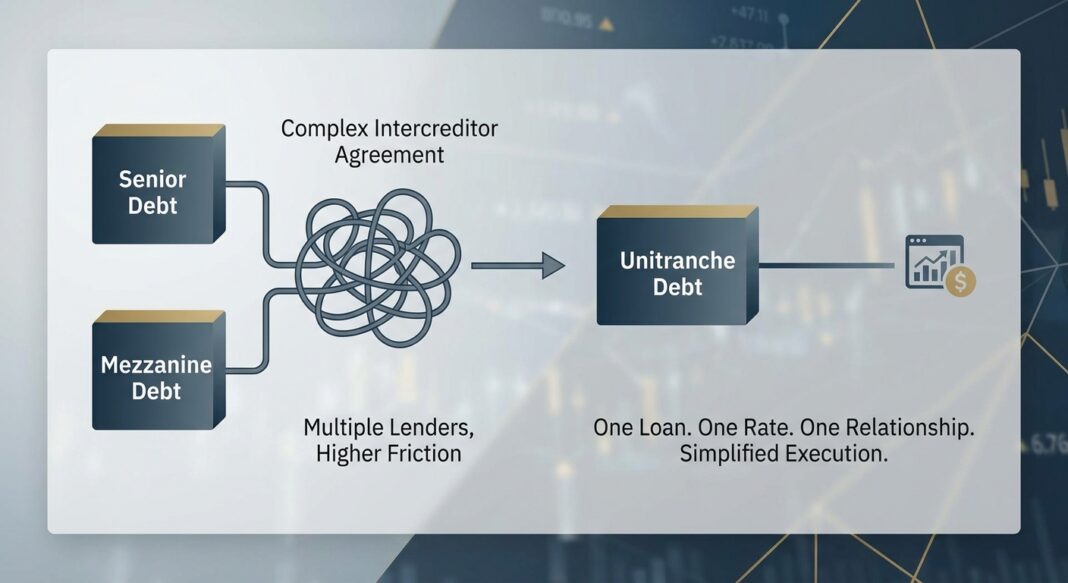
One Loan. One Rate. One Relationship.
For decades, a business owner seeking acquisition financing had to do something unpleasant: negotiate simultaneously with two adversarial creditor groups. A senior bank wanted low leverage, strict covenants, and quarterly reporting packages. A mezzanine lender wanted warrants, higher rates, and a separate set of default triggers. The intercreditor agreement between them could take months to finalize and cost hundreds of thousands in legal fees, before the deal even closed.
Then private credit lenders invented a workaround.
The unitranche loan collapsed that entire multi-party structure into a single instrument: one credit agreement, one lender (or a small club acting as one), one blended interest rate, and one post-close relationship to manage. For middle-market borrowers (companies with enterprise values typically between $25 million and $500 million) it changed the math on how deals get done. According to CT Acquisitions (June 2026), roughly 70–80% of lower-middle-market acquisitions now use at least partial unitranche funding. Understanding why requires understanding what it actually is, and how the economics work beneath the surface.
What Unitranche Debt Actually Is
Unitranche debt is a single-facility term loan that combines what would otherwise be a senior secured tranche and a subordinated or mezzanine tranche into one unified instrument. As Mayer Brown (July 2026) explains, rather than creating two distinct debt layers with separate credit agreements and intercreditor arrangements, unitranche achieves a form of internal subordination within a single credit facility.
From the borrower’s perspective, the simplicity is genuine: one credit agreement, one lien, one interest rate. But behind the scenes, lenders often divide the economics between themselves through a confidential document called an Agreement Among Lenders (AAL). As detailed in SEC fund filings from CPG Vintage Access Fund IV (FY2026 N-CSR), the AAL creates a “first-out” tranche (paid back first, bearing less risk) and a “last-out” tranche, which absorbs losses first and earns a higher return in compensation. Critically, the borrower typically has no visibility into the AAL’s specific terms; they see only a single facility.
The blended interest rate the borrower pays sits between what pure senior debt would cost and what subordinated debt would demand, making it more expensive than a bank revolver, but cheaper than layering in a mezzanine fund separately. As described by Stirling Capital Group (July 2026), the rate is “a blended figure that falls between the senior and subordinated components.”
The Numbers: A Concrete Example
Consider a private equity sponsor acquiring a software-enabled services business at a $50 million enterprise value, with $8 million in EBITDA. The deal is structured at 5.0x leverage, consistent with Private Capital Global’s (2025) observation that most transactions are now clearing around 5.0x EBITDA leverage.
Scenario A: Traditional Two-Tranche Structure
- Senior bank debt: 3.5x EBITDA = $28M at SOFR + 350 bps (~7.2% all-in)
- Mezzanine debt: 1.5x EBITDA = $12M at 12–13% cash + PIK
- Two lenders, two credit agreements, one intercreditor negotiation
- Timeline to close: typically 8–12 weeks
Scenario B: Unitranche Structure
- Single unitranche facility: 5.0x EBITDA = $40M at SOFR + ~500 bps
- All-in coupon in Q3 2026: approximately 9.0%–9.75%, per Valuation Research Corporation (July 2026)
- One lender, one credit agreement, no intercreditor
- Timeline to close: as fast as 2–3 weeks
The borrower pays a modestly higher blended rate than they would on senior-only debt, but avoids the mezzanine premium on the junior slice, and eliminates the legal friction of two separate negotiations entirely. On a $40 million facility, 25 basis points of pricing advantage over the traditional layered structure can translate to $100,000 in annual interest savings: before factoring in reduced legal and arrangement fees at close.
Current Market Conditions: What the Data Shows
Unitranche is not a niche product. CT Acquisitions (June 2026) reports that unitranche structures continue to dominate new issuance in the middle market. Here is what current pricing and market data indicate:
| Metric | Current Level | Source |
|---|---|---|
| Middle-market unitranche spreads (Q1 2026) | SOFR + 475–550 bps | VRC, July 2026 |
| New-issue private credit spreads (Aug 2026) | SOFR + 502 bps avg. | PitchBook LCD via Kadenwood, Sep 2026 |
| All-in unitranche yield range | ~9.00%–9.75% | VRC, July 2026 |
| Private credit premium over syndicated loans | ~162 bps | PitchBook LCD via Kadenwood, Sep 2026 |
| Typical LBO leverage (unitranche) | 4.0x–6.0x EBITDA | CT Acquisitions, June 2026 |
| Global private credit AUM | ~$1.7–$2.1 trillion | Preqin via CT Acquisitions, June 2026 |
Two structural dynamics are reshaping unitranche pricing in 2026. First, PitchBook LCD data via Kadenwood (September 2026) shows that in Q1 2026, only 25% of sponsor-backed direct lending deals priced between 500–549 basis points; by August, that figure had risen to 52%, meaning the middle of the market repriced upward in just a few months. Second, the Federal Reserve’s July 2026 SLOOS confirmed that C&I lending standards at banks held broadly unchanged in Q2, meaning the incremental tightening that occurred in Q1 2026 has not yet reversed, keeping borrowers who cannot access the syndicated markets firmly in private credit territory.
Meanwhile, ABF Journal (September 2026) notes an emerging structural evolution: insurers are now funding the senior “first-out” slice of large unitranche facilities at investment-grade risk-based capital treatment, while direct lenders retain the higher-spread “last-out” portion. This bifurcation reduces the blended cost of capital for the manager without changing the borrower’s economics.
Decision Framework
For Investors Evaluating Private Credit Funds:
- Understand where in the AAL your fund sits. A fund holding predominantly last-out positions earns a higher spread but absorbs first-dollar losses in a default. Investors should ask managers to disclose what percentage of their book is first-out versus last-out within unitranche structures.
- Track the private-credit-to-syndicated-loan premium. At 162 basis points as of August 2026, per PitchBook LCD, investors are being compensated for illiquidity and complexity, but this premium has narrowed materially from historical levels. Tighter spreads mean less cushion against defaults.
- Scrutinize covenant quality alongside yield. Per Lord Abbett (June 2026), new unitranche loans are increasingly carrying improved credit structures alongside wider spreads, but investors should verify this deal by deal, not assume it category-wide.
For Operators and Business Owners Considering Unitranche:
- Evaluate speed vs. cost. Unitranche closes in two to three weeks versus four to six weeks for a syndicated deal. In competitive M&A processes, that execution certainty can be more valuable than 50 basis points of cheaper bank pricing.
- Understand the OID and call protection. A standard 2026 unitranche carries 1–2% original issue discount and a 102/101/par prepayment schedule. On a $40M facility, 2% OID means receiving $39.2M while owing $40M from day one. Model this into true cost-of-capital calculations.
- Know when unitranche stops making sense. For businesses above $300M enterprise value, the broadly syndicated leveraged loan market typically offers lower all-in rates. Unitranche’s speed and simplicity advantages narrow materially above that threshold.
Key Takeaways
- Unitranche collapses the capital stack: It eliminates the senior-mezzanine split and the intercreditor agreement, replacing multi-party negotiations with a single credit relationship, simplifying execution without eliminating the underlying risk stratification.
- The AAL is the hidden architecture: Lenders internally divide economics between first-out (lower risk, lower return) and last-out (higher risk, higher return) positions. Borrowers pay a blended rate and typically have no visibility into this split.
- Pricing is moving wider in 2026: New-issue private credit spreads averaged 502 bps over SOFR through August 2026, up from 475 bps in Q1, a meaningful repricing in a short period, per PitchBook LCD data.
- Bank standards remain a tailwind: With C&I lending standards at banks holding firm or tightening, middle-market borrowers who cannot access syndicated markets continue to rely on unitranche as their primary financing option.
- Structural evolution is accelerating: Insurance capital entering the first-out sleeve of large unitranche facilities signals a maturing market, and a more complex one. Investors and operators alike benefit from understanding the full architecture, not just the headline rate.


