
Why Borrowers Are Choosing One Lender Over Many
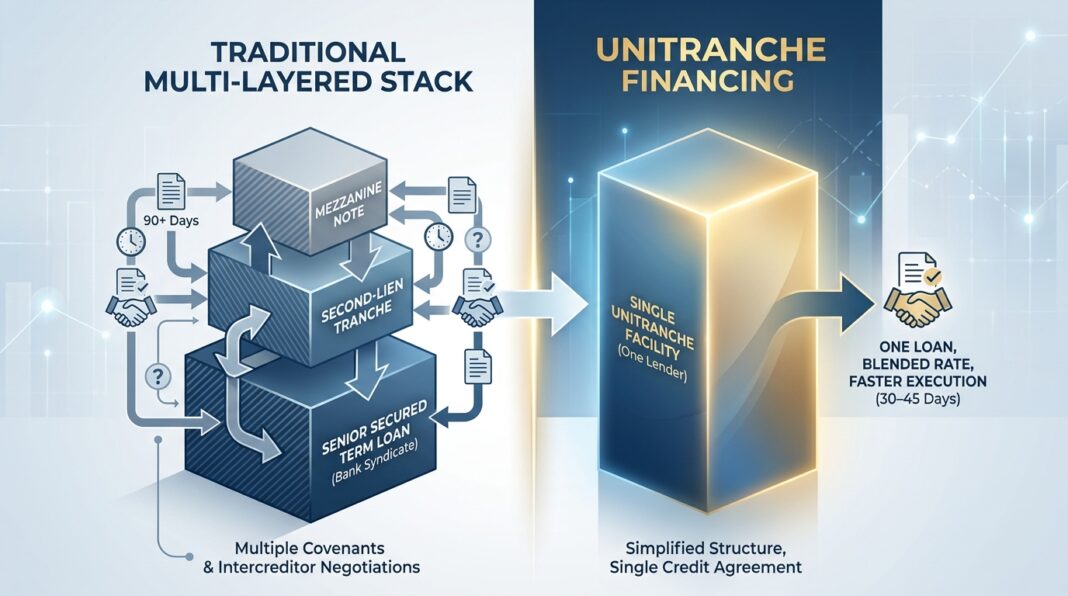
In traditional leveraged buyout financing, a borrower assembles layers: a senior secured term loan from a bank syndicate, a second-lien tranche from another group of lenders, and perhaps a mezzanine note from a third party. Each layer has its own credit agreement, its own set of covenants, its own intercreditor negotiation, and its own timeline. For a middle-market acquisition trying to close in 45 days, that complexity can kill a deal.
Enter the unitranche loan: arguably the most important structural innovation in private credit over the past decade. A single lender (or a small club of lenders) provides one consolidated facility that economically combines senior and subordinated debt into a unified instrument with a single blended interest rate. The result: faster execution, fewer counterparties, and one set of documents. For private equity sponsors and growth-oriented businesses alike, unitranche has become the default financing structure in the lower and middle market.
Understanding how unitranche works (including its pricing mechanics, its structural trade-offs, and where it sits today in a market of $1.7 trillion in private credit AUM) is essential for any investor evaluating direct lending or any operator considering a leveraged recapitalization.
The Mechanism: Blending Senior and Subordinated Risk Into One Rate
Unitranche financing combines senior and mezzanine (or subordinated) debt into a single instrument, eliminating the need for separate tranches with distinct priority claims. Rather than having a senior lender at 6x EBITDA and a mezzanine lender layered on top at 7–8x, a unitranche lender steps in and provides the full 5–6x EBITDA in one facility.
The interest rate on a unitranche loan is a blended rate: one that reflects a weighted average of what the senior and subordinated components would have priced at independently. Because the lender is technically absorbing risk across the full leverage stack, the all-in rate sits above a pure senior secured loan but below what a borrower would pay if they stacked a senior loan and a mezzanine note separately.
Behind the scenes, in deals involving multiple unitranche lenders, an Agreement Among Lenders (AAL) privately allocates the economics and payment priority between a “first-out” portion (senior-like) and a “last-out” portion (subordinated-like). Critically, from the borrower’s perspective, there is still just one credit agreement, one agent, and one relationship to manage. This approach is particularly attractive when swift execution is paramount, as it involves a single covenant package and credit agreement.
How It Works: A Concrete Example
Consider a private equity firm acquiring a software business at a $50 million enterprise value, financing with 5x EBITDA leverage on $8 million of EBITDA, a $40 million debt package.
Traditional Two-Tranche Structure:
- Senior Secured Term Loan (3.5x EBITDA / $28M): SOFR + 375 bps = ~7.4% all-in
- Mezzanine Note (1.5x EBITDA / $12M): 13–14% (often with PIK toggle)
- Blended effective cost: ~9.6% | Two credit agreements | Two sets of covenants | 90+ day process
Unitranche Alternative (5x EBITDA / $40M):
- Single Facility: SOFR + 525 bps = ~9.0–9.5% all-in
- Original Issue Discount (OID): 1.0–2.0% upfront (adds ~25–35 bps annualized yield to lender)
- One credit agreement | One covenant package | 30–45 day close
The borrower pays a modestly higher headline rate than a pure senior loan, but avoids the expensive mezzanine layer, eliminates intercreditor complexity, and gets certainty of execution. The effective economic difference is often 25–50 basis points in all-in cost: a price many sponsors willingly pay for deal certainty and speed. For the lender, the blended rate compensates for holding risk across the full leverage range within one facility.
Current Market Reality: Pricing, Volume, and Competition in 2026
Unitranche is not just a theoretical structure; it currently dominates new issuance in the U.S. middle market. Here is where the data stands heading into Q4 2026:
| Metric | Data Point | Source |
|---|---|---|
| New-issue unitranche spreads (Aug 2026) | Avg. 502 bps over SOFR | PitchBook LCD via Kadenwood, Sep 2026 |
| Unitranche all-in yield range (Q2 2026) | ~9.00%–9.75% | Valuation Research Corp., Jul 2026 |
| Premium over syndicated loans (Aug 2026) | ~162 bps | PitchBook LCD via Kadenwood, Sep 2026 |
| CDLI 2025 calendar-year return | 9.3% (20-yr avg: 9.5%) | Cliffwater CDLI, Mar 2026 |
| Private credit AUM (start of 2026) | ~$1.7 trillion globally | Preqin via CT Acquisitions, Jul 2026 |
| Bank C&I lending standards (Q2 2026) | Unchanged, easing from Q1 tightening | Federal Reserve SLOOS, Aug 2026 |
A critical trend: PitchBook LCD data show new-issue private credit spreads averaging 502 basis points in the three months to August 31, 2026, up from 475 basis points in Q1. Notably, the share of sponsor-backed direct lending deals priced between 500 and 549 bps jumped from 25% in Q1 to 52% by August, signaling a broad repricing of the market’s middle tier, not just isolated outliers.
Meanwhile, the July 2026 Federal Reserve SLOOS reported basically unchanged C&I lending standards for businesses of all sizes in Q2, with stronger demand from large and middle-market firms, a backdrop that continues to direct sponsor-backed borrowers toward private credit’s certainty of execution rather than syndicated bank markets. According to Lord Abbett’s 2026 midyear outlook, spreads have widened roughly 50–100 basis points since late 2025, while loan documentation and covenant quality have also improved, a combination that creates a more lender-friendly environment for new capital.
Decision Framework: Investors and Operators
For Investors Evaluating Unitranche Direct Lending
Unitranche positions investors across the full leverage range of a borrower’s capital structure, which means the yield compensates for subordinated-tranche risk exposure even when that risk is not always visible in a first-lien label. Institutional investors may consider:
- Yield-to-risk alignment: At 9.0%–9.75% all-in (per VRC Q2 2026), does the spread adequately compensate for blended first-out/last-out risk exposure?
- Manager scale and sourcing: The ten largest private credit managers now control over 65% of global AUM. Smaller managers may offer differentiated deal flow but face capital-raising headwinds.
- Historical benchmark context: The Cliffwater CDLI has delivered a 20-year average annual return of approximately 9.5%, with interest income, not capital appreciation, as the primary driver. That income-first return profile distinguishes private credit from equity-like alternatives.
- Default and recovery realism: PitchBook LCD data show trailing-12-month private credit default rates near 3.7% in Q1 2026, up from 1.1% in Q1 2022. First-lien recoveries have averaged approximately 68 cents on the dollar in recent default cohorts.
For Operators Evaluating Unitranche Financing
Business owners and operators weighing a leveraged recapitalization, acquisition financing, or growth capital raise may find unitranche compelling when:
- Speed matters: A 30–45 day close timeline versus 90+ days for a syndicated deal can determine whether an acquisition closes at all.
- Certainty of terms is critical: Unitranche lenders commit to full terms at signing. Syndicated markets can reprice or flex terms during the marketing period.
- Amendment flexibility is needed: With one lender (or a small club), covenant amendments and waivers require far fewer parties. This is especially valuable for businesses with cyclical revenue patterns.
- All-in cost is competitive: At SOFR + 500–700 bps for lower-middle-market transactions (per CT Acquisitions, Jun 2026), the blended cost of a unitranche often undercuts a senior-plus-mezzanine stack on a total-interest basis once mezzanine PIK accrual is modeled.
Key Takeaways
- One loan, full stack: Unitranche replaces senior and subordinated tranches with a single blended-rate facility, reducing complexity and accelerating execution, typically to 30–45 days from signing.
- Pricing reflects blended risk: At ~9.0%–9.75% all-in as of Q2 2026, unitranche yields sit above pure senior debt but below a stacked senior-plus-mezzanine total cost, making the structure economically rational for both sides.
- Spreads are repricing wider in 2026: PitchBook LCD data show new-issue spreads rising from 475 to 502 bps by August 2026, with over half of new sponsor deals now priced in the 500–549 bps band, a meaningful shift from Q1.
- Bank competition is stabilizing, not collapsing: The July 2026 SLOOS shows C&I lending standards unchanged in Q2, meaning unitranche does not win solely on bank retreat; it wins on speed, certainty, and structural flexibility.
- The CDLI benchmark provides historical context: Twenty years of Cliffwater CDLI data averaging 9.5% annual returns, driven primarily by interest income, offer investors a long-run frame for evaluating whether today’s unitranche yields are adequate compensation for credit risk.


