
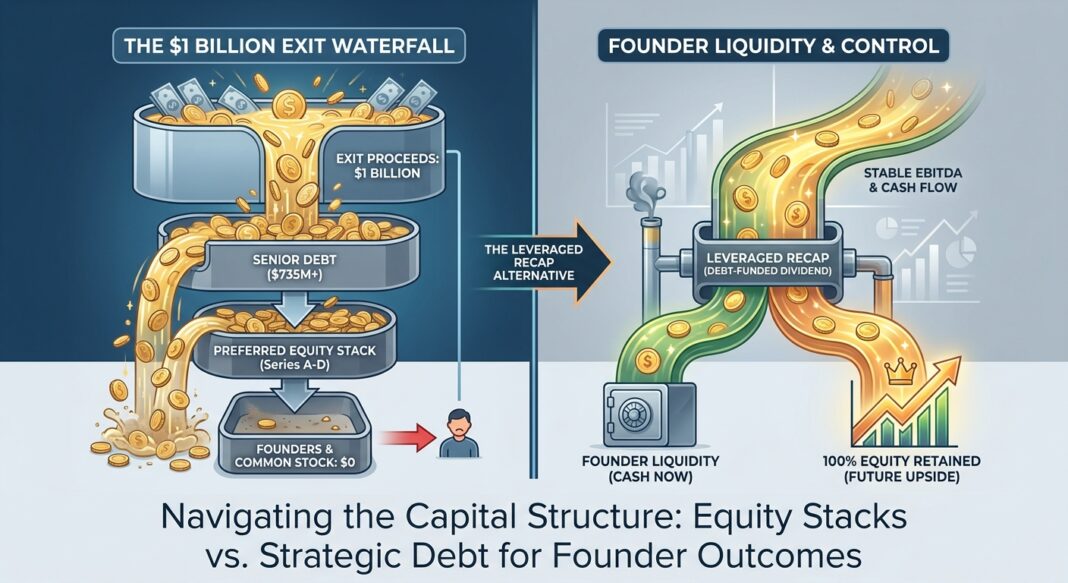
The Story: A Billion-Dollar Exit, A Zero-Dollar Payout
In January 2025, the headlines looked triumphant. Divvy Homes, a San Francisco-based rent-to-own proptech startup, was selling to Brookfield Properties for approximately $1 billion. For a company born in 2016 with a mission to help renters become homeowners, it read like a success story.
It wasn’t.
Within days of the announcement, a letter from CEO and co-founder Adena Hefets to shareholders told a starkly different story. Common shareholders and holders of Series FF preferred stock, the class typically awarded to founders, would receive no consideration from the sale whatsoever. Neither would most employees. Neither, reportedly, would many of the venture capital investors who had poured hundreds of millions into the company at peak valuations.
The deal that looked like a billion-dollar win was, for the people who built the company, a total loss.
How does a company sell for $1 billion and leave its founders with nothing? The answer lies in three interlocking forces that every operator, family business owner, and growth-stage founder needs to understand before they sign their next term sheet: the preference stack, the debt waterfall, and the brutal mathematics of VC-structured equity.
And the contrast, the path not taken, sits in a capital structure called the leveraged recapitalization: a tool that, when used correctly, lets owners extract real liquidity from their business without ever surrendering control to a venture firm, and without betting their entire outcome on a single exit event.
The Decision: $700 Million In, and the Waterfall That Waited
Divvy’s rise was genuinely remarkable. Founded in 2016, it raised more than $700 million in combined debt and equity from marquee investors including Tiger Global, GGV Capital, and Andreessen Horowitz. Its Series D alone, a $200 million round announced in August 2021, valued the company at $2.3 billion, announced just six months after a $110 million Series C.
Then, critically, Divvy layered in a $735 million debt financing in October 2021: secured against its portfolio of roughly 7,000 homes, to fund the capital-intensive business of buying residential real estate at scale. That debt sat senior to every dollar of equity ever invested.
The capital structure Divvy chose was a function of its model: it needed to own homes to operate. The problem wasn’t the debt alone; it was the combination of senior secured real-estate debt and a tower of preferred equity liquidation preferences stacked round after round, from Series A through Series D, each investor negotiating priority over the next in any exit scenario.
When interest rates surged in 2022, the model broke. Three rounds of layoffs followed. New home acquisitions were paused entirely by 2023. The $1 billion Brookfield acquisition looked like a rescue. From the inside, the math was unsparing: the debt repaid first, transaction costs absorbed next, then the liquidation preferences of preferred shareholders, layer by layer, until there was nothing left for founders or common stockholders.
As Hefets wrote to stakeholders, “this was not the ending I had hoped for.” It was a $1 billion exit, and it delivered zero to the people who created it.
The Outcome: What the Numbers Actually Say
The mathematics of the Divvy outcome are not complicated; they are just final. By the time the deal closed, the waterfall order left nothing for those at the bottom:
- $735M+ in senior debt: repaid first, unconditionally
- Transaction costs: legal, advisory, and structuring fees absorbed next
- Preferred equity liquidation preferences: Series A through D investors collected their contracted minimums
- Common shareholders, founders, and employees: received $0
The company had a peak valuation of $2.3 billion in 2021. It sold for $1 billion in 2025, less than half, into a market its own debt structure had made it impossible to navigate.
Now consider the counterfactual. A founder-owned business generating stable EBITDA (one that never raised a VC dollar, never stacked a preference tower) could have used a leveraged recapitalization to create founder liquidity years earlier, on their own terms, without surrendering a single point of control.
According to the Pepperdine Private Capital Markets Report, lower middle market leveraged recapitalizations typically close at 3x to 5x EBITDA in total debt, with pricing tied to prevailing senior secured rates. A business generating $5 million in EBITDA could raise $15–$25 million in debt, distribute it to the owner as a special dividend, and retain 100% of their equity. The owner takes real cash off the table. The business continues operating. No preference stack. No VC board seats. No forced exit timeline.
That structure produces what the Divvy waterfall destroyed: optionality. The owner gets liquidity and keeps the upside of a future sale at full value, not the residual after six rounds of preference.
The Lessons: Principles for Operators Who Want to Win the Waterfall
1. Equity Stacking Is a Tax on Your Own Exit
Every VC round that adds a new tier of liquidation preference is a structural claim on your future exit proceeds. The Divvy outcome was not a surprise to anyone who read the cap table; it was arithmetic. Founders who raise five rounds of preferred equity at escalating liquidation preferences are, in effect, pre-spending their exit to investors who will always stand ahead of them in line.
2. Debt Has a Senior Claim, but It Has No Preference Stack
The counterintuitive insight of the leveraged recap is this: used strategically on a profitable business, debt actually preserves more of the founder’s equity value than selling equity does. When a leveraged recap distributes $20 million to an owner, there is no preferred investor claiming a 2x multiple on that cash. The debt is repaid from cash flow, and the remaining equity, 100% owned by the founder, accretes value freely.
The key distinction: debt taken on by a business with stable, predictable free cash flow is fundamentally different from debt layered onto a growth-stage startup burning cash to acquire assets in an interest-rate-sensitive model.
3. The Recap Window Is Open, But It’s Tightening
Market data supports urgency for operators who qualify. Leveraged loan issuance tied to sponsored dividend recapitalizations grew to $74.3 billion in 2025, according to PitchBook data, and recapitalization activity more than doubled in Q4 2025 relative to earlier quarters. However, with wider spreads and heightened lender caution entering 2026, these transactions are becoming more selective and more expensive to execute. The window is not closed, but the terms available in 2024 and early 2025 were materially more favorable than what operators face today.
4. Free Cash Flow Stability Is the Only Real Qualifier
A leveraged recap works when the business generates consistent, predictable free cash flow sufficient to service the new debt. It fails when the model is capital-intensive, rate-sensitive, or reliant on continued equity infusions to operate. The decision to recap hinges on three variables: free cash flow stability, lender appetite for the sector, and the owner’s tolerance for covenant-heavy debt on the balance sheet. Divvy checked none of these boxes at the point of maximum leverage, which is exactly when its structure became fatal.
5. Liquidity and Control Are Not Mutually Exclusive
The most persistent myth in founder finance is the binary choice between “take VC money and grow” versus “stay small and stay in control.” The leveraged recap dissolves that false binary. Operators with real EBITDA can take meaningful personal liquidity, millions of dollars, through a debt-funded dividend, retain full control of their business, and position themselves for a full exit at a later date without a preference stack eroding the proceeds. They get the cash now. They keep the company. They keep the upside.
Key Insights
- The billion-dollar exit that pays founders zero is not a paradox; it is preference stack math. Divvy’s outcome was structurally determined long before the Brookfield deal closed. Every preferred round added a layer of claims that stood ahead of the founder in the waterfall.
- A leveraged recapitalization gives profitable founders liquidity without joining a preference stack. Debt taken against EBITDA distributes cash directly to the owner. There are no new equity investors ahead of them at the next exit.
- The recap market is real and active, but selective. Over $74 billion in leveraged loan issuance was tied to dividend recapitalizations in 2025. Operators with stable cash flows and clean balance sheets remain credible candidates, though 2026 conditions are tightening.
- Debt and equity carry different structural risks depending on the business model. Capital-intensive, rate-sensitive models that require ongoing debt to acquire assets are fundamentally different from cash-generative operating businesses using a one-time recap to return capital. The instrument is the same; the outcome is not.
- The right time to take liquidity is before you need it. Founders who wait for the exit to crystallize their personal wealth are at the mercy of markets, interest rates, buyer appetite, and the preference claims of investors who moved faster. The leveraged recap puts the timing decision back in the operator’s hands, where it belongs.
Framework: Is a Leveraged Recap Right for Your Business?
| Factor | Supports a Recap | Disqualifies a Recap |
|---|---|---|
| EBITDA Stability | Consistent, growing over 3+ years | Volatile, cyclical, or declining |
| Business Model | Cash-generative, asset-light or predictable capex | Capital-intensive, rate-sensitive, equity-dependent |
| Owner Goal | Partial liquidity, estate planning, partner buyout | Full exit in near term, sell the whole company |
| Leverage Tolerance | Comfortable operating under 3x–5x debt/EBITDA covenants | Needs operational flexibility without debt restrictions |
| Market Timing | Credit markets open, spreads reasonable | Spreads wide, lender appetite selective, macro uncertainty high |


