
The Growth-Stage Financing Problem: Too Big for the Bank, Too Early for Equity
You run a $12M EBITDA business-services company. Your senior bank will lend 3.0x-$36M, against your cash flows. You need $60M to close a bolt-on acquisition that doubles your addressable market. The $24M gap is real, it is immediate, and it is the defining capital challenge of the growth stage.
The instinct is to close that gap with equity. But a growth equity minority round at a pre-inflection valuation means surrendering 25–40% of a business whose value is about to compound. The math is punishing when the acquisition closes and the multiple expands: you will have sold your cheapest equity at your worst moment.
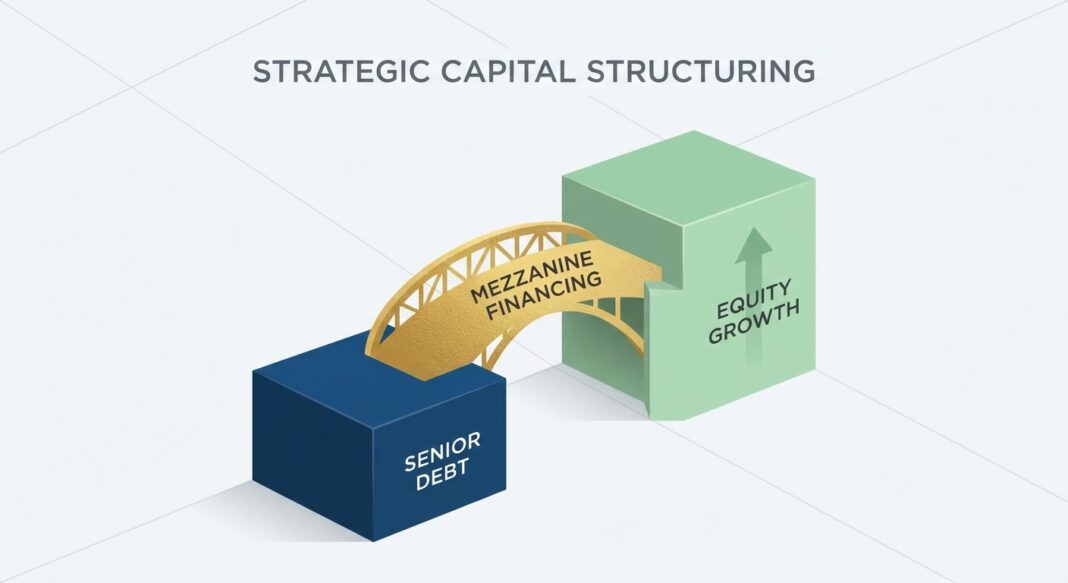
Mezzanine financing exists precisely for this scenario. Positioned between senior debt and common equity in the capital stack, it provides the subordinated tranche that fills the funding gap while preserving ownership control through a critical growth catalyst. Understanding how to structure it, price it, and negotiate it is one of the most important skills a growth-stage operator or capital advisor can develop, especially in the 2026 environment, where mezzanine funds are actively deploying and pricing has come off its 2024 peaks.
Structure Breakdown: The Three Layers of a Mezzanine Facility
A mezzanine facility is not a single instrument; it is a bundle of three economically distinct components that, together, create a blended return for the lender and a manageable cost of capital for the borrower.
1. Cash Interest (Current Pay)
The base coupon paid in cash, typically quarterly. This component services the lender’s income need and forms the floor of the facility’s economics. In current market conditions, this is the largest piece of the pricing stack.
2. PIK Interest (Payment-in-Kind)
Rather than a cash outflow, PIK interest accrues as additional principal on the outstanding balance. This is structurally important for growth-stage businesses: it conserves operating cash flow during the period when the acquisition is being integrated or the expansion is ramping. The compounding nature of PIK, however, increases the refinancing burden at bullet maturity, a risk that must be modeled explicitly.
3. Equity Kicker (Warrants)
The equity participation component gives the mezzanine lender the right to purchase a small percentage of the borrower’s fully diluted equity at a fixed price, typically at a nominal or at-money strike. This is what allows lenders to accept subordinated, unsecured risk at a below-equity return: the warrant converts financing-risk into upside participation. It is also what makes mezzanine dilutive, despite being structured as debt.
Illustrative Example: A $60M Acquisition for a $12M EBITDA Business Services Company
Consider a $12M EBITDA business-services platform pursuing a $60M bolt-on acquisition (5.0x purchase multiple). The senior bank lends 3.0x EBITDA, $36M, leaving a $24M gap. The capital stack might be structured as follows:
- Senior Secured (Bank): $36M at SOFR + 275 bps (~7.5% all-in). Maximum leverage: 3.0x EBITDA. First-lien security on all assets. Quarterly maintenance covenant: maximum leverage at 4.5x.
- Mezzanine Tranche: $18M at 12% cash coupon + 2% PIK + 3% warrant coverage on fully diluted equity. Subordinated, unsecured. Bullet maturity at year 5. No amortization. Governed by an intercreditor agreement with the senior lender.
- Equity (Sponsor/Management Roll): $6M equity contribution (~10% of total capitalization).
Total leverage: 4.5x EBITDA. Total acquisition cost: $60M. Founder retains majority control. The mezzanine lender earns a blended 15–18% IRR target, cash coupon plus PIK compounding plus warrant participation at exit.
This structure is directionally consistent with the 2026 lower-middle-market standard observed by practitioners: a 3.0x senior tranche paired with a 1.0x–1.5x mezzanine layer, leaving the operator with majority ownership and operational control.
The Cost of Capital Spectrum: Mapping Your Options
Before committing to a mezzanine structure, operators must map the full cost-of-capital spectrum against their specific use-of-proceeds and risk tolerance. Each layer of the stack has a different cost, a different access threshold, and a different set of lender expectations.
| Layer | Typical 2026 All-In Cost | Leverage Capacity | Access Threshold |
|---|---|---|---|
| Senior Bank Debt | 7.0–8.5% | 2.5x–3.5x EBITDA | Established cash flows, hard assets or receivables |
| Unitranche (Direct Lending) | 9.0–11.0% | 4.0x–5.5x EBITDA | $5M+ EBITDA; sponsor or strong management team |
| Mezzanine Debt | 13–18% (cash + PIK + warrants) | 1.0x–2.0x EBITDA incremental | $3M+ EBITDA; clear liquidity event or refinancing path |
| Preferred Equity | 14–20% | N/A (equity instrument) | Below-debt businesses; flexible repayment preferred |
| Growth Equity (Minority) | 20–30% IRR hurdle for investor | N/A | High-growth trajectory; founder willing to cede governance rights |
The key structural insight: mezzanine wins when the deal’s unlevered return exceeds the blended cost of the debt stack, but the company cannot access sufficient leverage through senior debt alone. It loses when the borrower’s cash flows are too cyclical to service the fixed cash coupon or when the warrant coverage materially dilutes a high-confidence exit.
The primary competing structure is the unitranche, which combines senior and subordinated risk into a single instrument at a blended rate. Unitranche is optimal when speed and simplicity matter most (a competitive auction, a roll-up platform with frequent add-ons) but it prices above a bifurcated senior-plus-mezzanine stack on a total cost basis for larger transactions where the senior layer can be optimized separately.
Current Market Terms: What the 2026 Mezzanine Market Is Actually Pricing
The mezzanine market has evolved materially since the rate peak of 2024. Practitioners should anchor their expectations to the following market benchmarks, sourced from active participants and market data aggregators.
- Cash coupon range (LMM, $5M–$15M EBITDA): 11–14% current-pay, down from the 14–16% peak seen in late 2024 as senior spreads compressed through the first half of 2026.
- PIK component: 1–4% accruing, with smaller or more cyclical borrowers carrying the higher end of the PIK range.
- Warrant coverage: 1–5% of fully diluted equity is the standard range for lower-middle-market transactions, with the percentage inversely correlated to credit quality and EBITDA scale.
- Blended all-in cost: 15–18% IRR target for the mezzanine fund, inclusive of the equity kicker’s modeled value at exit.
- Tranche sizing: Typical LMM mezzanine checks run $5M–$75M, with SBIC-licensed funds handling smaller checks down to $2M.
- Covenant structure: Mezzanine facilities typically sit within an intercreditor framework where the senior lender holds a first-lien security interest and the mezzanine lender holds subordinated, unsecured claims with specific cure rights on senior default events.
On covenants specifically: the 2026 private credit market has maintained a clear bifurcation between direct lending (which retains quarterly financial maintenance covenants, the primary early-warning mechanism for lenders) and the broadly syndicated market, where covenant-lite incurrence-only packages dominate. For mezzanine borrowers, this matters because the intercreditor agreement will govern which lender can trigger remedies first, and how cure periods interact between the two layers. Borrowers negotiating a mezzanine add-on over an existing bank line must pay particular attention to the intercreditor terms, not just the mezzanine credit agreement itself.
The Gap Capital Playbook: Quantifying, Preparing, and Running the Process
The single biggest mistake growth-stage operators make is approaching mezzanine lenders without having quantified the gap precisely. Mezzanine is not a fallback; it is a structured product with specific return requirements, and lenders will immediately test whether the borrower has done the capital architecture work or is simply calling everyone they know.
Step 1: Quantify the Gap with Precision
Start with the total capital requirement for the use-of-proceeds (acquisition cost, transaction fees, integration capital, plus a liquidity buffer). Then model the senior debt capacity at multiple lender assumptions (bank at 3.0x, unitranche at 5.0x) and identify the gap that remains. Quantify the equity check you are willing to write. The mezzanine quantum is the residual. If the residual is below $5M, you are likely in SBIC territory. If it is above $50M, you are approaching the upper LMM or considering a club of mezzanine providers.
Step 2: Prepare the Mezzanine-Specific Information Package
Mezzanine lenders underwrite differently from senior lenders. They are modeling a blended IRR that depends on both the debt repayment and the equity kicker value at exit. Your information package must include: (a) 24 months of historical financials with trailing EBITDA clearly defined and add-backs documented; (b) a fully integrated acquisition model showing combined entity leverage, free cash flow coverage, and projected de-leveraging cadence; (c) a clear exit narrative (whether IPO, strategic sale, or private equity sponsor entry) with a modeled exit multiple range; and (d) a capitalization table showing current ownership, proposed structure post-close, and the warrant dilution pool the mezzanine lender will participate in.
Step 3: Run a Focused Process
Target 8–12 mezzanine funds simultaneously. The LMM mezzanine market has active participants including institutional funds targeting $50M+ sponsor relationships, middle-market funds that flex on smaller sponsor profiles, and SBIC-licensed vehicles for smaller checks. Match the fund profile to your EBITDA scale and sector. A focused process with 8 targeted lenders produces better economics and tighter timing than a broad blast to 30 names.
Step 4: Manage the Intercreditor Negotiation in Parallel
The mezzanine term sheet is only half the documentation work. The intercreditor agreement between your senior lender and the mezzanine fund must be negotiated simultaneously. Key intercreditor terms include: the standstill period (how long the mezzanine lender must wait before exercising remedies after a senior default), cure rights (the mezzanine lender’s ability to cure a senior default to prevent foreclosure), and the payment waterfall on a sale or liquidation. Delay on the intercreditor is the most common source of broken timelines in mezzanine transactions.
Negotiation Guidance: The Five Points That Determine Your True Cost of Capital
Mezzanine term sheets are negotiable across several dimensions that materially affect the all-in cost. Here are the five points operators should prioritize:
- Warrant Coverage Percentage: The equity kicker is the most economically significant component if the business performs. Push to minimize warrant coverage by demonstrating credit quality and offering a higher cash coupon in exchange for reduced dilution. For most operators, a 2–3% warrant package is preferable to a 5% package with a lower coupon.
- PIK Toggle vs. Mandatory PIK: Negotiate for an optional PIK toggle, the right to elect PIK in low-cash-flow periods, rather than mandatory PIK that accrues regardless of your liquidity position. Performance-based triggers that permit PIK elections only when leverage exceeds a threshold or liquidity falls below a floor are structurally cleaner and less likely to compound against you.
- Call Protection Structure: Mezzanine facilities typically carry 2–3 year call protection (a make-whole or declining prepayment premium). Negotiate the tightest possible call structure (ideally a 2/1/0 schedule (2% in year one, 1% in year two, par thereafter)) to preserve refinancing optionality if senior spreads continue to tighten or if you achieve an accelerated exit.
- PIK-to-Warrant Interaction at Prepayment: If you prepay the facility early, ensure the credit agreement explicitly defines whether call protection applies to the accumulated PIK balance and how warrant value is treated in the premium calculation. Ambiguity on this point is a documented source of post-closing disputes, particularly when the company outperforms the original underwriting.
- Covenant Headroom: Unlike the broadly syndicated market, mezzanine facilities in the private credit space typically carry financial maintenance covenants tested quarterly. Negotiate adequate headroom, at least 20–25% cushion to the leverage covenant test, to absorb integration volatility without triggering a technical default that accelerates amendment fees and lender intervention rights.
Key Takeaways
- Mezzanine fills the structural gap between what senior debt can reach (2.5x–3.5x EBITDA at a bank) and what equity dilution should cost; it is the optimal instrument for growth-stage acquisitions when the unlevered return on the transaction exceeds the blended cost of the debt stack.
- The three-component pricing model: cash coupon (11–14%), PIK (1–4%), and warrant coverage (1–5% of fully diluted equity): produces a blended 15–18% IRR target for the mezzanine fund; operators must model all three components, not just the stated cash coupon, to understand true cost.
- PIK is a cash flow tool, not free money: it conserves liquidity during integration but compounds the principal balance and increases refinancing risk at bullet maturity; PIK elections should be performance-triggered and negotiated as optional, not mandatory.
- The intercreditor agreement governs the deal in stress: the standstill period, cure rights, and payment waterfall between the senior lender and the mezzanine fund are as important as the mezzanine credit agreement itself; negotiate both simultaneously or accept timing risk at close.
- The 2026 market favors disciplined borrowers: cash coupons have drifted down from 2024 peaks as senior spreads compress, and mezzanine funds are actively deploying capital in the $5M–$75M EBITDA range; a focused, well-prepared process with 8–12 targeted lenders produces materially better terms than a reactive, broad-market outreach.


