
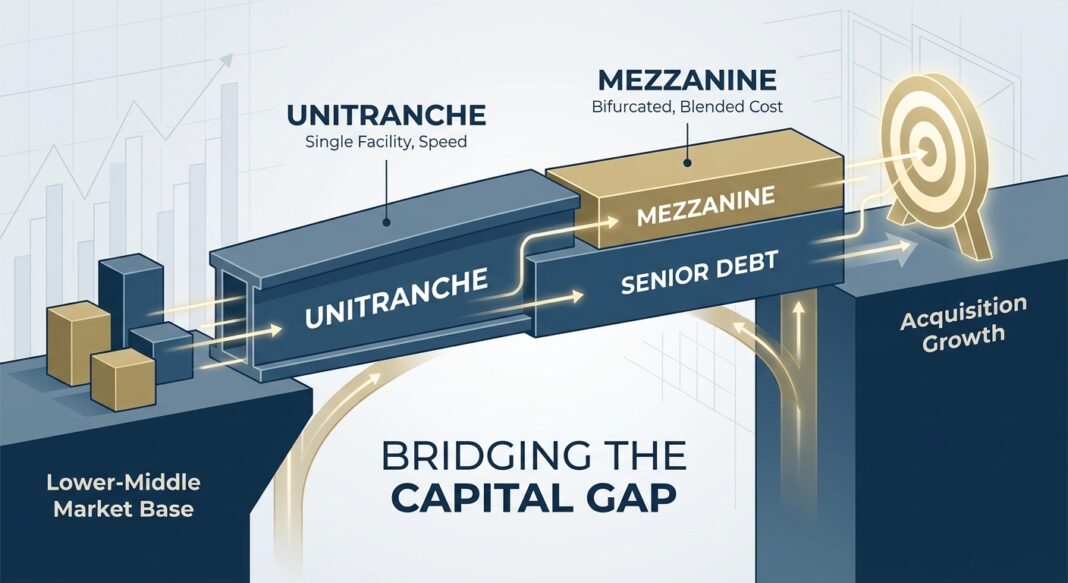
The Growth-Stage Capital Gap: Where Strategy Meets Structure
A business generating $8M–$20M in EBITDA faces a structural paradox. It has grown past the SBA 7(a) ceiling, lacks the operating history and asset base that wins a clean senior bank line at competitive leverage, and is too small to access the broadly-syndicated loan market. Yet the acquisition opportunity (a bolt-on target, a succession trade, a market-share grab) is on the table now.
This is the growth-stage capital gap: the distance between what a bank will lend at 3.0x–3.5x EBITDA and what a deal actually requires at 4.5x–5.5x. Filling that gap is not a single product decision. It is a structural one. The operator or sponsor who understands the full cost-of-capital spectrum, from senior secured bank debt all the way to common equity, and who can map each instrument to a specific use of proceeds, is the one who wins the deal on terms that don’t cripple the business afterward.
This article selects Growth Capital for Acquisition Financing as its structural focus: the use-of-proceeds is a platform or bolt-on acquisition at a $50M–$150M enterprise value, the business stage is growth-to-mature transition, and the structural question is whether a unitranche or a traditional senior-plus-mezzanine stack delivers better economics, speed, and covenant flexibility for the borrower.
Mapping the Cost-of-Capital Spectrum: Banks to Equity
Before selecting a structure, practitioners must anchor to current pricing across the full stack. The spectrum in 2026, per GF Data as reported by Middle Market Growth, runs as follows:
- Bank Senior Debt (3.0x–3.5x EBITDA): Bank senior debt pricing has softened modestly from its 2024 peak of 7.8%, settling at approximately 7.6% in 2025, confirming a higher-rate equilibrium rather than a full cyclical reversal.
- Unitranche (4.0x–5.5x EBITDA, single facility): Unitranche pricing has eased 40 basis points from Q1 2025 to Q1 2026, moving from 12.0% to 11.6% all-in.
- Subordinated / Mezzanine (incremental 1.0x–1.5x EBITDA above senior): Sub/mezz has declined 40 basis points over the same period, from 13.6% to 13.2%, a market absorbing rate shock and normalizing at a structurally higher level than the pre-2022 era.
- Preferred Equity / Common Equity: Unlevered return thresholds of 18%–25%+ depending on stage and risk profile; always the most dilutive and most expensive layer in the stack.
The pricing differential between bank and alternative lenders has become one of the most consequential variables in deal structuring. The gap between bank senior at ~7.5% and unitranche at ~11.6% is 410 basis points, and that spread has a direct impact on post-close debt service capacity and sponsor IRR.
Structure Breakdown: Unitranche vs. Senior-Plus-Mezzanine
Option A: Unitranche (Single-Facility Structure)
The unitranche loan structure combines senior and subordinated debt into one debt instrument, funded by a single lender or lender syndicate, which speeds up the funding process. From the borrower’s perspective, there is one loan document, one lender (or lender-led syndicate), one set of covenants, one interest rate, and one prepayment schedule.
Illustrative Term Sheet, $65M Unitranche for a $120M EV Industrial Services Platform:
- Facility Size: $65M (5.4x EBITDA on $12M EBITDA base)
- Pricing: Current middle-market unitranche spreads run approximately SOFR+4.75% to SOFR+5.50% for mid-sized deals in the $40M–$100M EBITDA range, per Lincoln International Q1 2026 private market data. At this facility size, expect SOFR+5.25% (approximately 11.25% all-in).
- OID: New issue unitranche OIDs have tightened to approximately 1% on average, with some transactions carrying no OID at all, per Lincoln International’s Q4 2025 Private Market Index.
- Amortization: 1% per annum, bullet at maturity
- Maturity: 6 years
- Covenants: Single financial maintenance covenant, total net leverage ≤ 6.25x; tested quarterly with 35% equity cure right
- Call Protection: 103/102/101/par (years 1–4)
- Behind the Scenes: In bifurcated structures, multiple lenders divide the facility into first-out and last-out tranches through an Agreement Among Lenders (AAL), a private inter-lender contract the borrower is typically not party to. The borrower sees one clean credit agreement; what happens among lenders remains a separate arrangement entirely.
Option B: Senior-Plus-Mezzanine (Bifurcated Structure)
A classic leveraged structure separates risk explicitly: senior debt carries the lowest risk and lowest pricing with strict covenants; mezzanine debt carries higher risk and higher pricing, and is looser on covenants, often with PIK components or warrants. This structure introduces intercreditor agreements, payment waterfalls, and complexity, but also pricing efficiency.
Illustrative Term Sheet, Same $120M EV Deal, Senior-Plus-Mezz Structure:
- Senior Secured Term Loan: $42M at SOFR+3.75% (~7.4% all-in); 6-year term; springing financial maintenance covenant; 1% amortization per annum
- Mezzanine Tranche: A typical 2026 mezzanine debt financing rate for a healthy lower-middle-market company runs 11%–14% cash coupon plus 1%–4% PIK, with warrant coverage of roughly 1%–5% of fully diluted equity. On this deal: $23M at 12% cash + 2% PIK; 7-year bullet; 3% warrant coverage on fully diluted equity
- Total Debt: $65M across two facilities (same leverage as unitranche)
- Blended Cost of Debt: ($42M × 7.4% + $23M × 14%) / $65M = approximately 9.87%
- Equity: $55M from sponsor (45.8% of total capitalization)
- Intercreditor: Full subordination agreement; mezz lender standstill period of 180 days post-senior default
Traditional senior-plus-mezzanine can achieve a lower weighted cost of capital if mezz carries equity kickers, but intercreditor complexity slows execution and reduces flexibility.
How the Structures Compare: Trade-Offs and Decision Framework
On the above example, the senior-mezz stack produces a blended cost of approximately 9.87% versus 11.25% for unitranche, a 138-basis-point cost advantage. That translates to roughly $900K in annual interest savings on a $65M facility. So why does unitranche dominate the market?
Speed advantage: a 45–90 day unitranche close versus 90–150 days for traditional senior-plus-mezz syndication, a difference that matters most for buyers running roll-up platforms with frequent add-ons. In competitive auction processes, that timing gap can cost a buyer the deal entirely.
Unitranche remains the default format for private-credit-backed buyouts, but by the third quarter of 2025, 56% of direct loans priced below SOFR+500 bps as the syndicated market competed spreads tighter. The structure’s market share is a function of execution certainty, not just economics.
The senior-mezz structure reclaims relevance in three specific scenarios:
- Larger Transactions: The largest mezz funds ($1B+) now focus on transactions where total debt exceeds $500M and a single unitranche lender cannot provide the full leverage package.
- Seller-Financed Components: When a seller takes back a note in lieu of cash, structuring it as a quasi-mezz tranche behind a clean senior facility is cleaner than embedding it in a unitranche AAL.
- Cash-Flow Constrained Borrowers: PIK interest accrues on the principal balance instead of being paid in cash, compounding over the life of the facility and increasing the effective cost of borrowing over time, but it preserves near-term free cash flow for operations, making it structurally optimal for businesses in a heavy growth-investment phase.
For the $50M–$200M EV band specifically, unitranche dominates; it is the heart of the market, with direct lenders aggressively competing for deals in this range.
Current Market Terms: 2026 Data Points
Practitioners should anchor their structuring conversations to the following current benchmarks, drawn from market data sources as of mid-2026:
- Unitranche Spread Compression: New issue unitranche spreads for borrowers generating between $40M and $100M in EBITDA settled at SOFR+450 bps in Q4 2025, with OIDs tightening to approximately 1% on average, per Lincoln International’s Q4 2025 Private Market Index.
- Leverage Standards: Average total leverage in sponsored middle-market unitranche deals hovered around 5.0x EBITDA in mid-2024 as lenders focused on free cash flow and covenant headroom. Expect similar parameters through 2026, with top-tier sponsors achieving 5.25x–5.5x on high-quality recurring-revenue businesses.
- Mezz Pricing Drift Lower: GF Data and Lincoln International both reported cash coupons drifting down from 2024 peaks as senior spreads compressed through the first half of 2026.
- Covenant Architecture: Private credit agreements increasingly involve leverage ratios, EBITDA definitions, incurrence and maintenance testing, covenant-lite structures, equity cure rights, and other provisions that shape lender-borrower relationships. Covenant-lite or incurrence-based covenants are tested only when a borrower takes an affirmative action, such as incurring additional debt, rather than by a deterioration in financial condition. Borrowers should push for incurrence-only packages where possible.
- Private Credit AUM Context: Global private credit assets under management reached approximately $2.1 trillion in 2025, up from $1.5 trillion a year earlier, providing meaningful lender competition that borrowers with strong EBITDA profiles can actively exploit in a process.
The Gap Capital Playbook: Quantify, Prepare, Run the Process, Negotiate
Step 1: Quantify the Gap
Begin with a clean EBITDA reconciliation. Identify adjusted EBITDA (stripping owner add-backs, one-time costs, and run-rate synergies with appropriate haircuts). In 2024, market caps on pro-forma cost savings add-backs clustered around 25%–35% of EBITDA, lenders will apply similar scrutiny in 2026. Map the gap: purchase price minus available senior debt capacity at 3.0x–3.5x equals the junior capital requirement. That number determines whether unitranche, mezz, preferred equity, or seller financing is the right fill.
Step 2: Prepare Your Materials
A lender-ready package for a middle-market acquisition credit includes: three years of audited financials; a trailing-twelve-months management bridge; a monthly covenant sensitivity model showing headroom at base case and 20% EBITDA downside; an org chart with key-man identification; and a use-of-proceeds memo mapping every dollar. Later-stage growth lending relies more heavily on company fundamentals: revenue visibility, gross margin, retention, customer concentration, sales efficiency, cash-burn trajectory, and proximity to free cash flow become central underwriting criteria. Anticipate these questions and pre-answer them in the CIM.
Step 3: Run the Process in Parallel
Buyers who lock in an equity sponsor before pricing senior debt routinely give up 300–500 bps of blended cost and 8–12 points of equity that a competitive process would have preserved. The winning approach is to run senior debt, unitranche, and mezz quotes in parallel, then use the tightest term sheet as leverage on the equity conversation. Process sequencing is itself a negotiation lever.
Step 4: Negotiate the Structure
The key negotiation points for borrowers in a unitranche or mezz process in 2026 are:
- EBITDA Definition: Push for maximum flexibility on add-backs, run-rate adjustments, and synergy recognition. The EBITDA definition in the credit agreement directly determines covenant headroom for the life of the facility.
- Covenant Package: Incurrence tests are tested only when a borrower seeks to undertake a specified action, such as incurring additional indebtedness or making an acquisition, and they are typically embedded in negative covenant baskets requiring the borrower to demonstrate pro-forma compliance before accessing a basket. Negotiate for a single springing maintenance covenant (leverage only, tested only when the revolver is drawn) rather than a quarterly-tested maintenance package.
- PIK Toggle: If cash flow is constrained in years one through two post-acquisition, negotiate a PIK toggle option on 2%–3% of the coupon. When borrowers elect PIK interest, the outstanding balance compounds, increasing total debt burden, and if the anticipated liquidity event is delayed, the growing PIK balance creates a larger refinancing burden at bullet maturity. Use PIK toggling tactically, not as a structural crutch.
- Prepayment Flexibility: OID and early call terms make the first two years the most expensive period, which shapes refinancing windows. Quantify prepayment friction by layering call protection and OID into the effective APR for year one and year two, and negotiate a 101 soft call rather than a hard call schedule wherever market dynamics allow.
- Warrant Coverage (Mezz Only): Every warrant granted to a mezzanine lender dilutes existing common equity, and in a successful exit, the mezzanine lender’s equity kicker reduces the return available to the sponsor and management team, a cost that must be weighed against the benefit of reduced upfront equity contribution. Negotiate warrant strike price at current fair market value and push for a hard cap on coverage at 3% of fully diluted equity.
Key Takeaways
- Map the gap before selecting the instrument. The distance between senior bank capacity and total deal leverage requirement determines whether unitranche, mezz, preferred equity, or a layered stack is the right structural answer, not the other way around.
- Unitranche wins on speed and simplicity; senior-mezz wins on blended cost. Unitranche wins on speed, confidentiality, and single-document control. For auctions and roll-up platforms with frequent add-ons, that execution premium is worth 100–150 bps of all-in cost.
- 2026 pricing has normalized at structurally higher levels. This is not a dramatic loosening; it is a market absorbing the rate shock and normalizing at a structurally higher level than the pre-2022 era. Model for 11%–12% all-in unitranche and 13%–15% all-in mezz as base-case assumptions.
- Covenant architecture is the most durable negotiation point. The difference between a maintenance covenant and an incurrence covenant is not paperwork; it is the difference between a technical default in a soft quarter and operational freedom to manage through a downturn.
- Run competitive process discipline. With $2.1 trillion in private credit AUM competing for middle-market paper, borrowers with $8M+ EBITDA, recurring revenue, and clean financials hold genuine negotiating leverage. Use it by running lenders in parallel, never serially.


