
The Growth-Stage Financing Problem Nobody Warns You About
You have a target. You have a thesis. You have a signed LOI. What you do not have is a clean financing path. This is the defining capital challenge of the growth stage: the business has outgrown venture equity terms but has not yet earned its way into broadly syndicated leveraged finance. Senior lenders will extend credit, but not far enough to fund the deal. The equity cost of filling the remaining gap is punishing. And the clock on your exclusivity window is already running.
The companies that close these deals do not find a better lender. They build a better capital stack: one that assigns each layer of capital to its correct risk tier, cost level, and structural role. The gap between what a senior lender will provide and what total deal consideration demands is not a problem. It is a structuring exercise. This article addresses the full playbook: how to map use-of-proceeds across the stack, what each layer costs in today’s market, how to run the process competitively, and which term sheet points move the most value at the negotiating table.
Step 1: Map the Capital Stack Before You Approach a Single Lender
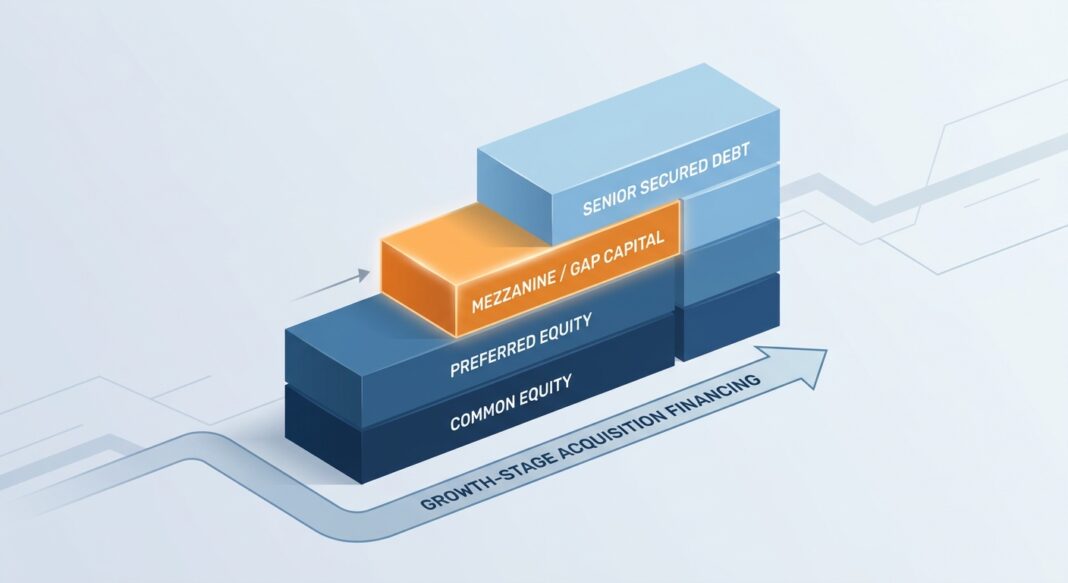
In a growth-stage acquisition, the capital stack typically comprises three to four distinct layers, each carrying a different cost of capital, a different set of structural expectations, and a different risk tolerance. Understanding the hierarchy before you talk to capital providers is not preparation; it is the work itself.
The hierarchy, from lowest cost to highest:
- Senior Secured Debt (Bank or Unitranche): First-lien, typically secured against all assets. Banks cap leverage at roughly 3.0x–4.0x EBITDA. A unitranche from a private credit lender stretches to 4.0x–5.0x, depending on business quality and sector.
- Mezzanine / Subordinated Debt (Gap Capital): Sits behind senior debt. Carries a blended cash-pay and PIK coupon, and often includes equity participation via warrants or a co-investment right. This is the layer that fills the delta between senior debt capacity and total capital required.
- Preferred Equity: Technically equity, but priced and structured like debt: fixed return, liquidation preference, and often a conversion feature. Used when subordinated debt capacity is exhausted or when lender documents prohibit additional indebtedness.
- Common Equity / Sponsor Equity: The risk-absorbing base. Typical equity contribution in a sponsored middle-market deal runs 40%–50% of total capitalization at close.
The private credit market now extends beyond senior loans to include junior lending with equity upside, mezzanine financing, infrastructure debt, and asset-backed finance, offering growth-stage borrowers a wider set of structural options than at any prior point in the market’s development. Understanding where each provider sits in that ecosystem determines which conversation to have first.
Step 2: Quantify the Gap with Precision
The gap is the delta between senior debt capacity and total capital required. Sizing this number with precision, before entering any process, determines which instruments you need, how much equity dilution you can avoid, and whether the deal is financeable at your target ownership structure.
A worked example illustrates the mechanics:
Illustrative Transaction: A growth-stage B2B software company acquires a complementary platform for $75M total enterprise value. The combined business generates $10M EBITDA post-close on a pro forma basis.
- Senior debt capacity (unitranche at 4.5x): $45M
- Total capital required: $75M
- Gap: $30M, too large to fill with equity alone without unacceptable dilution; too large to sit inside the senior facility
- Structural solution: $15M mezzanine (1.5x EBITDA) + $15M preferred equity or sponsor co-invest
- Resulting stack: $45M unitranche + $15M mezz + $15M preferred/equity = $75M
Senior debt capacity is the critical differentiator here: the choice between a traditional bank loan limited to 3.0x–4.0x leverage and a unitranche at 4.0x–5.0x is not a pricing question; it is a capacity question that reshapes the entire structure below it. Borrowers who default to the cheapest senior option without modeling its capacity constraints often discover the gap is larger than anticipated, forcing a more expensive mezzanine or equity solution later in the process.
Step 3: Understand What Each Layer Costs in Today’s Market
Capital markets in 2026 are more expensive and more lender-friendly than at any point in the previous decade. Borrowers entering processes today must underwrite to current market terms, not to the compressed spreads of 2021–2022.
Senior / Unitranche Debt
Unitranche pricing in 2026 runs SOFR + 500–700 basis points, plus a 2%–3% original issue discount (OID) and a 2%–3% prepayment fee declining over the first 24 months. The all-in cost of capital for a typical 5x leverage deal runs 9.5%–11% blended. By enterprise value band, the market has standardised around clear structural defaults: the $50M–$200M EV range is the heartland of the unitranche: a single-facility structure that blends senior and subordinated risk into one instrument, one credit agreement, one lender relationship, and no intercreditor negotiation.
The unitranche commands a spread premium over plain first-lien bank debt, roughly SOFR + 450–650 bps against SOFR + 250–350 bps for a syndicated term loan, because it carries junior risk inside a first-lien wrapper. Borrowers pay that premium to buy speed, certainty, and structural flexibility: a unitranche can close 30–45 days faster than a syndicated alternative, eliminating syndication flex risk on a time-sensitive acquisition close.
Mezzanine / Subordinated Debt
Mezzanine debt sits at the intersection of debt and equity: subordinated in the capital structure, with a return profile blending cash-pay interest, PIK (payment-in-kind) accrual, and equity participation. In 2026, mezzanine fundraising rebounded approximately 26% after a sharp prior-year decline, reflecting renewed appetite for the structure as persistent higher rates make mezzanine’s fixed-income component more attractive for investors. Typical all-in yields for mezzanine instruments in the growth-stage acquisition context range from 14%–18%, depending on leverage, sector, and equity participation.
Payment-in-kind (PIK) usage has risen notably across private credit in recent years, with public BDCs now receiving an average of 8% of investment income via PIK. Once limited to mezzanine and subordinated debt, PIK is increasingly appearing in senior secured documentation, a signal that borrowers are managing cash interest burden by deferring a portion of their coupon. Growth-stage acquisition borrowers should model PIK versus cash-pay tradeoffs carefully: PIK preserves near-term cash flow but compounds the debt balance, increasing refinancing risk at maturity.
The Cost-of-Capital Spectrum
| Layer | Instrument | 2026 All-In Cost | Leverage Capacity | Key Feature |
|---|---|---|---|---|
| Senior Secured | Bank Term Loan / Revolver | 7.5%–9.0% | 3.0x–4.0x EBITDA | Lowest cost; most restrictive capacity |
| Senior Secured | Unitranche (Private Credit) | 9.5%–11.0% | 4.0x–5.0x EBITDA | Speed, certainty, single lender |
| Subordinated / Gap | Mezzanine / 2nd Lien | 13%–18% | 1.0x–2.0x EBITDA (incremental) | PIK toggle, warrant coverage |
| Hybrid / Preferred | Preferred Equity | 15%–20% | Deal-specific | Liquidation pref, conversion rights |
| Equity | Common / Sponsor Equity | 25%+ (implied IRR) | Residual | Control, upside participation |
Note: Ranges reflect 2026 middle-market conditions sourced from S&P LCD, PitchBook, and market reporting. All data is directional and will vary by credit quality, sector, and leverage.
Step 4: Prepare the Four Materials That Move Gap Capital Providers
Gap capital providers (mezzanine funds, subordinated debt funds, family offices providing preferred equity) underwrite differently than senior lenders. They are underwriting to equity-like risk and expecting an equity-like information package. The four materials that accelerate their process are:
- The Leverage Bridge: A single-page document showing total sources and uses, the senior debt capacity ceiling, the specific gap, and the proposed instrument to fill it. This frames the ask and demonstrates that the borrower understands the structure.
- The Pro Forma Capital Structure: Show the post-close stack (every layer, its cost, its maturity, its amortization profile, and its covenant package) with a cash flow waterfall that demonstrates debt service coverage at each layer under base, downside, and stress scenarios.
- The EBITDA Bridge: Gap capital providers model downside more aggressively than senior lenders. Show the path from reported EBITDA to pro forma adjusted EBITDA, line by line, with conservative add-back support. Market caps on pro forma cost-savings add-backs clustered around 25%–35% of EBITDA in 2024; your presentation should stay inside that range.
- The Exit or Refinancing Path: Mezzanine lenders are bullet-maturity creditors. They need to understand the mechanism by which their position is repaid: whether through a primary exit, a refinancing into a broader senior facility as the business scales, or a defined leverage step-down schedule.
Step 5: Run a Competitive Process, Not a Sequential Search
The most common mistake growth-stage borrowers make in gap capital processes is running them sequentially: approach one lender, get a term sheet, negotiate it, then approach the next. This approach destroys leverage and extends timelines into exclusivity windows.
The correct process is parallel. Approach six to eight gap capital providers simultaneously with your four materials. Set a term sheet deadline at 10–14 days from first distribution. Evaluate term sheets across five dimensions simultaneously: all-in cost, leverage multiple, covenant package, PIK versus cash-pay composition, and prepayment flexibility.
Private credit AUM crossed $1.7 trillion in H1 2026, with roughly 40% of new deployment targeting the lower middle-market growth segment. Capital availability is not the constraint, structure and price are. Use the abundance of capital supply to negotiate, not just to access.
Direct lenders do their own underwriting. Unlike syndicated markets, there is no arranger intermediary softening your terms. The relationship you build with the credit officer doing the underwriting is the relationship that determines how covenant headroom is set, whether PIK is offered as a toggle or mandatory, and how prepayment penalties are structured. Engage that person directly, early, and with transparency about competitive tension in your process.
Step 6: Negotiate the Structure, Five Points That Move the Most Value
Term sheets in growth-stage gap capital deals vary across dozens of provisions. Five structural points account for the majority of economic value:
1. EBITDA Definition and Covenant Headroom
Unitranche and private credit deals are maintenance-covenant instruments, tested quarterly. The practical difference between a maintenance covenant and an incurrence covenant is foundational: maintenance covenants require borrowers to pass financial tests every quarter regardless of any action taken, while incurrence covenants only apply when the borrower takes a specific action: incurring new debt, paying a dividend, or completing an acquisition. Over 85% of institutional leveraged syndicated loans are now covenant-lite (incurrence only); private credit deals, particularly in the middle market, retain maintenance covenants to preserve lender early-warning rights.
For borrowers, the leverage covenant level is not fixed. Negotiate the EBITDA definition comprehensively upfront. Explicitly include synergy add-backs with a reasonable realisation timeline, non-recurring transaction costs, and stock-based compensation. These items can move covenant headroom by 0.5x–1.0x leverage turns, meaningfully changing the risk profile of the structure at close and reducing the probability of a technical breach in the first year post-acquisition.
2. PIK Toggle vs. Mandatory PIK
A PIK toggle gives the borrower the option to elect PIK payment in lieu of cash interest when needed. Mandatory PIK removes that optionality. For growth-stage acquisitions with near-term integration costs, the toggle is meaningfully more valuable than the headline coupon spread. Negotiate for toggle rights, even at a modest spread premium, before conceding on the all-in rate.
3. Prepayment Flexibility
Gap capital instruments typically carry call protection structures, prepayment premiums that decline over a 24–36 month schedule. On acquisition financing, where refinancing into a more efficient senior structure is the likely exit for mezzanine debt as the business scales, call protection is a direct tax on optionality. Negotiate either a shorter call protection window (12–18 months rather than 24–36) or a make-whole structure that caps the premium at a defined level.
4. Equity Participation: Warrants vs. Co-Investment Rights
Mezzanine lenders extract equity upside through either warrants (options to purchase equity at a fixed strike) or co-investment rights (the right to invest alongside the sponsor in the equity round). Co-investment rights are generally less dilutive in scenarios where the business appreciates significantly, because they are exercised at a future valuation rather than a fixed historical strike. Where the borrower has strong conviction in equity value creation, negotiate for co-investment rights over warrants.
5. Incremental Debt Baskets
Post-close, a growth-stage company will need access to additional capital: for tuck-in acquisitions, working capital seasonality, or capex. Incurrence covenants control access to this capacity via ratio-based and fixed-dollar baskets embedded in negative covenants. Negotiate grower baskets (baskets that scale with EBITDA) over starter baskets (fixed-dollar baskets) wherever possible, and ensure the credit agreement includes a limited condition transaction election permitting incurrence testing at LOI signing rather than deal close.
Covenant Design: The Detail That Defines Operational Freedom
Maintenance covenants function as quarterly trip wires, if the borrower’s financial metrics decline past a threshold, the lender gains the right to accelerate the loan and enforce creditor rights. In the middle market, borrowers with EBITDA below $50M are typically subject to a full maintenance covenant package. As companies grow and become more seasoned, the prevalence of maintenance covenants declines, and lenders increasingly accept incurrence-based packages. The covenant negotiation is not separate from the pricing negotiation; it is part of the same economic trade.
The practical implication for borrowers: if your deal has integration risk in year one (most acquisitions do), negotiate a covenant holiday or a covenant step-up schedule that provides additional headroom during the integration period. A 6-month covenant holiday following close, or a first-year leverage covenant set 0.5x–0.75x looser than the long-term package, is a standard ask in growth-stage acquisition financing and one that most direct lenders will consider without a corresponding spread increase.
Key Takeaways
- The gap is structural, not a financing failure. Growth-stage acquisitions routinely exceed senior debt capacity. The correct response is layered capital (unitranche or senior, mezzanine, and preferred) not a larger equity cheque.
- Quantify before you process. The gap between senior capacity (typically 3.0x–4.5x EBITDA) and total deal consideration must be sized precisely before approaching any lender. Structure follows from that number; it cannot be retrofitted after the process starts.
- Run parallel, not sequential. With private credit AUM at over $1.7 trillion and 40% targeting lower middle-market growth companies, capital is abundant. Your leverage is competition, not access. Approach six to eight gap capital providers simultaneously and use parallel term sheets to anchor your negotiation.
- The EBITDA definition is a negotiation, not a given. Covenant headroom can move 0.5x–1.0x leverage turns based on how add-backs are defined. Negotiate this comprehensively at the term sheet stage; it is significantly harder to reopen post-exclusivity.
- PIK toggle, prepayment flexibility, and basket design are the three structural provisions that determine operational freedom post-close. All-in rate matters; these provisions matter more. A deal that closes 50 basis points cheaper but with mandatory PIK, two-year call protection, and no grower baskets is structurally inferior to a modestly higher-priced deal with full toggle rights, a 12-month call window, and EBITDA-scaling incremental capacity.


