
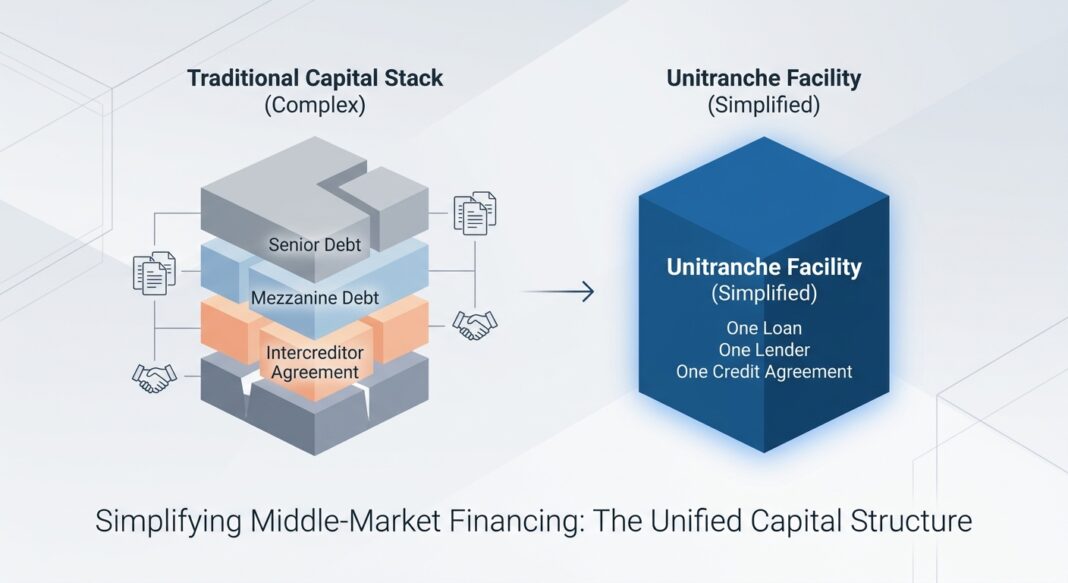
The Loan That Ate the Capital Stack
Imagine you are a private equity sponsor closing a $150 million leveraged buyout. Traditionally, that meant weeks of negotiation with at least two creditor groups (a senior bank lender and a mezzanine fund) each with their own documents, covenants, and competing enforcement rights. The intercreditor agreement alone could take months to negotiate.
Now imagine collapsing all of that into a single loan, a single lender, and a single credit agreement signed in under 45 days. That is the core promise of the unitranche facility, and it has quietly become the dominant financing structure for middle-market companies in the United States.
Understanding unitranche debt is essential for any investor evaluating private credit funds, and for any business owner or CFO weighing acquisition financing options. This article explains what unitranche is, how it is priced, what protections lenders require, and what the current market looks like heading into the second half of 2026.
What Is a Unitranche Facility?
Unitranche debt is a single-facility loan structure that combines what would traditionally be separate senior secured debt and subordinated (mezzanine) debt into one instrument, with one interest rate, one covenant package, and one lender relationship. As PipelineRoad’s financing glossary explains, the entire capital structure below equity collapses into a single instrument.
The traditional alternative requires a borrower to negotiate with multiple creditor groups (a senior lender or syndicate, a second-lien provider, and potentially a mezzanine fund) each with its own documents, pricing, and enforcement rights. The intercreditor agreement governing the relationship between those parties is among the most complex documents in leveraged finance.
Unitranche eliminates that layer entirely. The borrower sees one loan. Internally, the direct lender may split economics between a “first-out” and “last-out” tranche via an Agreement Among Lenders (AAL), but that arrangement is invisible to the borrower. The result is a structurally simpler, faster-closing instrument, at a cost that sits between pure senior and mezzanine pricing.
According to Stirling Capital’s direct lending analysis citing Golub Capital’s research, return targets for senior debt run 7–9%, unitranche runs 9–11%, and junior debt runs 10–12%, a yield spectrum that reflects the structural risk each layer absorbs.
How Unitranche Works: A Concrete Example
Consider a sponsor acquiring a manufacturing business with $20 million of EBITDA at a 6.0x enterprise value multiple: a $120 million purchase price. The sponsor puts in $48 million of equity (40% of the capital structure). The remaining $72 million comes from a unitranche facility at 5.0x leverage on EBITDA ($72M / $20M = 3.6x, or at 4.5x leverage, $90M of debt on a higher-value deal).
Here is how the economics of that loan look in mid-2026:
- Base Rate: 3-month Term SOFR at approximately 3.69% (as of June 2026, per Valuation Research Corp., Q2 2026)
- Credit Spread: 475–550 basis points over SOFR for a quality middle-market credit
- All-In Yield: Approximately 9.00–9.75% on a spot basis
- Original Issue Discount (OID): 1–2%, meaning the borrower receives slightly less than the face amount at close but owes the full principal
- Prepayment Schedule: Typically 102/101/par over years one, two, and three
- Amortization: Very low, often around 1% annually, with a bullet repayment at maturity
- Maturity: Typically 5–7 years
Compared to a split senior/mezzanine structure, the borrower pays a modest spread premium but gains substantial execution benefits: one negotiation, one closing, one lender to call for covenant amendments post-close. For a $72 million loan, a 50-basis-point premium translates to roughly $360,000 per year in extra interest, a cost that most sponsors accept readily in exchange for certainty of close.
Covenant structure is deliberately simple. According to Sidley Austin’s March 2026 analysis of financial covenants in private credit, the leverage ratio dominates private credit documentation. Most unitranche deals carry a single net leverage maintenance covenant tested quarterly, lenders and sponsors can compare a company’s risk profile cleanly against market benchmarks using this metric. Real BDC data confirms the pattern: as of June 30, 2026, Nuveen Churchill Direct Lending’s portfolio reported a weighted average net leverage of 5.20x and an interest coverage ratio of 2.46x across its first-lien loans, with approximately 86% of debt investments carrying financial covenants.
Current Market Reality: Unitranche by the Numbers
Unitranche is no longer a niche product. It is the defining instrument of the private credit era.
| Metric | Current Data Point | Source |
|---|---|---|
| Unitranche all-in yield range (Q2 2026) | ~9.00%–9.75% | Valuation Research Corp., July 2026 |
| New-issue private credit spread (Aug 2026) | Avg. 502 bps over SOFR | PitchBook LCD via Kadenwood, Sept 2026 |
| Premium over syndicated loans (Q3 2026) | ~162 bps | PitchBook LCD via Kadenwood, Sept 2026 |
| Global private credit AUM (start of 2026) | ~$1.7 trillion | Preqin 2026 Global Alternatives Report via CT Acquisitions |
| LMM buyouts using unitranche (2025) | ~80% of deals | S&P Global Market Intelligence via CT Acquisitions |
| CDLI trailing-year return (to June 30, 2026) | 7.7% | Cliffwater CDLI, August 2026 |
| Private credit trailing-12M default rate (Q1 2026) | ~3.7% by principal | PitchBook LCD via CT Acquisitions, June 2026 |
One dynamic worth noting: PitchBook LCD data through August 2026 show that the share of new sponsor-backed direct lending deals priced between 500 and 549 basis points rose from 25% in Q1 to 52% by late August, meaning spreads on new deals are moving higher even as existing book spreads appear stable. Borrowers negotiating today will encounter a market that has repriced meaningfully since the start of the year.
On the macro backdrop, the Federal Reserve’s July 2026 SLOOS reported that bank standards for commercial and industrial loans remained broadly unchanged in Q2, but the April 2026 survey revealed that banks had tightened all terms on loans to non-depository financial intermediaries (including stricter covenants and higher risk premiums) over the prior year. That asymmetry reinforces why direct lenders continue to win deal flow: their unitranche structures offer speed and certainty that bank syndication cannot match for sub-$500 million transactions.
Decision Framework: Investors and Operators
For Investors Evaluating Private Credit Funds
- Evaluate first-out vs. last-out exposure. Not all unitranche positions carry the same risk. Funds that hold predominantly first-out positions within an AAL structure absorb losses later in a default scenario. Understand where in the AAL your fund sits before assessing yield.
- Examine the interest coverage ratio. With all-in yields of 9–10% and leverage at 4–5x EBITDA, a borrower needs consistent cash generation to sustain coverage above 2.0x. Falling EBITDA compresses this ratio quickly. Portfolio-level coverage metrics, like Churchill’s 2.46x reported figure above, offer a useful benchmark.
- Scrutinize covenant tightness. A single leverage covenant is simpler, but also means less early-warning signal. Investors should ask how frequently portfolio companies breach or seek amendments, as amendment frequency is a proxy for credit stress that headline NAV may not capture.
- Assess vintage and spread timing. Deals originated at peak spreads (late 2023, near 12.5% all-in) will deliver different outcomes than 2026 originations at 9–9.75%. Understand your fund’s deployment period relative to the rate cycle.
For Business Owners and CFOs Considering Unitranche
- Unitranche is most efficient at 4–6x EBITDA leverage. Below 3x, a senior bank loan is almost certainly cheaper. Above 6x, the risk premium embedded in the blended rate becomes very expensive relative to equity alternatives.
- Speed matters in competitive auctions. If certainty of close is a differentiator in an acquisition process, unitranche’s single-lender dynamic can be decisive. Bank syndication introduces market risk that a direct lender’s hold commitment eliminates.
- Understand OID and prepayment penalties before signing. The stated coupon understates the true cost of capital when OID and a 102/101/par prepayment schedule are included. Model the total cost on a 3-year hold, not just the headline spread.
- Negotiate the leverage covenant with headroom. Operators should seek at least 30–35% headroom above their projected peak leverage to absorb a demand downturn without triggering a covenant waiver process: which, even with a single lender, consumes management time and can involve fees.
Key Takeaways
- Unitranche has structurally displaced traditional split senior/mezzanine financing for the U.S. lower middle market, with roughly 80% of LMM leveraged buyouts in 2025 using this structure.
- All-in yields of 9–9.75% (as of Q2 2026) reflect a blended rate between senior and subordinated risk, down from 2023 peaks near 12.5%, but still above pre-2022 historical norms of 7–8%.
- New-issue spreads are widening in 2026, with PitchBook LCD data showing average spreads on new deals rising from 475 bps in Q1 to 502 bps through August, a dynamic that matters more to borrowers closing today than to investors marking existing books.
- The single-covenant, single-lender structure trades early-warning signals for execution efficiency: a tradeoff investors must weigh carefully, especially with trailing-12-month default rates rising to approximately 3.7% as of Q1 2026.
- The Cliffwater Direct Lending Index has delivered 9.5% annualized returns over nearly 22 years with only one negative year, providing long-run evidence that the asset class can sustain its risk-adjusted proposition across cycles, though past performance does not guarantee future results.


