
The Growth-Stage Funding Gap: When Senior Debt Isn’t Enough and Equity Is Too Expensive
You have crossed $5M in EBITDA. The organic runway is clear, but the fastest path to scale runs through an acquisition: a bolt-on competitor, a new geography, a capability you cannot build in time. Your bank will stretch to 3.0× leverage. The deal requires 5.0×. That 2.0× gap is not a failure of your business; it is a structural feature of growth-stage M&A financing. And it has a name: the mezzanine layer.
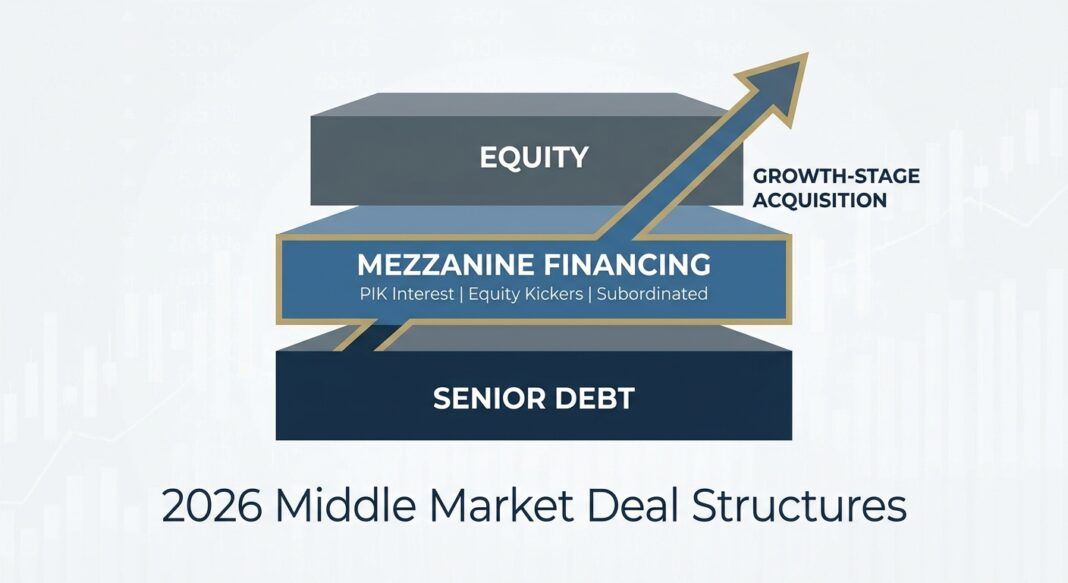
Mezzanine debt sits precisely in this space. It occupies the capital stack between senior debt and equity. If things deteriorate, senior lenders are paid first and equity last, mezzanine waits in the middle. In exchange for that subordinated position, mezzanine investors receive high cash yields, payment-in-kind (PIK) interest, and often an equity kicker through warrants or conversion features. For a growth-stage operator engineering an acquisition without surrendering majority control, this instrument is often the most precise tool available, but only if you understand its mechanics, its cost, and when alternatives make more sense.
This article breaks down the full mezzanine structure: component by component, term-sheet element by element, and decision criterion by decision criterion. Market data is anchored to Q2–Q3 2026 transaction evidence.
Structure Breakdown: Components, Mechanics, and a Live Term-Sheet Example
The Three-Layer Cost Architecture
Mezzanine financing is not a single rate; it is a blended return delivered through three stacked components:
- Cash-Pay Coupon: Current interest paid quarterly or monthly. A typical 2026 mezzanine rate for a healthy $5M–$15M EBITDA lower-middle-market company runs 11%–14% cash coupon.
- PIK Interest: Interest that accrues to principal instead of being paid in cash. Warrant coverage of roughly 1%–5% of fully diluted equity accompanies a 1%–4% PIK layer in most 2026 lower-middle-market structures. The PIK feature is what makes mezzanine attractive to growth-stage borrowers whose free cash flow does not yet support the full coupon.
- Equity Kicker (Warrants): A warrant or co-invest right that gives the mezz lender participation in equity upside. Mezzanine lenders frequently take equity warrants, typically 1%–3% of the fully diluted equity, struck at the transaction valuation. The warrants give the mezzanine investor a piece of the equity upside in exchange for accepting a coupon lower than the borrower’s cost of equity.
A blended cost of capital of 15%–18% is normal for mezz plus warrants; the equity kicker is the reason funds accept a subordinated position without a board vote.
Illustrative Term Sheet: $15M Mezzanine Tranche for a $75M EV Industrial Services Acquisition
Consider a $35M EBITDA industrial services platform pursuing a $75M enterprise value bolt-on. The bank will provide 3.0× EBITDA ($10.5M) in senior secured debt. The sponsor contributes 45% equity ($33.75M). The remaining $15M, the gap, is filled with a mezzanine tranche structured as follows:
| Term-Sheet Element | Structure |
|---|---|
| Facility Size | $15,000,000 |
| Instrument Type | Subordinated Term Note |
| Cash Coupon | 12.0% per annum, paid quarterly |
| PIK Toggle | 2.5% PIK, electable in years 1–2 only |
| All-In Yield (blended) | ~14.5% before warrant value |
| Warrant Coverage | 2.5% of fully diluted equity at close |
| Warrant Strike Price | Transaction equity valuation ($33.75M) |
| Maturity | 6 years, bullet repayment |
| Prepayment Premium | 3% / 2% / 1% (declining over years 1–3) |
| Covenants | Maximum leverage (5.5×), minimum DSCR (1.10×), tested quarterly |
| Security | Second-priority lien on all assets; subordinated to senior lender via intercreditor agreement |
| Intercreditor | Standard standstill provisions; 180-day standstill on mezz enforcement post-senior default |
In a typical $50M enterprise value platform in 2026, GF Data reports a stack funded with roughly 40% senior debt, 10% mezzanine, 45% sponsor equity, and 5% seller rollover. The example above mirrors this architecture at a higher EV, with PIK elected only during the integration period to protect near-term cash flow.
PIK Mechanics: PIK does not provide current cash income; it accrues as additional principal and is received only at bullet maturity or exit. Investors and operators modeling mezzanine cash flows must distinguish between the cash-pay and PIK portions of the coupon to correctly project IRR and duration. On a $15M tranche at 2.5% PIK, the borrower accrues $375K annually to the principal balance, compounding forward, a material step-up in the repayment amount if the PIK is held for the full facility life.
Warrant Dilution: Every warrant granted to a mezzanine lender dilutes existing common equity. In a successful exit, the mezzanine lender’s equity kicker reduces the return available to the sponsor and management team, a cost that must be weighed against the benefit of reduced upfront equity contribution.
How It Compares: Mezzanine vs. Unitranche vs. Traditional Senior + Mezz
Mezzanine vs. Unitranche
A unitranche combines senior and subordinated debt into one instrument and can be used to acquire financing from multiple parties, speeding up the funding process. From the borrower’s perspective, there is one loan document, one lender or lender-led syndicate, one set of covenants, one interest rate, and one prepayment schedule.
Traditional senior-plus-mezzanine can achieve a lower weighted cost of capital if mezz carries equity kickers, but intercreditor complexity slows execution and reduces flexibility. Unitranche wins on speed, confidentiality, and single-document control. The speed advantage is tangible: a unitranche closes in 45–90 days vs. 90–150 days for traditional senior-plus-mezz syndication, critical for buyers running roll-up platforms with frequent add-ons.
However, unitranche pricing reflects the blended risk. A unitranche prices above a standalone senior loan, roughly SOFR+450 to 650 bps, against SOFR+250 to 350 bps for a plain first-lien term loan. A bifurcated senior-plus-mezz stack, when sized correctly, can produce a lower weighted average cost of capital for the borrower if the senior tranche is bank-priced, particularly relevant for companies with strong asset collateral or existing bank relationships.
When Mezzanine Wins
- Leverage above 3.5× but below 5.5× EBITDA: Senior debt is tapped out; equity is too expensive or dilutive to raise alone.
- Cash-flow constrained growth periods: PIK toggle provides a cash-preservation valve during integration.
- Founder-owned businesses resisting majority dilution: Mezz avoids a control-level equity event.
- Add-on acquisitions where existing credit agreements cap senior borrowings: Mezzanine remains relevant in portfolio company add-on financings where existing credit agreements restrict additional senior debt.
When to Avoid Mezzanine
Conditions that signal mezzanine is the wrong structure: EBITDA growth historically below 5% organic, margin compression in the industry, customer concentration above 30%, cyclical or seasonal cash flow, and CapEx above 8% of EBITDA. In these conditions, mezzanine amplifies risk without adequate return; alternative strategies (smaller deal, more equity, different structure) usually serve the buyer better.
Current Market Terms: What the Data Shows in 2026
Five evidence-anchored data points define the mezzanine market as of Q2–Q3 2026:
- Cash Coupon Range (Lower Middle Market): A typical 2026 mezzanine financing rate for a healthy $5M–$15M EBITDA company runs 11%–14% cash coupon plus 1%–4% PIK, with warrant coverage of roughly 1%–5% of fully diluted equity. GF Data and Lincoln International both reported cash coupons drifting down from 2024 peaks as senior spreads compressed through the first half of 2026.
- Unitranche Spread Benchmark (Context for Mezz Pricing): Unitranche structures continue to dominate new issuance, with coupon spreads generally ranging from 4.75%–5.50%, nearly 25 basis points higher than year-end 2025 levels, and original issue discounts holding steady between 98.75 and 99.25 for standard transactions, per Valuation Research Corp.’s Q2 2026 private markets update.
- Deal Volume Context: LCD recorded $29.2 billion across 138 direct lending transactions through late June 2026, well short of the $74.1 billion across 217 deals in Q1 2026, the best quarter in two years by volume. M&A financing windows are episodic; borrowers who prepared materials in advance captured Q1’s favorable conditions.
- Equity Contribution Has Risen: Sponsors typically write 40%–55% of enterprise value as equity in 2026 deals, up from the 30%–35% norms of 2018–2020 as senior debt multiples have compressed. This compression creates the structural need for mezzanine as a gap-filler rather than a fringe instrument.
- Covenant Divide, Maintenance vs. Incurrence: Most syndicated leveraged loans today are covenant-lite (incurrence only), though private credit deals typically retain maintenance covenants for earlier lender intervention. For mezzanine specifically, maintenance covenants provide early warning signals, and incurrence covenants prevent actions that increase lender risk. Borrowers negotiating mezzanine terms should expect quarterly maintenance testing as the default, and should focus negotiation on headroom cushions, not elimination.
Covenant Design: What Borrowers Need to Know
Ongoing performance is tested with financial maintenance covenants, which require periodic, typically quarterly, compliance with specified financial metrics. Incurrence tests are triggered only when a borrower seeks to undertake a specific action, such as incurring additional debt, making an acquisition, or paying a dividend. To access a basket, the borrower must demonstrate compliance with the relevant financial test after giving pro forma effect to the proposed transaction.
For a borrower navigating an acquisition with a mezzanine layer, the practical implication is significant: cov-lite structures replace maintenance covenants with incurrence covenants, which only test the ratio when the borrower takes an affirmative action. A borrower can sit on deteriorating financials for quarters without ever triggering lender intervention rights. While this sounds borrower-friendly, the data suggests it creates systemic risk. ABF Journal’s March 2026 analysis of the covenant divide confirms that restructurings initiated at the covenant-breach stage, before a payment default, produce materially higher recoveries than those triggered by missed payments.
The Gap Capital Playbook: Quantifying, Preparing, and Running the Mezzanine Process
Step 1: Quantify the Gap
Start with your target enterprise value and work backward. Map your available senior debt capacity (typically 2.5×–3.5× EBITDA from bank lenders or 4.0×–5.0× from unitranche), then subtract your committed equity. The remainder is the mezzanine ask. Mezzanine debt is most commonly used for acquisitions, buyouts of minority partners, dividend recapitalizations, and organic growth that cannot be fully funded by senior debt. Validate the ask against your projected DSCR at the blended debt service load, cash-pay coupon plus amortization. Most mezz lenders underwrite to a minimum 1.10×–1.25× DSCR post-close.
Step 2: Prepare the Package
Mezzanine funds underwrite both the credit and the equity story. Your package should contain: (a) a trailing 3-year CIM with normalized EBITDA and EBITDA bridge; (b) a 5-year financial model with base, downside, and recovery scenarios; (c) an acquisition thesis with integration milestones; (d) a management presentation emphasizing recurring revenue, customer concentration metrics, and margin durability; and (e) a proposed capital stack showing the full senior + mezz + equity + rollover layering with pro forma leverage ratios at each level.
The underwriting process for mezzanine financing runs 60–90 days from term sheet to close. Prepare the package 45–60 days before you need commitments. Given that direct lending activity in Q1 2026 was characterized by fewer but larger transactions, with outsized deals driving volume above year-ago levels even as deal count lagged, timing your process to avoid macroeconomic headwinds is as important as the quality of the package itself.
Step 3: Run a Targeted Process
Mezzanine debt for lower-middle-market transactions sizes from $5M–$75M, with SBIC-licensed funds like Plexus Capital and Falcon Investment Advisors handling smaller checks down to $2M. Named institutional players include Audax Mezzanine, NewSpring Mezzanine, Peninsula Capital Partners, Northstar Mezzanine, Star Mountain Capital, and Twin Brook Capital Partners. Run a focused process of 4–6 targeted funds rather than a broad blast, mezz lenders respond to relationships and specificity, not volume.
In 2025–2026, mezzanine funds have seen renewed interest as investors seek strategies with built-in cash yields in a higher-rate environment, which means lenders are actively looking to deploy. Use that appetite as leverage in your process.
Negotiation Guidance: Five Deal Points That Determine the Real Cost
1. PIK Toggle Window
Push to limit the PIK toggle to the first 2–3 years of the facility and restrict PIK election to periods when a defined DSCR threshold is not met. This prevents the lender from characterizing open-ended PIK as a structural feature that compounds the repayment obligation. Remember: PIK interest compounds the debt balance and warrants dilute the equity at exit, both must be reflected accurately to calculate correct returns.
2. Warrant Coverage and Strike Price
Negotiate both the percentage and the strike methodology. Warrants struck at a fixed equity value at close are preferable to warrants struck at a discount to close value. For a founder retaining majority ownership, warrant coverage above 3% of fully diluted equity begins to meaningfully erode exit proceeds. Ask for a warrant cap tied to a defined IRR, once the lender achieves a target return, warrants should be callable at fair market value.
3. Covenant Headroom Cushion
Maintenance covenants set at close leverage levels leave no room for integration bumps. Negotiate a 15%–25% cushion below closing leverage as the covenant trigger level, and request a cure right (typically 30–45 days and one cure per 12-month period) before any event of default is declared. Maintenance covenants give the lender the ability to intervene early when financial performance deteriorates, rather than waiting for a payment default that may come too late to protect the position, but the headroom determines whether that intervention is a constructive dialogue or a coercive amendment process.
4. Prepayment Penalties and Refinancing Flexibility
A standard 3%/2%/1% call premium over three years is typical, but borrowers with a clear unitranche refinancing path at year 2–3 should negotiate a soft-call window or a make-whole cap. The unitranche sweet spot is $25M–$200M EV; below that range, SBA plus senior bank wins on cost; above $300M, broadly syndicated loans win on cost. As your business grows into the unitranche range, the ability to refinance without punitive penalties becomes structurally valuable.
5. Intercreditor Agreement Standstill Period
The intercreditor agreement governs what a mezzanine lender can and cannot do during a senior default. A 180-day standstill (during which the mezz lender cannot accelerate, foreclose, or enforce) is market standard. Push for the right to cure a senior default during the standstill period (by paying arrears or catching up on covenants) to preserve the mezzanine position rather than be frozen out of the process entirely.
Key Takeaways
- Mezzanine fills a specific, quantifiable gap. It is not a last resort; it is the engineered layer that bridges senior debt capacity and equity contribution in acquisitions above 3.5× leverage.
- The real cost is three-dimensional. Cash coupon (11%–14%), PIK accrual (1%–4%), and warrant dilution (1%–5% equity) combine for a 15%–18% all-in blended cost. Model all three before committing.
- PIK is a cash-flow tool, not a free lunch. Electing PIK conserves cash during integration but compounds the repayment obligation. Restrict the toggle window and tie it to a DSCR trigger.
- Maintenance covenants are the price of subordinated capital in private credit. Expect quarterly testing. Negotiate headroom cushions and cure rights rather than trying to eliminate testing entirely.
- Timing the process matters as much as the structure. Direct lending activity is episodic. Q1 2026 saw the strongest volume in two years; Q2 fell sharply. Build your materials 45–60 days before you need commitments and target 4–6 active mezzanine funds with a specific, relationship-driven process.


