
The following is a detailed hypothetical case study constructed to illustrate real mechanics and real market conditions. All company names, founder names, and deal specifics are fictional. All market data cited is drawn from public sources and reflects actual conditions as of 2024–2026.
The Story: Thirteen Years In, and She Owned All of It
By the time Claire Mercer reached her late forties, she had built something genuinely rare. Starting with a single commercial landscaping contract in 2011, she had quietly grown Greenline Services: a regional facilities management and grounds maintenance company, into a $28 million annual revenue business generating $6.2 million in EBITDA. No outside investors. No co-founders. No debt beyond a modest equipment line. Just reinvested profit, compounding year over year.
She owned 100% of the equity. Which sounds like a dream, until the morning her accountant reminded her of a less poetic truth: nearly her entire net worth, somewhere north of $18 million, was tied up in a business she could not spend, diversify, or transfer without either selling or inviting strangers onto her cap table.
The pressure wasn’t existential. Greenline was healthy. But a divorce settlement two years earlier had drawn down her personal liquidity, her eldest daughter was heading to university, and she had watched two peers in the lower middle market sell their companies at multiples they considered unfair, one to a PE firm that gutted management within eighteen months, one in a rushed sale that closed well below fair value because the founder needed cash immediately. Claire did not want either fate.
She wanted liquidity. She wanted to keep the company. And she wanted to stay in the chair.
The Decision: Three Paths, One That Made Sense
Her M&A advisor laid out the menu plainly. A full sale at a 7x EBITDA multiple would produce roughly $43 million, not bad, but Claire believed the business was worth considerably more in three to five years as she executed a buy-and-build strategy she had already mapped out. Selling now felt like handing someone else the upside she had earned the right to capture.
A minority equity sale: bringing in a PE firm at 30% for roughly $9 million, would create some liquidity and a growth partner. But it would also mean a board seat, quarterly reporting, a preferred return, and an alignment problem: her partner’s fund would need an exit within five years; her timeline was longer. As one deal-maker observes, the PE firm becomes the controlling owner; the founder typically stays on for 2-5 years to grow the business toward the PE firm’s exit
, not necessarily Claire’s exit.
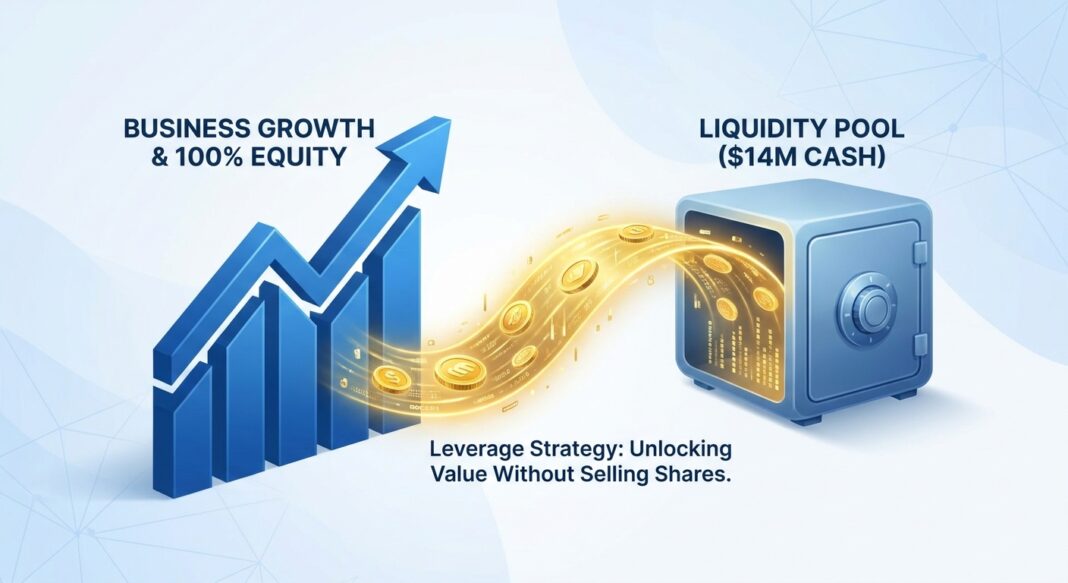
The third option was the one her advisor had to explain twice: a dividend recapitalization. The mechanics were straightforward. Greenline would borrow against its own cash flow (taking on a term loan sized at approximately 2.8x EBITDA, or $17.4 million) and distribute the proceeds directly to Claire as a special dividend. She would walk away with approximately $14 million in cash after transaction costs and applicable taxes, while retaining 100% of her equity and full operational control.
The structure looked like this:
- EBITDA: $6.2M
- Term Loan: $17.4M at SOFR + 425bps (~8.1% all-in rate)
- Annual Debt Service: ~$1.95M interest + $1.75M amortization = ~$3.7M/year
- Post-Recap Free Cash Flow: ~$2.5M/year (after debt service)
- Net Cash Distributed to Founder: ~$14M (post costs)
- Founder Equity Retained: 100%
Uncomfortable? Slightly. Greenline was carrying more debt than it ever had. But the company’s cash flow coverage ratio was a manageable 1.68x, above the 1.5x floor most private credit lenders require, and the recurring-contract nature of the business provided the revenue predictability lenders needed to get comfortable.
The Outcome: Cash in Hand, Upside Intact
Eighteen months after closing, Greenline had paid down $2.6 million of principal ahead of schedule and completed a small tuck-in acquisition, a two-county landscaping operation purchased for $3.1 million, using a modest revolver drawn against the business. EBITDA had grown to $7.4 million. The equity value, now more conservatively estimated at a 6.5x multiple, had risen to approximately $48 million.
Contrast this to the counterfactual. If Claire had sold at the time of the recap decision (7x EBITDA, $43.4 million) she would have captured her liquidity but permanently surrendered the equity growth from $43M to $48M and counting. Had she taken the minority PE deal instead, she would have given away 30% of that upside, worth roughly $14.4 million at current valuations, to a financial partner whose exit timeline was increasingly misaligned with hers.
The dividend recap gave her something neither of the other options could: personal financial security without the permanent cost of a control premium.
This is not an isolated result. It reflects a broader shift in how sophisticated operators are managing their balance sheets. Through the first eleven months of 2025, PE-backed companies issued $70.2 billion in leveraged loans earmarked for dividend recapitalizations, a post-Global Financial Crisis record, according to PitchBook LCD data. The driver is structural: with M&A exit volumes still well below 2021 peaks and IPO windows largely closed for sponsor-backed companies, dividend recapitalizations have become the primary mechanism for returning capital to limited partners. Founders operating without a sponsor intermediary can access the same instrument on their own terms.
The Cautionary Counterpoint: When Leverage Goes Wrong
The Greenline story works because the math is conservative and the business is resilient. Not every recap story ends that way, and the graveyard of overleveraged buyouts offers clear instruction on where the line sits.
Consider the fate of Party City. The large amount of debt used to finance its LBO added to Party City’s financial burdens, and following the transaction, the company had an extremely high debt-to-equity ratio relative to its retail company peers. Its interest coverage ratio collapsed. In 2023, Party City filed for Chapter 11 bankruptcy protection, and in 2024, announced it was winding down operations and permanently closing all of its stores. The business had low margins and volatile cash flows, precisely the conditions that make heavy leverage lethal.
The pattern runs deeper. One of the primary criticisms of dividend recapitalizations is that the re-leveraging of transactions introduces additional risks that are not adequately mitigated, particularly through the implementation of a new value creation plan in the target company. When leverage is applied to fund financial engineering rather than operational growth, the outcome is predictably fragile.
The distinction between Greenline and Party City is not clever structuring. It is business quality. Recurring-contract B2B services with 90%+ retention and predictable cash flows are a fundamentally different collateral base than low-margin, seasonally volatile consumer retail. Dividend recaps are best suited for businesses with strong cash flow, stable margins, and predictable revenue. The recap does not create resilience; it borrows against it.
The Lessons: A Framework for Founders Facing the Same Decision
Claire’s story surfaces five principles that apply broadly to any founder-operator considering a leveraged recap as a liquidity strategy.
1. Liquidity ≠ exit. Recapitalization is a middle ground that allows you to retain a portion of the equity while staying on as CEO. The founder’s instinct to conflate “taking money out” with “giving something up” is the first obstacle to clear thinking on this tool. A recap creates personal liquidity without changing the ownership structure.
2. Your business must be the right vehicle. The businesses that execute successful recaps share a profile: strong recurring revenue, durable customer relationships, EBITDA margins north of 15-20%, and cash flow visibility. A cyclical, margin-thin, or customer-concentrated business is not a good recap candidate; it is a bankruptcy candidate if forced to service significant new debt in a downturn.
3. Size the debt against service capacity, not ambition. The market standard for founder-led dividend recaps sits between 3x and 5x EBITDA depending on sector and credit quality. Claire’s 2.8x was deliberate conservatism. Coverage ratios below 1.5x DSCR introduce meaningful distress risk; above 2.0x, the deal is leaving liquidity on the table. The sweet spot is specific to your cash flow durability.
4. Misaligned incentives are a hidden tax. The founder de-risks their personal financial situation while retaining control and upside. The PE minority structure, by contrast, introduces a clock, a fund’s exit timeline that runs independently of the founder’s vision. The recap eliminates that clock entirely. The company’s time horizon stays the founder’s time horizon.
5. The market window matters. Leveraged loan issuance tied to sponsored dividend recaps grew 11% year-over-year to $74.3 billion in 2025, after rising 326% year-over-year in 2024. Lender appetite is high. Spreads have compressed from their 2023 peaks. Founders with strong businesses have more pricing power in the credit market today than they have had at any point since 2021, and more leverage to negotiate covenant-light structures that preserve operational flexibility.
Key Insights
- The recap is not a compromise; it is a synthesis. It combines owner liquidity with retained equity upside, eliminating the binary of “sell or stay illiquid” that forces founders into bad timing decisions.
- $74.3 billion in dividend recap issuance in 2025 signals institutional validation. Sophisticated sponsors are using this tool at record volume. Founder-operators can access the same mechanics without a PE intermediary taking 30-40% of their equity to do it.
- Business quality is the underwrite, not the deal structure. Party City’s collapse and Greenline’s success share the same instrument but opposite outcomes. Recurring, high-margin, contract-based cash flows are what make debt safe to carry. Volatility and thin margins make it lethal.
- Financial security changes founder decision-making quality. Operators who have diversified their personal balance sheet are less likely to make distressed decisions: accepting a bad acquisition, signing a predatory term sheet, or selling at the bottom of a cycle. The recap creates optionality, not complacency.
- The right question is not “should I take money off the table?” but “what is the cheapest form of capital that lets me do it?” Equity sold to a PE partner is permanent, expensive, and comes with governance strings. Debt taken on a strong business is temporary, predictable in cost, and leaves the founder holding all the upside.


