
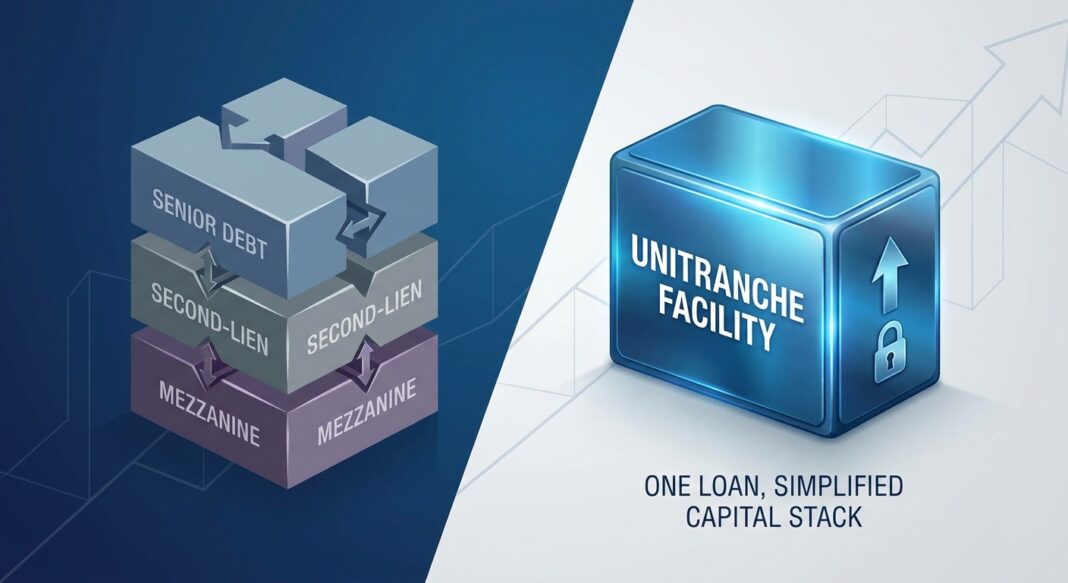
When One Loan Does the Work of Three
In traditional leveraged finance, a business borrowing to fund an acquisition would negotiate with a senior bank lender, a second-lien creditor, and a mezzanine fund: three separate credit agreements, three sets of covenants, three closing timelines, and three lender groups who may not agree when things go wrong. Unitranche financing collapses that complexity into a single instrument. One credit agreement, one lien package, one administrative agent, one closing.
For the middle market (broadly defined as companies generating between $10 million and $150 million in annual EBITDA) unitranche has shifted from an alternative option to the default structure. Understanding how it is built, priced, and governed is now a prerequisite for anyone evaluating private credit as an investor or accessing it as a business owner.
What a Unitranche Loan Actually Is
A unitranche loan is a single secured term loan that blends senior and subordinated debt economics into one instrument under one credit agreement. It occupies a first-priority lien on substantially all of the borrower’s assets, including the equity of domestic subsidiaries, and typically carries a five-to-seven-year term with limited amortization and a balloon payment at maturity.
The apparent simplicity on the borrower’s side often conceals a more nuanced arrangement between lenders. Many unitranche facilities use an Agreement Among Lenders (AAL), a private document that sits behind the borrower-facing credit agreement and splits the facility into a first-out tranche (which has payment and enforcement priority, earns a lower spread, and carries lower risk) and a last-out tranche (which absorbs loss first, earns a higher spread, and represents the riskier position). The borrower interacts with a single blended rate and a unified set of terms, the internal risk-sharing remains between lenders.
A super-senior revolver: typically provided by a bank for working capital, may sit ahead of the unitranche term loan in the payment waterfall, governed by a separate intercreditor agreement. When present, this structure preserves the unitranche’s first-lien character while giving the borrower flexible liquidity for day-to-day operations.
The Numbers: A Concrete Example
Consider a private equity sponsor acquiring a software company at a $100 million enterprise value. The deal is structured as follows:
- Purchase Price: $100 million
- Unitranche Facility: $55 million (5.5x leverage on $10M EBITDA)
- Revolving Credit Facility: $5 million super-senior (working capital)
- Sponsor Equity: $45 million
The unitranche is priced at SOFR + 500 basis points. With three-month Term SOFR near 3.69% as of Q2 2026, the all-in rate to the borrower is approximately 8.69% annually on a $55 million facility, a fully-loaded interest cost of roughly $4.8 million per year, covered by $10 million of EBITDA at a 2.1x interest coverage ratio.
Internally, the lender may split the $55 million into a $33 million first-out tranche (priced at SOFR + 350 bps) and a $22 million last-out tranche (priced at SOFR + 725 bps). The blended rate back to the borrower remains SOFR + 500 bps. The borrower sees one rate; the lenders share risk and return according to their sleeve. This internal architecture allows insurance companies and lower-risk capital to fund the first-out at investment-grade economics, while a direct lending fund holds the last-out at higher yield, an approach that McKinsey’s Global Private Markets Report 2026 confirms is increasingly common as insurance capital flows into investment-grade private credit structures at scale.
In a traditional senior-plus-mezzanine structure, this same deal might involve a senior bank term loan at SOFR + 250 bps and a mezzanine note at 12-14% cash or PIK. The borrower’s blended cost could be comparable, but the closing timeline, documentation burden, and inter-creditor negotiation are substantially higher.
Current Market Relevance
Unitranche is not a niche innovation; it is the dominant structure for middle-market leveraged finance in 2026. The market data underscore just how thoroughly it has reshaped capital formation:
| Metric | Data Point | Source |
|---|---|---|
| Lower-middle-market LBO unitranche penetration (2025) | ~80% of deals | S&P Global Market Intelligence via CTA Acquisitions, July 2026 |
| New-issue unitranche coupon spreads (Q2 2026) | SOFR + 475–550 bps | Valuation Research Corp., Q2 2026 Private Markets Update |
| Average all-in unitranche yield range (Q2 2026) | ~9.00%–9.75% | Valuation Research Corp., Q2 2026 Private Markets Update |
| New-issue private credit spread premium over syndicated loans (Aug 2026) | 162 bps | PitchBook LCD via Kadenwood Group, September 2026 |
| Global private credit AUM (start of 2026) | ~$1.7 trillion | Preqin 2026 Global Alternatives Report via CTA Acquisitions |
| LPs planning to increase private credit allocations (next 12 months) | 40% | McKinsey January 2026 LP Survey |
| Bank C&I lending standards Q2 2026 (SLOOS) | Broadly unchanged; C&I standards easier than historic midpoint | Federal Reserve July 2026 SLOOS |
A notable dynamic is the growing bifurcation between the existing book and new deals. PitchBook LCD data published September 10, 2026, show that new-issue private credit spreads averaged 502 basis points in the three months to August 31, up from 475 basis points in Q1, and that the premium over syndicated loans widened by approximately 39 basis points in that span. As Northleaf Capital noted in its Q1 2026 market update, direct lending continues to generate high single-digit unlevered asset returns, a meaningful premium relative to public credit markets.
On the bank side, the Federal Reserve’s July 2026 SLOOS shows that C&I lending standards were broadly unchanged in Q2, but bank demand data skews toward large firms ($50 million or more in revenue). Smaller sponsors and lower-middle-market borrowers, the natural unitranche universe, continue to face a more constrained bank channel, sustaining the structural case for private credit execution.
Decision Framework
For Investors Evaluating Unitranche Exposure
- First-out vs. last-out economics matter. Investors considering a fund may be exposed primarily to last-out risk without realizing it. Reviewing the fund’s AAL terms, tranche composition, and seniority definitions in portfolio disclosures is a foundational diligence step.
- Covenant density is declining. According to McKinsey’s Global Private Markets Report 2026, covenant-lite transactions rose to 21% of all direct lending deals by 2025, up from just 4% in 2023. Thinner covenant protection means lenders may have less early-warning time before a borrower deteriorates.
- Spread compression versus credit-cycle timing. All-in unitranche yields of roughly 9–9.75% remain well above pre-2022 historical ranges of approximately 7–8%, but are approximately 250 basis points below late-2023 peak levels. Investors evaluating new vintage commitments should weigh current spread levels against the credit cycle stage.
- PIK income trends signal portfolio health. Per the Cliffwater Direct Lending Index Q4 2025 report, payment-in-kind income as a percentage of total investment income declined to 7.3%, a constructive sign that most portfolio companies are paying cash interest.
For Operators and Sponsors Evaluating Unitranche vs. Alternatives
- Execution certainty has a price. Unitranche sponsors typically pay a 100–162 basis point premium over a syndicated bank loan for the same credit. That premium buys speed, confidentiality, and certainty of close, valuable when competing for acquisitions but worth quantifying in dollar terms over the life of the loan.
- Unitranche suits asset-light, cash-generative businesses. Typical unitranche borrowers are sponsor-backed companies with positive EBITDA, predictable cash conversion, and limited hard-asset collateral: software, business services, healthcare services, and specialty distribution are recurring sectors.
- Consider the super-senior revolver. Operators should evaluate whether a bank-provided super-senior revolver layered above the unitranche reduces their all-in cost for working capital liquidity, even if it adds a second lender relationship. The interest savings on drawn revolving balances can be meaningful.
Key Takeaways
- Unitranche is the structural default, not the alternative. Approximately 80% of lower-middle-market leveraged buyouts in 2025 used unitranche financing, according to S&P Global Market Intelligence data. Understanding its mechanics is foundational for anyone operating in private credit markets.
- One borrower rate, multiple lender economics. The AAL, invisible to the borrower, splits cash flows and control between first-out and last-out lenders. Investors must look through the surface simplicity to understand their actual position in the waterfall.
- Spreads are rising on new issuance even as existing book marks hold. PitchBook LCD data through August 2026 show new-issue private credit spreads averaging 502 basis points, up from 475 in Q1, while the premium over syndicated loans has widened to 162 basis points.
- Covenant protection is eroding with deal size. The rise of covenant-lite unitranche structures reduces lender control levers in early-stage borrower stress, a risk worth pricing carefully at current spread levels.
- Operators pay a premium for certainty. Unitranche’s key value proposition (speed, confidentiality, and a single lender group) commands a real pricing premium over syndicated alternatives. That trade-off is rational in competitive M&A processes and less rational in refinancings where time is available.


