
Mezzanine Financing for Growth-Stage Acquisitions: Structuring the Capital Stack Gap Between Senior Debt and Equity
The Capital Stack Problem Every Growth-Stage Acquirer Eventually Faces
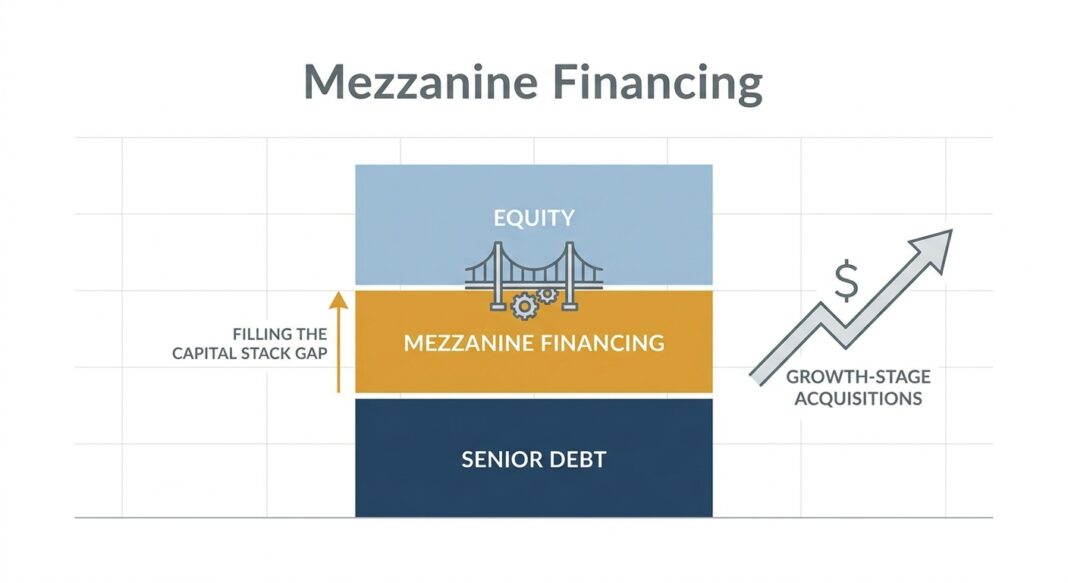
A profitable lower-middle-market operator (say, $6M in EBITDA, growing 15% annually) has identified an acquisition target at a $40M enterprise value. The senior bank stretches to 3.0x EBITDA, writing a $18M term loan. The sponsor or management team commits $14M of equity. That leaves an $8M gap sitting between the bank commitment and the equity check, a gap that is too structured for more equity and too subordinated for the bank to touch.
This is the canonical mezzanine moment. And in 2026, it is one of the most active deployment environments for subordinated debt that practitioners have seen in a decade. Understanding how to fill that gap efficiently (without over-diluting equity or over-levering the business) is the core skill of growth-stage capital stack engineering.
The challenge is not simply finding a mezzanine provider. The challenge is understanding the true all-in cost of the instrument, designing the PIK-versus-cash split to match your free cash flow profile, negotiating warrant coverage to minimize dilution at exit, and constructing a covenant package that preserves operational flexibility without compromising lender protections. Each of those decisions compounds through the hold period and shows up materially at the exit multiple.
Mezzanine Structure: Components, Mechanics, and a Worked Example
The Four Building Blocks
Mezzanine debt has a consistent anatomy across providers and deal sizes. Every instrument combines some weighting of four components:
- Cash Coupon. A base interest rate paid monthly or quarterly in cash, the portion of the instrument that looks and feels like traditional debt service. This is the component that directly loads onto the borrower’s near-term free cash flow.
- PIK (Payment-in-Kind) Interest. Rather than paying cash, PIK interest accrues onto the principal balance. The outstanding loan compounds over the hold period, with the full amount due at bullet maturity or exit. PIK is the cash-flow relief valve that makes mezzanine viable for acquisitive growth strategies where early FCF is thin.
- Equity Kicker (Warrants or Co-Investment Rights). A warrant or co-investment right that gives the mezzanine lender a small slice of the equity upside. This is the component that compensates the lender for accepting a subordinated position in the capital structure. It is also the component that makes mezzanine genuinely dilutive even though it is technically structured as debt.
- Origination and Arrangement Fees. Upfront fees paid at closing, typically layered on top of the yield economics.
2026 Market Pricing Reference
Current market pricing for a well-underwritten lower-middle-market mezzanine tranche reflects the post-rate-environment normalization happening through 2026. According to market data compiled by CT Acquisitions, a typical 2026 mezzanine debt financing rate for a healthy $5M to $15M EBITDA lower-middle-market company runs 11% to 14% cash coupon plus 1% to 4% PIK, with warrant coverage of roughly 1% to 5% of fully diluted equity. For comparison, Golub Capital’s direct lending research shows return ranges of 7%–9% for senior debt, 9%–11% for unitranche, and 10%–12% for junior debt, positioning mezzanine above all three in the cost-of-capital spectrum when warrant dilution is added back.
The blended all-in IRR that mezzanine funds underwrite to is typically 15%–20%. Mezzanine debt combines a fixed cash coupon with an equity kicker (usually warrants or a small co-invest) so the fund earns a blended 15% to 20% IRR. Borrowers who anchor only on the stated coupon and ignore the warrant dilution are systematically underestimating the true cost of the instrument.
Worked Example: $50M Enterprise Value Software Services Acquisition
Consider a $6.5M EBITDA software services company being acquired at a 7.7x EBITDA multiple ($50M EV) by a management team backed by a lower-middle-market private equity sponsor.
Illustrative Capital Stack
| Layer | Amount | % of EV | Pricing |
|---|---|---|---|
| Senior Term Loan (3.0x EBITDA) | $19.5M | 39% | SOFR + 475 bps (first lien) |
| Mezzanine (1.5x EBITDA) | $9.75M | 19.5% | 12% cash + 2% PIK + 2% warrant coverage |
| Sponsor Equity | $18.5M | 37% | Common equity / preferred |
| Seller Rollover | $2.25M | 4.5% | Rollover equity |
| Total | $50M | 100% | Blended cost: ~13.8% |
In this structure, the mezzanine tranche carries a 12% cash coupon on $9.75M (~$1.17M annual cash interest), a 2% PIK accruing annually to the principal balance, and warrants representing 2% of the fully diluted cap table struck at the transaction valuation. The PIK feature matters here: the PIK feature is what makes mezzanine attractive to growth-stage borrowers whose free cash flow does not yet support the full coupon. Over a five-year hold at 2% annual PIK, the principal grows from $9.75M to approximately $10.77M, the compounding refinancing burden the management team accepts in exchange for current cash-flow relief.
The covenant structure for this tranche would typically include a maintenance-based leverage test (total debt/EBITDA, quarterly) and a minimum debt service coverage ratio, alongside incurrence-based restrictions on additional debt, dividends, and permitted acquisitions. The median EBITDA multiple accepted by direct lenders on new unitranche facilities dropped from 6.1x in Q4 2025 to 5.4x in Q1 2026, DSR floors moved from 1.20x to 1.30x, and roughly 62 percent of new middle-market facilities carried at least one financial maintenance covenant, up from 41 percent a year earlier. Mezzanine lenders, operating deeper in the capital structure, are even more insistent on maintenance protections.
Mezzanine vs. the Alternatives: When Each Structure Wins
The decision to use a mezzanine tranche rather than an alternative structure is fundamentally a cost-versus-access trade-off, and it changes materially depending on deal size, credit profile, and timeline.
Mezzanine vs. Unitranche
For deals in the $30M–$150M EV range, the unitranche has become the dominant structure in private credit. For a $50M to $500M enterprise-value platform buyout, the typical debt structure in 2026 is a 4.0x to 5.5x total leverage unitranche loan sized off adjusted EBITDA with an equity check of 45% to 55% of purchase price. The unitranche eliminates the intercreditor complexity of a senior/mezz split and moves faster: term sheets in 2 to 3 weeks, close in 60 to 75 days from LOI is normal, versus 90 to 120 days for a syndicated deal. However, it prices above a comparable senior facility for a reason: a unitranche prices above a plain senior loan because it is carrying junior risk inside the same wrapper. What the borrower buys is not a lower coupon but a simpler, faster, more certain deal, and they pay a premium in spread for it.
The mezzanine-plus-senior split wins when: (a) the borrower has strong banking relationships and can source senior debt at tight bank pricing; (b) the equity sponsor wants to minimize lender control over the full capital structure; or (c) traditional senior plus mezzanine can achieve a lower weighted cost of capital if mezz carries equity kickers, but intercreditor complexity slows execution and reduces flexibility.
Mezzanine vs. Preferred Equity
When a company cannot support the fixed debt-service burden of mezzanine (either because EBITDA is too thin or cash flow is highly seasonal) preferred equity is often the structurally safer choice. Preferred equity makes more sense when the company wants flexibility: no fixed repayment obligation and no default risk if cash runs short during a rough quarter. The trade-off is that preferred equity is typically more expensive on a dilution basis and does not carry the tax-deductibility of interest payments that mezzanine debt provides. Borrowers often choose mezzanine financing when they want to keep the instrument classified as debt. That structure preserves tax-deductible interest and limits dilution to the warrant component.
When to Avoid Mezzanine Entirely
Mezzanine amplifies risk in declining-margin or cyclical businesses. The conditions that make mezzanine structurally wrong include: customer concentration above 30%, CapEx-intensive operations, organic EBITDA growth below 5% historically, and seasonal or lumpy cash flow profiles. In these conditions, mezz amplifies risk without adequate return; alternative strategies (a smaller deal, more equity, or a different financing structure) usually serve the buyer better.
Current Market Terms: What the 2026 Mezzanine Market Is Actually Clearing At
The mezzanine market in 2026 is operating in a compression environment following the rate-driven peak of 2024. Data points that practitioners should anchor to:
11%–14%
Mezzanine debt financing sits between senior credit and equity, priced today at roughly 11% to 14% cash coupon plus 1% to 4% PIK plus warrants of 1% to 5% of the fully diluted cap table.
1%–5% fully diluted
Mezzanine lenders frequently take equity warrants, typically 1% to 3% of the fully diluted equity, struck at the transaction valuation. Higher-risk credits or smaller issuers may see coverage drift toward the upper end of the 1%–5% range.
15%–20%
A blended cost of capital of 15% to 18% is normal for mezz plus warrants; the equity kicker is the reason funds accept a subordinated position without a board vote.
$5M–$75M
Typical LMM tranche size runs $5M to $75M, with SBIC-licensed funds like Plexus Capital and Falcon Investment Advisors handling smaller checks down to $2M.
Tightening in 2026
Respondents that won’t do deals without financial maintenance covenants grew dramatically to 46%, climbing 11 percentage points from 2025 and pointing to an increased desire on the part of lenders to seek credit deterioration protection.
SOFR + 475–550 bps
Current middle-market unitranche spreads run approximately S+4.75% to S+5.50% for mid-sized deals, per Lincoln International’s Q1 2026 data, though all-in rates vary by deal size, credit quality, and market conditions. Current spreads in the middle market run approximately S+4.75% to S+5.50% for deals in the $40M–$100M EBITDA range.
The covenant trend is worth special attention. The private credit market’s shift toward higher maintenance covenant frequency in 2026 reflects a reset from the cov-lite permissiveness of 2023–2024. Proskauer’s Private Credit Insights Report found that cov-lite deals rose to 21% of private credit transactions in 2025, up from just 4% in 2023. But the pendulum is swinging back: lenders who observed rising non-accrual rates are now insisting on quarterly maintenance tests that give them early intervention rights before a credit deteriorates to default. Maintenance covenants, mostly confined to private middle market loans, have two key characteristics. First, they require borrowers to report key financial metrics on a regular basis, providing lenders with early warning signals of potential distress. Second, they serve as functional levers to force engagement, where lenders can prompt corrective action if signs of stress begin to appear.
For borrowers, this means the PIK toggle conversation has also evolved. Effective PIK structures include carefully tailored triggers that constrain or condition PIK elections. Performance-based triggers might require a minimum liquidity threshold, a maximum leverage ratio, or positive free cash flow before permitting cash-pay toggling. Accepting an unconstrained PIK toggle in 2026 is increasingly difficult, lenders are requiring performance floors before the borrower can defer cash interest.
The Gap Capital Playbook: Quantify, Prepare, Run the Process, Negotiate
Mezzanine is not a capital source you stumble into. The providers are relationship-oriented, the diligence process runs 60–90 days from term sheet to close, and the best lenders are allocation-constrained. Operators and sponsors who run a disciplined process get materially better terms than those who arrive at the mezzanine conversation after failing to close a senior deal.
Step 1: Quantify the Gap Precisely
Before approaching a single provider, build a sources-and-uses model that makes the gap explicit. The gap is not simply “the amount left over after senior debt.” It is the residual after mapping: (a) total enterprise value at the agreed purchase price multiple, (b) senior debt capacity at the lender’s underwritten leverage multiple, (c) realistic equity contribution from the sponsor and any seller rollover, and (d) required closing liquidity reserves. The gap is the number at the intersection of those four constraints. The mezzanine tranche is sized to fill it, not padded, not undersized.
Step 2: Prepare the Right Materials
Mezzanine funds underwrite to a return model that requires the equity kicker to work. Mezzanine debt providers evaluate your historical and projected cash flow, growth potential, and ability to service both existing senior debt and the new mezzanine layer. Materials should include: three-year audited financials, a detailed LTM EBITDA bridge with management adjustments clearly labeled and defensible, a five-year projection model with sensitivity cases, a cap table showing current and pro forma dilution (including warrant scenarios), and a clear articulation of the acquisition thesis and expected value creation path. Do not underestimate the warrant scenario, mezzanine funds model the equity kicker value at the projected exit multiple. If your exit thesis is weak, the equity kicker looks thin, and the fund compensates by pushing the cash coupon higher.
Step 3: Run a Competitive Process
Send the package to at least four to six providers simultaneously. The mezzanine market has enough active participants (BDCs, dedicated mezzanine funds, family office credit vehicles) that competitive tension on term sheets is achievable. Named institutional players include Audax Mezzanine, NewSpring Mezzanine, Peninsula Capital Partners, Northstar Mezzanine, Star Mountain Capital, and Twin Brook Capital Partners. SBIC-licensed funds can offer pricing advantages due to their government-subsidized cost of capital. Running a competitive process is the single highest-leverage action a borrower can take, spreads and warrant coverage are directly influenced by how many credible competing term sheets exist.
Step 4: Understand the PIK Compounding Risk Before You Accept It
The PIK feature solves a near-term cash-flow problem but creates a future refinancing burden. When borrowers elect PIK interest, the outstanding balance compounds, increasing total debt burden. If the anticipated liquidity event is delayed, the growing PIK balance creates a larger refinancing burden at bullet maturity, a risk that can become severe in deteriorating markets. Model the PIK compounding at your base case hold period and at a hold period 24 months longer than expected. The number you get in the stress case is the leverage position you need to refinance or exit against. If it is uncomfortable, negotiate the PIK rate down before accepting the instrument.
Negotiation Guidance: The Five Levers That Move Mezzanine Terms
Mezzanine term sheets are more negotiable than borrowers typically assume. The key levers, ranked by the magnitude of economic impact:
1. Warrant Coverage and Strike Price
Every warrant granted to a mezzanine lender dilutes existing common equity. In a successful exit, the mezzanine lender’s equity kicker reduces the return available to the PE sponsor and management team, a cost that must be weighed against the benefit of reduced upfront equity contribution. Negotiate hard here. A 1% reduction in warrant coverage can be worth more to the management team at exit than a 50-basis-point reduction in the cash coupon. Ask for warrants struck at current enterprise value (not at a discount), with a defined sunset or buyout provision that lets the company repurchase the warrants at fair value before exit.
2. PIK Toggle Triggers
Push for an unconstrained PIK toggle for the first two years if your acquisition thesis involves investment-heavy growth spending. After year two, accept a performance-linked trigger that steps the toggle down as EBITDA scales. This structure aligns the PIK feature with the actual cash-flow ramp of the business rather than giving the fund an open-ended compounding right.
3. Call Protection and Prepayment Premiums
If the borrower elects to prepay the mezzanine instrument, the agreement should clarify whether make-whole or call protection applies to both the debt and the warrant value, and how capitalized PIK is factored into any premium calculation. A standard call schedule (3% in year one, 2% in year two, 1% in year three, par thereafter) is market-standard. Resist provisions that extend hard call protection beyond year three, as this creates a structural barrier to a refinancing event that benefits the lender at the borrower’s expense.
4. Covenant Headroom
The most common maintenance covenants are maximum leverage ratio, total debt divided by EBITDA, typically set at 4–6x depending on the industry and transaction. Negotiate the covenant levels to provide meaningful headroom above your base case projections, not just above your stress case. The standard ask is 20%–30% cushion above the closing leverage multiple. Given that financial maintenance covenant frequency in new middle-market facilities rose to 62% in Q1 2026, up from 41% a year earlier, you will not avoid them, but you can negotiate the thresholds and the cure mechanics.
5. Equity Kicker Buyout Provision
Request a defined buyout right on the warrants, a provision allowing the company to repurchase the warrants at a formula-based fair value before an exit event. This protects the equity holder from a scenario where the mezzanine lender holds warrants through a contested sale process, creating misaligned incentives at the time when alignment matters most.
Key Takeaways
- Mezzanine fills the capital stack gap precisely. It is the instrument designed for the layer between senior debt capacity and equity contribution, and it is most effective when sized to that specific gap rather than used as a substitute for equity or a replacement for senior leverage.
- The true all-in cost includes the warrant. A 12% cash coupon with 2%–3% PIK and 2% warrant coverage at a 7x exit multiple produces a blended lender IRR well above 18%. Borrowers who evaluate mezzanine only on the stated coupon are systematically underestimating the cost of capital.
- PIK compounding is a deferred risk, not a free lunch. Every year of PIK accrual increases the bullet refinancing burden at maturity. Model the hold period stress case, including a scenario 24 months longer than expected, before accepting the PIK toggle.
- The 2026 covenant environment has tightened materially. Maintenance covenants are now present in over 60% of new private credit facilities, and lenders who will not close without them have grown to nearly half the market. Negotiate headroom and cure rights, not covenant elimination.
- A competitive process is the most powerful negotiating tool. Running four to six simultaneous mezzanine processes (including SBIC-licensed funds and BDCs alongside dedicated mezz funds) produces materially better terms on warrant coverage and PIK mechanics than any single-track negotiation.


