
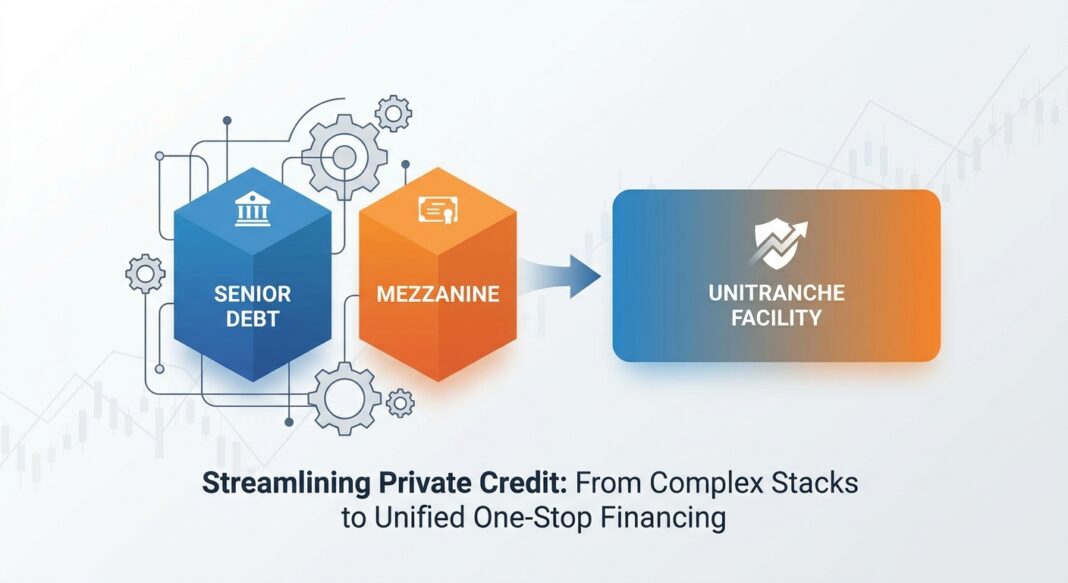
The Deal That Used to Take Three Lenders Now Takes One
Not long ago, a private equity sponsor acquiring a middle-market company would spend weeks negotiating with at least two creditor groups (a senior bank syndicate and a mezzanine fund) each with its own credit agreement, covenant package, fees, and approval process. Closings were slow, documentation was duplicative, and the moment a company needed an amendment, it required sign-off from multiple parties who did not always share the same interests.
The unitranche loan changed that. Today, according to CT Acquisitions (June 2026), roughly 80% of lower-middle-market leveraged buyouts use a private credit unitranche rather than a syndicated bank loan. Understanding how this instrument is structured (and why it has become the default financing tool for private equity-backed acquisitions) is foundational knowledge for both investors allocating to direct lending funds and business owners evaluating capital options.
What Is a Unitranche Loan?
A unitranche facility is a single-tranche term loan that merges what would traditionally be two separate debt instruments (a senior secured loan and a subordinated mezzanine note) into one unified credit agreement with one lender, one set of covenants, and one blended interest rate.
The mechanics work like this: a direct lender (or a small club of lenders coordinated by a lead) provides the full debt capital needed for an acquisition. Internally, the economics of the facility may be split between a first-out (FO) tranche and a last-out (LO) tranche through an Agreement Among Lenders (AAL), but the borrower sees only one loan document. The first-out holder gets repaid first and bears less risk; the last-out holder receives a higher yield to compensate for absorbing losses before the first-out position is impaired.
The blended rate the borrower pays sits between what a pure senior loan would cost and what a mezzanine note would demand, making it a compressed, efficient cost of capital compared to maintaining two separate facilities. As Stirling Capital Group (July 2026) explains, the unitranche rate is a weighted average that falls between the lower senior rate and the higher subordinated rate.
How It Works: A Concrete Example
Consider a private equity firm acquiring a software-as-a-service company with $10 million in EBITDA at a 7.0x purchase multiple, implying a $70 million enterprise value. The sponsor contributes 40% equity ($28 million) and needs $42 million in debt financing.
Under the traditional two-tranche structure, the deal might look like this:
- Senior bank loan: $28M at Term SOFR + 275 bps (~6.2% all-in)
- Mezzanine note: $14M at 13.0% fixed (often with warrants)
- Two separate credit agreements, two amendment processes, closing timeline of 8–12 weeks
Under a unitranche structure, a single direct lender provides the full $42 million:
- Unitranche loan: $42M at Term SOFR + 525 bps (~9.3% all-in as of Q2 2026)
- One credit agreement, one covenant (a maximum leverage ratio), closing in 3–4 weeks
- Original Issue Discount (OID): Approximately 1.0%–1.5%, meaning the borrower receives ~$41.4M but repays $42M in principal
- Prepayment schedule: 102/101/par over years 1–2, then par thereafter
The headline rate on the unitranche looks higher than the senior bank loan rate in isolation. But when the blended all-in cost of the traditional two-tranche structure (including mezzanine fees, warrant dilution, and duplicated documentation costs) is factored in, the unitranche frequently proves competitive. As Glacier Lake Partners (August 2026) notes, a unitranche can be less expensive than senior debt plus mezzanine once all fees, OID, unused commitments, warrants, and duplicated documentation are included.
Current Market Conditions: What the Data Shows
Unitranche financing is not just popular; it is the dominant architecture of private credit in 2026. Here is what current market data reveals:
| Metric | Current Reading | Source |
|---|---|---|
| Unitranche all-in yield (Q2 2026) | ~9.00%–9.75% | VRC Q2 2026 |
| Unitranche coupon spreads over SOFR | 4.75%–5.50% | VRC Q2 2026 |
| Maintenance covenant frequency (new unitranches, Q1 2026) | 62% carry at least one (up from 41% a year prior) | Yanne Capital / S&P LCD, Q1 2026 |
| Median EBITDA leverage (new unitranches, Q1 2026) | 5.4x (down from 6.1x in Q4 2025) | Yanne Capital, Q1 2026 |
| CDLI full-year 2025 return | 9.3% (20-year avg: 9.5%) | Cliffwater / Morningstar, March 2026 |
| Private credit global AUM (start of 2026) | ~$1.7 trillion (up from $970B in 2019) | CT Acquisitions / Preqin, June 2026 |
A notable structural development is the simultaneous compression in headline yields and tightening of underwriting terms. According to Yanne Capital (September 2026), median new-issue unitranche all-in yields dropped from 11.9% in Q4 2025 to 10.6% in Q1 2026, but lenders simultaneously raised debt service reserve floors and increased covenant frequency. This is a maturing market repricing risk rather than abandoning discipline.
Meanwhile, the broader bank lending backdrop has remained ambiguous. The Federal Reserve's July 2026 SLOOS showed C&I lending standards essentially unchanged in Q2, while the April 2026 SLOOS confirmed that banks tightened all surveyed terms for non-depository financial institution (NDFI) loans: including higher risk premiums, stricter covenants, and lower maximum credit line sizes. This bank-level retrenchment from non-bank finance continues to widen the addressable market for direct lenders.
Decision Framework: Investors and Operators
For Investors Evaluating Direct Lending Funds:
- Covenant quality matters now more than ever. With 62% of new unitranches carrying at least one maintenance covenant, up sharply from 41% just one year ago, investors should examine whether their fund manager is using covenants as an early-warning and value-protection mechanism, or simply as a negotiating point to be waived.
- Evaluate yield net of defaults. Per CT Acquisitions / PitchBook LCD (June 2026), trailing-12-month private credit default rates ran at approximately 3.7% by principal amount in Q1 2026, up from 1.1% in Q1 2022. Gross yield of 9–10% must be weighed against this loss experience.
- Assess first-out vs. last-out positioning within the AAL. Funds emphasizing first-out economics carry meaningfully lower risk profiles than those taking last-out exposure at higher nominal yields.
- Track leverage creep. The median underwriting leverage at 5.4x in Q1 2026 is lower than the 6.1x seen in Q4 2025, a healthier signal, but managers competing aggressively on deal flow can drift higher.
For Operators and Business Owners Evaluating Unitranche:
- Compare total cost, not headline rate. The all-in cost of a unitranche includes the spread, OID, upfront fees, and prepayment premium. Compare this against the fully-loaded cost of a senior bank line plus any mezzanine or equity component it would replace.
- Value the single-counterparty relationship. One lender means one amendment process, one waiver negotiation, and one relationship to manage if performance dips. This operational simplicity has tangible value during periods of stress.
- Understand what the maintenance covenant actually tests. Most unitranches include a single leverage covenant, typically set at 30–40% headroom above the base case plan. Model a downside scenario and verify the company can operate through it without triggering a technical default.
- Not every company is a fit. Businesses with volatile or seasonal EBITDA, asset-heavy balance sheets that qualify for cheaper asset-based lending, or near-term public-market refinancing options should evaluate alternatives before committing to unitranche economics.
Key Takeaways
- Unitranche combines senior and subordinated debt into one instrument, eliminating the structural complexity of the traditional senior-plus-mezzanine capital stack while delivering a blended rate that can be cost-competitive on a fully-loaded basis.
- The structure now dominates lower-middle-market M&A financing, with roughly 80% of lower-middle-market LBOs in 2025 closing with unitranche rather than syndicated bank debt, per S&P Global Market Intelligence.
- All-in yields have compressed from 2023 peaks: from ~12.5% to ~9.0%–9.75%, but lenders are simultaneously tightening underwriting, raising DSR floors, and increasing maintenance covenant frequency, signaling a market that is maturing rather than abandoning credit discipline.
- For investors, covenant quality and default-adjusted yield are the correct metrics to evaluate, not gross spread alone. With trailing default rates rising to ~3.7%, the spread-to-loss equation deserves careful scrutiny by vintage and manager.
- For operators, the unitranche is a powerful but not universal tool. Its value is maximized for businesses with predictable cash flows, clean capital structures, and acquisition-driven growth strategies where closing certainty and execution speed justify the blended cost of capital.


