
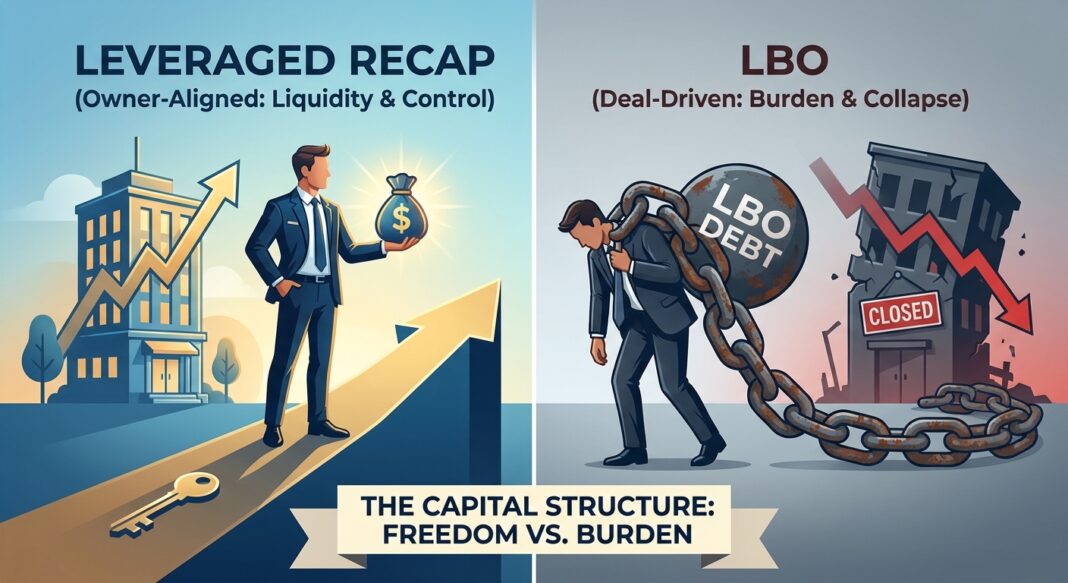
The Debt That Freed You vs. The Debt That Buried You
A Leveraged Recap vs. LBO Cautionary Tale
One owner used a unitranche leveraged recapitalization to pocket $30 million and keep 100% of his business. Another company took PE-backed LBO debt of $2.2 billion, roughly equal to its annual revenue, and eventually ceased to exist. The capital structure was everything.
The Story
Imagine spending two decades building a 60-unit quick-service restaurant (QSR) franchise operation. You’ve outperformed the system, driven same-store sales growth above the brand average, and assembled a loyal team that knows your territory cold. On paper, you’re worth a significant multiple. In the bank account? The business eats what it earns and reinvests the rest.
That was the situation for the owner profiled in CapitalSpring’s published recapitalization case studies, a franchisee operator who reached a pivotal moment common to owner-operators in their fifties and sixties: he wanted personal liquidity for estate planning purposes, but had no interest in handing the keys to a private equity buyer. He didn’t want a co-pilot. He wanted his equity out, while staying in the cockpit.
Contrast that with Party City. In 2012, private equity firm Thomas H. Lee Partners acquired the party supplies retailer in a leveraged buyout, saddling it with a debt load that would ultimately define (and end) its existence. The LBO wasn’t framed as a risk at the time. It was framed as a transformation. Party City would be taken private, improved operationally, and returned to the public markets. By 2015, it had indeed gone public again. But the debt never went away.
Two businesses. Two moments of capital decision. Two very different outcomes: separated not by industry luck, but by how leverage was structured, for whose benefit, and whether the underlying business could sustain the load placed on it.
The Capital Decision
The Franchisee Operator: Leveraged Recap on His Terms
The QSR operator faced a fragmented balance sheet. His 60 units were spread across multiple entities with disparate credit groups and several lender relationships, creating operational complexity and capping his debt capacity. A full sale would have solved the liquidity question, but at the cost of everything he’d built. Venture capital was irrelevant; he wasn’t a growth-stage startup. What he needed was a capital structure transaction designed for an owner who wanted to stay.
The solution was a leveraged recapitalization using a unitranche loan. CapitalSpring provided a unitranche structure at 6.0x EBITDA that consolidated all of the operator’s disparate entities under a single, flexible credit facility. The proceeds funded a ~$30 million special dividend paid directly to the owner: cash in hand, tax-managed, personal liquidity achieved. Critically, he retained 100% ownership of his business. No new shareholders. No board seats ceded. No cap table complexity introduced. The lender also structured the facility to preserve accordion capacity, leaving room for future bolt-on acquisitions in adjacent territories.
This is the architecture of a founder-aligned leveraged recap: debt sized to cash flow capacity, structured for operational flexibility, and designed to serve the owner rather than extract from the business. The instrument didn’t demand an exit. It created one, partially, on the owner’s schedule.
Party City: LBO Debt Calibrated to a Deal, Not a Business
The Party City LBO worked from a different logic entirely. The debt in an LBO is sized around deal economics, what leverage ratio allows a PE sponsor to achieve its target return on equity at a given purchase price. The business’s ability to service that debt over a full economic cycle, through competitive disruptions, or across unexpected operational headwinds, is a secondary consideration to closing the transaction.
When Thomas H. Lee Partners acquired Party City in 2012, the resulting debt load was $2.2 billion, an amount roughly equal to the company’s entire annual revenue. For a retailer with thin margins, seasonal demand patterns, and supply chain dependencies (including a meaningful reliance on helium for its balloon business), that leverage profile left almost no room for error. The interest coverage ratio became extremely low relative to retail industry peers. Any deviation from plan, any at all, would become a crisis.
The Outcome
The Franchisee: Liquidity, Retained Control, Growth Optionality
The QSR operator achieved exactly what he set out to accomplish. He walked away from closing with approximately $30 million in personal liquidity, diversifying decades of concentrated wealth, while retaining 100% equity ownership in a growing franchise operation. The unitranche structure consolidated his lender relationships into a single credit facility, reducing administrative drag and freeing management bandwidth. The accordion feature in the facility gave him optionality to fund acquisitions in contiguous territories without returning to market for fresh capital.
The counterfactual here is instructive. Had he sold to a PE buyer instead, likely at a 7x–9x EBITDA multiple for a well-performing QSR franchisee portfolio, he would have received a larger nominal check, but surrendered control, accepted rollover equity at a minority stake, and faced a 3–5 year hold period before a secondary exit. The leveraged recap delivered real cash now, preserved the upside of continued ownership, and left his incentives perfectly intact.
Party City: The Debt That Outlasted the Business
Party City’s story is a textbook case of leverage mismatch, debt calibrated to a deal model colliding with a business reality it couldn’t survive. The company hit its revenue high-water mark of $2.43 billion in 2018. Then came the disruptions: a nationwide helium shortage in 2019 devastated one of its most defensible and profitable service lines. COVID-19 struck at the core of its business model (celebrations and social gatherings) in 2020. Inflation eroded discretionary consumer spending through 2022 and 2023.
None of these events would have been fatal to a well-capitalized operator. To a company carrying $2.2 billion in LBO debt, they were a death sentence delivered in installments. By early 2023, Party City was forced to file for Chapter 11 bankruptcy, eliminating nearly $1 billion in debt. It emerged from that restructuring still carrying approximately $800 million in obligations, and without a credible operational turnaround plan. In late 2024, it filed for Chapter 11 a second time and announced the closure of its entire store footprint of nearly 700 locations. The party was permanently over.
Critically, the debt that buried Party City didn’t come from a bad business decision; it came from a capital structure decision made by a financial sponsor whose incentives were oriented around deal returns, not long-term business resilience. As one industry observer noted, Party City had a defensible market position and genuine consumer loyalty. It was the balance sheet, not the brand, that broke it.
The Lessons
1. Debt Structured for the Owner Serves the Business. Debt Structured for a Deal Serves the Sponsor.
The most important variable in any leverage decision isn’t the rate or the multiple, it’s the alignment of interests. In the franchisee recap, the lender and the operator shared a single goal: the business must generate sufficient cash flow to service the debt while the owner retains full upside. In the Party City LBO, the sponsor’s exit strategy required equity appreciation over a 3–5 year hold; the company’s long-term debt service capacity was a less pressing concern at origination.
2. Leverage Capacity Must Be Sized for Downside Scenarios, Not Upside Models.
Party City’s debt load was manageable, briefly, when revenue was growing. The moment growth plateaued, it became untenable. Lower-middle-market leveraged recapitalizations typically close at 3x to 5x EBITDA in total debt, according to the Pepperdine Private Capital Markets Report, leaving meaningful headroom for operational variability. The Party City LBO’s debt-to-revenue ratio of roughly 1:1 left none. Structuring leverage around a stressed, not optimistic, cash flow scenario is the discipline that separates durable capital structures from fragile ones.
3. Owner Liquidity and Owner Control Are Not Mutually Exclusive.
The persistent myth in private markets is that founders must choose: sell to get liquid, or stay to retain control. The leveraged recap demolishes this binary. A well-structured dividend recap allows owners to access capital without issuing new equity or changing ownership percentages, the equity stack remains untouched, the operating authority remains intact. The dividend recap is essentially debt-funded personal liquidity: the business borrows, the owner collects, and the company continues to compound on its own trajectory.
4. The Market Moment Matters, But It Doesn’t Change the Principles.
Leveraged buyout financing rose to $81 billion in 2025, the highest level on record, even as the number of individual LBO deals declined, suggesting sponsors are concentrating capital into larger transactions with stronger underlying cash flows. Simultaneously, dividend recapitalization volume in just the first half of 2025 reached $35 billion in leveraged loan issuance alone, reflecting widespread demand among operators and PE sponsors alike for liquidity without full exit. The structural market for owner-controlled recaps is deep and active. All-in yields on new private credit originations have declined meaningfully as base rates have fallen, making 2025 and 2026 a constructive environment for owners considering this structure.
5. The Best Leverage Creates Optionality. The Worst Leverage Eliminates It.
The franchisee’s unitranche facility included an accordion feature for future acquisitions. The debt was a platform, not a ceiling. Party City’s LBO debt consumed operating cash flow that could have funded e-commerce investment, store modernization, and competitive repositioning. Instead, as one analyst noted directly, the debt load meant the company failed to make the investments in technology that retailers must make to remain relevant. The capital structure didn’t just constrain the balance sheet. It constrained the strategy.
A Framework for Owner-Operators Facing This Decision
If you’re an operator considering your capital options, here are the questions that separate a liberating capital structure from a constraining one:
- Who does the debt serve? If the lender’s return depends on your business compounding, your interests are aligned. If it depends on a transaction closing, they may not be.
- What is your downside debt service coverage? Model your worst plausible revenue year, not your plan. Can you service principal and interest from that number alone?
- Does the structure preserve your strategic optionality? Accordion capacity, prepayment flexibility, and covenant headroom are not luxuries; they are the mechanisms by which debt becomes a tool rather than a trap.
- Is the liquidity event you’re creating durable? A dividend recap at 4x EBITDA with strong free cash flow conversion is durable. A dividend recap at 7x on a cyclical business with thin margins is not.
- What are you giving up? In the leveraged recap, the answer is cash flow, temporarily. In the PE-driven LBO, the answer is control, permanently, and if the thesis is wrong, the company itself.
Key Insights
- Debt that serves the owner preserves both liquidity and control. The unitranche leveraged recap gave one QSR franchisee $30 million in personal liquidity while leaving him with 100% ownership, a genuine third path between selling and staying put.
- LBO debt is sized for sponsor returns, not business resilience. Party City entered its LBO with $2.2 billion in debt against annual revenues of a similar magnitude, a leverage profile that survived growth but failed catastrophically when two consecutive shocks hit.
- The leveraged recap market is active and accessible. Dividend recap leveraged loan volume hit $35 billion in just the first half of 2025, with average leverage on sponsored recap transactions running at 5.1x EBITDA, a functional, liquid market for owners seeking structured liquidity.
- Overleveraged businesses cannot invest in their own survival. Party City’s debt service burden prevented reinvestment in technology and stores, a compounding strategic failure that outlasted every operational recovery attempt.
- The right leverage creates a platform. The wrong leverage creates a ceiling. Accordion features, flexible covenant packages, and conservative sizing transform debt into a strategic asset. Debt sized to maximize a deal’s equity returns transforms a business into a debt-service machine, until it breaks.


