
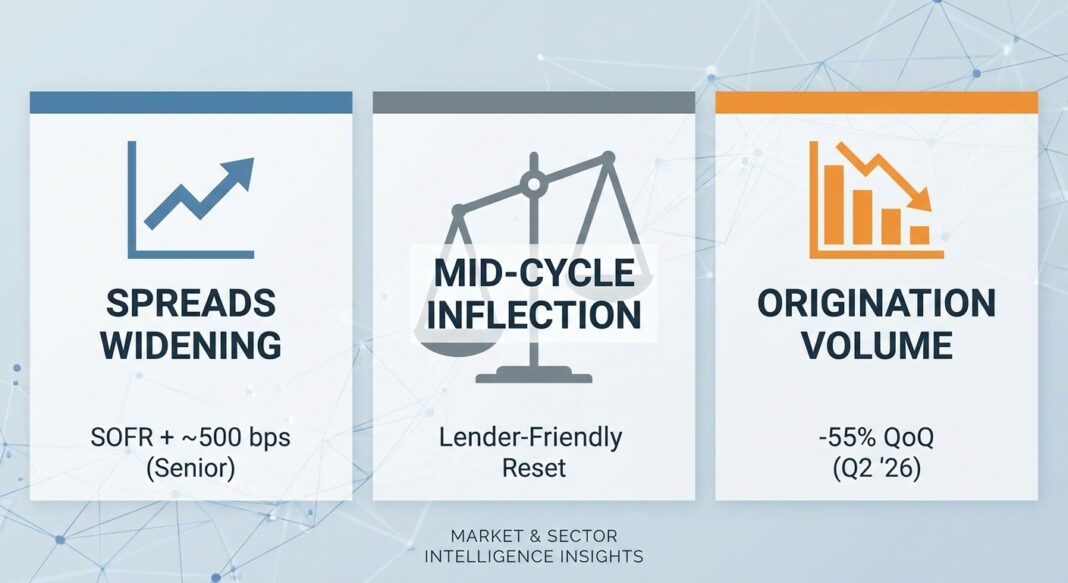
Market Headline: A Lender-Friendly Reset Is Underway, But Dispersion Is the Real Story
Private credit is navigating a genuine mid-cycle inflection point in Q3 2026. Three converging forces upended what had been a lender-benign environment heading into the year: a U.S.–Iran military conflict that rattled macro assumptions in February, an AI-driven reassessment of software credit quality that triggered sector-specific spread blowouts, and a wave of BDC redemption requests that exposed structural vulnerabilities in retail-oriented private credit vehicles. The result is a market that now strongly favors discipline over deployment velocity.
The headline shift is unambiguous on spreads. According to PitchBook data cited by Lord Abbett, middle market private credit spreads have widened by roughly 50 to 100 basis points since late 2025, with defensive documentation terms also improving in parallel. Hamilton Lane notes that senior direct lending spreads are back in the SOFR+500 bps context (up from the mid-400 bps level that prevailed through much of 2024 and early 2025) which, critically, is yield-enhancing for lenders in a higher-for-longer rate environment. Overnight SOFR stands at 3.65% as of September 4, 2026, while VRC reports that 3-month Term SOFR reached 3.68% in Q2, holding the all-in yield floor for floating-rate private credit firmly above 8.5% for core middle market loans.
But the spread move is only part of the story. Loan origination collapsed 55% quarter-over-quarter in Q2 2026, from $74.7 billion to $33.6 billion, making it the weakest lending quarter since Q2 2023. Deal counts fell in parallel. This is not a credit crisis; it is a market exercising selectivity. The second half of 2026 will be defined by performance dispersion between managers with covenant discipline and those carrying legacy 2021–2022 vintage exposures.
Quantitative Market Snapshot
All figures as of latest available data through September 9, 2026. Sources linked per metric.
| Metric | Current Value | Prior Period | Change | Source |
|---|---|---|---|---|
| Overnight SOFR Rate | 3.65% | ~4.30% (Q4 2024) | ↓ ~65 bps YoY | NY Fed / SOFRrate.com, Sep 4, 2026 |
| Middle Market Direct Lending Spreads (Core Senior) | SOFR + ~500 bps | SOFR + ~450 bps (late 2025) | ↑ ~50–100 bps | Hamilton Lane / PitchBook, H1 2026 |
| Software Sector Secondary Spreads | ~245 bps wider than year-end 2025 | ~16 bps above B-rated loan index (YE 2025) | ↑ +229 bps vs. broad B-rated index | VRC / PitchBook LCD, Jun 19, 2026 |
| Direct Lending Origination Volume (Q2 2026) | $33.6 billion | $74.7 billion (Q1 2026) | ↓ ~55% QoQ | PitchBook/LCD via Angel Investors Network, Aug 2026 |
| BDC Non-Accrual Rate (Top 20 by Median, Q2 2026) | 2.8% of total debt (at cost) | 2.0% (Q1 2026); ~1.3–1.4% (YE 2023) | ↑ +80 bps QoQ; highest since 2017 | Solve / Financial Times via Angel Investors Network, Sep 2026 |
| Private Credit vs. Public High Yield Spread Premium | ~150–200 bps over HY | ~350 bps (2019) | ↓ ~150–200 bps compression vs. 2019 | Owners.pe, Apr 2026 |
| 5-Year U.S. Treasury Yield | ~4.23% (Jun 2026) | 3.92% (Mar 2026) | ↑ +31 bps QoQ | VRC Private Markets Report, Jul 6, 2026 |
KPI Watchlist, Borrower Credit Quality: Heron Finance’s Q2 2026 analysis of 69 established private credit funds found that borrower interest coverage ratios (EBITDA/interest: a proxy for FCCR) improved year-over-year as rates moderated slightly and EBITDA grew, while loan-to-value (LTV) ratios remained stable, suggesting lenders have not materially loosened underwriting standards over the past three years. The Fed’s July 2026 SLOOS confirms that C&I bank lending standards remained essentially unchanged in Q2, with the current level reported as easier than the historical midpoint: providing a constructive, if cautious, backdrop for bank-originated credit.
Sector Analysis: Hot Capital, Cold Exposure, and Structural Rotation
🟢 Healthcare: The Enduring Anchor
Healthcare led all sectors in private credit deal activity in 2025, accounting for 19% of all direct lending transactions, and was notably the only major sector that did not experience meaningful year-over-year spread tightening, with pricing landing at approximately SOFR+500 bps in Q4 2025. That premium has held into 2026, reflecting both lender conviction in non-cyclical cash flow profiles and the continued absence of rate-sensitive M&A compression in the space. Demographic tailwinds and recurring revenue models continue to draw lender capital toward healthcare services, specialty pharma distribution, and outpatient care platforms.
🔴 Software & Technology: Structurally Re-Priced
No sector has undergone a more dramatic re-underwriting than software. Software secondary spreads are now approximately 245 basis points wider than year-end 2025 levels and roughly 229 basis points above the broader B-rated loan index, as AI-driven disruption concerns have prompted lenders to reassess recurring revenue durability, competitive moats, and the reliability of ARR-based leverage structures. AI strategy evaluation has become a critical underwriting component for any technology-exposed credit in Q1 2026 onward. Deals with software revenue concentration above 60% are facing materially higher spreads, tighter covenants, and, in several cases, lender refusal. The concentration of software in BDC portfolios is a direct contributor to the redemption pressure seen across several vehicles in Q1 and Q2.
🟡 Industrials & Energy: Cautious Appetite with Macro Overlay
Lenders have responded to the geopolitical energy shock of early 2026 by tightening underwriting standards for energy-intensive industries and businesses whose leverage was predicated on stable energy costs. Industrial businesses with meaningful oil price sensitivity (including transportation, chemical manufacturing, and consumer staples distribution) are now subject to explicit energy cost stress scenarios in credit underwriting. Despite this, broader industrials M&A activity remains a targeted opportunity, with lenders selectively supporting consolidation platforms with contractual pricing mechanisms.
🟢 Asset-Based Finance & Infrastructure: The Capital Rotation Beneficiary
The most significant structural shift in 2026 is the diversification of private credit capital away from pure direct lending. Direct lending’s share of global private debt capital raised fell from 58.4% in 2024 to roughly 31% by Q1 2026, with specialty finance (including asset-backed strategies, infrastructure debt, and real estate credit) emerging as the primary beneficiary. Specialty finance raised $37 billion in 2025, more than the prior two years combined. As European nations ramp infrastructure and defense spending, managers including Apollo and Ares have cited a substantial origination opportunity on the continent, creating a transatlantic capital flow dimension that U.S.-focused allocators should monitor closely.
🟡 Lower Middle Market: The Overlooked Premium
The lower middle market (LMM) spread premium over large-cap deals widened to 232 basis points in Q3 2025, a divergence that has only deepened in 2026 as the capital wave driving large-cap spread compression has not reached the $5M–$25M EBITDA segment. For lenders with the infrastructure and risk tolerance to operate there, real covenants, higher spreads, and a growing deal pipeline from baby boomer business succession create a structurally differentiated opportunity.
Strategic & Operational Implications
For Institutional Investors
The compression of the private credit–to–high yield spread premium is the most underappreciated structural risk in the market today. That premium has narrowed from approximately 350 bps in 2019 to 150–200 bps today, compressing the illiquidity premium, information asymmetry premium, and concentration premium that historically justified the asset class’s pricing relative to public high yield. At current spread levels, allocators must demand rigorous justification for the liquidity lockup they are accepting. Non-accruals, PIK usage, sector concentration, and 2021–2022 vintage exposure are now the portfolio differentiation variables that matter most. Managers with older vintages, heavy software concentration, or aggressive PIK structures should be subject to enhanced due diligence and, where appropriate, position sizing adjustments.
For investors in semi-liquid BDC vehicles specifically, the redemption data is a structural warning signal. Ares Strategic Income Fund received redemption requests representing 14.4% of shares outstanding in Q2, but honored only its 5% quarterly cap. Gating mechanics are not a crisis, but they are a liquidity constraint that institutional allocators must factor into portfolio-level cash flow planning, particularly in multi-asset vehicles where private credit serves as a diversifier.
For Operators and Borrowers
For companies seeking capital in 2026, the two-tier market structure is the dominant operating reality. Lending activity remains competitive for higher-quality deals, with large-cap borrowers benefiting from both bank re-entry, banks have gradually returned to the upper middle market since June, alleviating upward pressure on credit spreads, and ample private credit dry powder. Operators in the core middle market with demonstrable free cash flow generation, fixed charge coverage ratios (FCCR) above 1.25x, and minimal software revenue exposure can still access favorable unitranche pricing in the SOFR+450–500 bps range. Companies with AI-disruption risk embedded in their revenue model, energy cost exposure without contractual pass-throughs, or leverage above 5.5x EBITDA should anticipate tighter terms, deeper covenant packages, and higher pricing than 12 months ago.
The April 2026 SLOOS revealed that banks have tightened all terms surveyed on loans to non-depository financial institutions (NDFIs), including stricter loan covenants, shorter maximum maturities, and lower maximum credit line sizes. This tightening specifically affects the warehouse lines and subscription facilities that private credit fund managers themselves depend on, adding a secondary layer of cost and constraint that will flow through to deal economics over time.
Forward-Looking View: Liquidity and Lending Dynamics Through Q1 2027
The second half of 2026 is likely to be defined by dispersion, between sectors, between managers, and between vintages. The macro backdrop of higher-for-longer rates (the forward curve remained broadly flat as of June 2026), combined with still-elevated energy costs and ongoing AI disruption pricing across the technology sector, suggests that the credit environment will remain selective rather than broadly permissive for at least two more quarters.
The deployment gap is the most acute near-term risk for fund managers. With 154 completed direct lending transactions in Q2, a 29% drop from Q1’s 217 deals, GPs face mounting pressure from their own investors to show deployment progress, creating the risk that credit standards soften if the gap between raised and deployed capital persists. The Q2 data suggests managers largely held the line by pulling back on volume rather than relaxing terms, a constructive signal, but one that could shift rapidly in Q3 if M&A pipelines remain subdued.
Three indicators merit close monitoring through Q1 2027: (1) BDC non-accrual trajectory: the median rate across the top 20 BDCs reached 2.8% in Q2, roughly double the 2023 baseline; direction and velocity matter more than the absolute level at this stage; (2) Bank re-entry dynamics: banks reclaiming upper middle market share is a spread-compressing force in large-cap deals, but a credit-loosening risk if competitive pressure intensifies through H2; and (3) M&A pipeline recovery: a more active M&A backdrop expands the opportunity set for disciplined lenders, and any recovery in PE exit activity will be the single most powerful catalyst for deal flow normalization.
Structurally, the private credit market is not in crisis, headline stress has been company-specific, not systemic, and loan-to-value ratios remain conservative. But the era of undifferentiated spread compression is over. The opportunity is real, but the advantage will go to managers who combine patience with discipline.
Key Market Insights
- 📊 Spread Reset is Lender-Friendly, But Narrow: Middle market direct lending spreads have widened 50–100 bps since late 2025, returning to SOFR+500 bps for senior secured: enhancing yield for new originations, but the private credit premium over public high yield has compressed to just 150–200 bps, down from ~350 bps in 2019, narrowing the structural alpha justification. (Hamilton Lane; Owners.pe)
- ⚠️ Non-Accrual Acceleration is the Leading Stress Signal: The median non-accrual ratio across the 20 largest BDCs reached 2.8% in Q2 2026 (the highest since 2017 and roughly double the 2023 baseline) driven by software-sector concentration and 2021–2022 vintage leverage. A continued rise through Q3 would confirm a broader credit quality deterioration rather than idiosyncratic stress. (Solve/FT via Angel Investors Network; PitchBook LCD)
- 🔁 Sector Rotation Away from Direct Lending is Structural: Direct lending’s share of global private debt capital raised fell from 58.4% in 2024 to ~31% by Q1 2026, with asset-backed finance, infrastructure debt, and specialty finance absorbing displaced capital. This rotation is structural, not cyclical, and will reshape manager positioning and fee economics over the medium term. (Investing.com)
- 🏦 Bank Standards Are Steady, But NDFI Tightening is a Hidden Cost: The Fed’s July 2026 SLOOS shows C&I lending standards unchanged and easier than historic midpoints, broadly constructive for commercial borrowers. However, banks have tightened all terms on NDFI loans, including to private credit funds themselves, a second-order cost that will flow through to fund-level economics and potentially borrower pricing in H2 2026. (Federal Reserve SLOOS, Jul 2026; Federal Reserve SLOOS, Apr 2026)
- 🔍 Manager Selection and FCCR Discipline Are Now Differentiating: With LTV ratios stable and borrower interest coverage ratios improving modestly year-over-year, aggregate portfolio health is not yet alarming, but the gap between well-underwritten and legacy-exposed portfolios is widening. Institutional investors should prioritize managers with explicit FCCR floors (typically ≥1.20x), documented AI-risk screening, and energy cost sensitivity analysis in their underwriting protocols as minimum due diligence standards. (Heron Finance Q2 2026; Lord Abbett Midyear 2026)


