
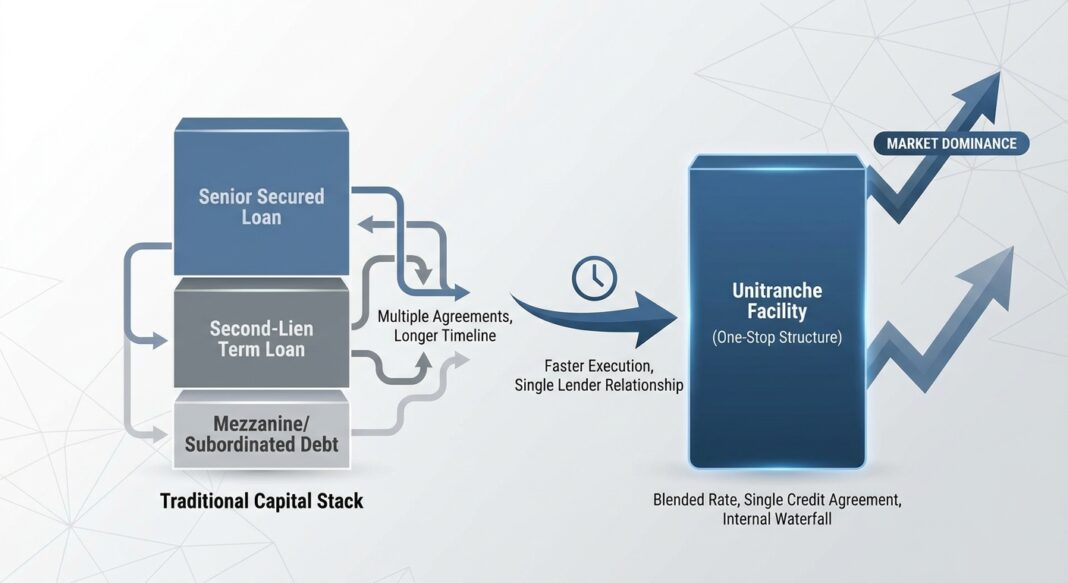
Why the Unitranche Loan Changed Everything
If you have ever tried to finance a middle-market acquisition, you know the old playbook: negotiate a senior secured loan with a bank, layer in a second-lien term loan with a specialty lender, wrestle two sets of counsel through competing covenants, and then watch the deal timeline stretch into months. Private credit managers invented a better way. The unitranche loan collapses that multi-party capital stack into a single credit facility, a single interest rate, and a single set of loan documents, giving borrowers execution speed while giving lenders full-stack economics.
Today, unitranche structures dominate new private credit issuance. Understanding how they actually work (mechanically, economically, and structurally) is the foundation of evaluating any middle-market direct lending opportunity, whether you are the business owner signing the term sheet or the institutional investor holding the paper.
What a Unitranche Loan Actually Is
A unitranche is a hybrid debt instrument that combines what would traditionally be separate first-lien senior debt and second-lien or subordinated debt into a single secured credit facility governed by one loan agreement. Rather than creating two distinct tranches with separate intercreditor arrangements, the unitranche structure achieves internal subordination within a single facility.
From the borrower’s perspective, the loan looks and feels like a straightforward first-lien term loan: one lender relationship, one closing process, one set of covenants, and one blended interest rate. What the borrower never sees is the Agreement Among Lenders (AAL): the private contract between the lender groups that splits the facility into a “first-out” (FO) tranche and a “last-out” (LO) tranche.
- First-Out (FO): Receives priority repayment in any waterfall event (default, sale, bankruptcy). Earns a lower spread because it carries lower risk, typically occupied by banks or senior-focused funds.
- Last-Out (LO): Absorbs first-dollar losses in a distress scenario. Earns a higher spread as compensation, typically occupied by private credit funds.
The AAL establishes the payment waterfall, repurchase rights, voting rights, and lender remedies between these two groups, none of which the borrower needs to negotiate directly. As Mayer Brown described in its July 2026 analysis, “there is only one lien, and the priority of payment is governed by an agreement among the lenders rather than by the relative priority of competing security interests.”
How It Works: A Concrete Example With Real Numbers
Consider a private equity sponsor acquiring a software business with $20 million in EBITDA at a 10x multiple, a $200 million enterprise value. The sponsor puts up 40% equity ($80 million) and needs $120 million of debt financing.
Traditional Bifurcated Structure:
- First-lien term loan: $80 million at SOFR + 3.50% (approx. 7.2% all-in)
- Second-lien term loan: $40 million at SOFR + 7.00% (approx. 10.7% all-in)
- Two sets of counsel, two credit agreements, intercreditor negotiations: 8–12 weeks to close
- Blended cost of debt: approximately 8.3%
Unitranche Alternative:
- Single unitranche facility: $120 million at SOFR + 5.25% (approx. 8.9% all-in)
- FO/LO split handled privately via AAL between lenders
- One credit agreement, one set of covenants, 3–5 weeks to close
- All-in borrower cost: approximately 8.9%
The borrower pays roughly 60 basis points more on the blended rate versus the bifurcated structure. What they receive in exchange: dramatically faster execution, reduced deal friction, and a single lender relationship post-close. For a competitive auction process where certainty of close is essential, that premium is frequently worth paying. According to Penfund’s structural analysis, the bifurcated structure can offer a lower blended cost of capital, but only when borrowers make optimal use of incremental baskets and are willing to accept the complexity of managing two lender groups.
Current Market Relevance: What the Data Shows in 2026
The unitranche structure isn’t just dominant, it’s repricing in real time as market conditions shift. Several current data points frame where this product sits today:
| Metric | Current Reading | Source |
|---|---|---|
| Unitranche all-in yield range (Q2 2026) | ~9.00% – 9.75% | Valuation Research Corp., July 2026 |
| Unitranche coupon spreads (new issuance) | SOFR + 4.75% to 5.50% | Valuation Research Corp., July 2026 |
| Middle market direct lending spread (Q4 2025) | ~SOFR + 500 bps | Octus, 2026 Private Credit Outlook |
| Maintenance covenant frequency (new unitranche, Q1 2026) | 62% of facilities (up from 41%) | Yanne Capital / S&P LCD, Q1 2026 |
| Median leverage accepted (new unitranche, Q1 2026) | 5.4x EBITDA (down from 6.1x in Q4 2025) | Yanne Capital / PitchBook, Q1 2026 |
Three structural dynamics are actively reshaping the unitranche market right now:
1. The covenant comeback. After years of borrower-friendly, covenant-lite issuance, lenders are reasserting discipline. According to Yanne Capital’s Q1 2026 credit markets analysis, financial maintenance covenant frequency in new middle-market unitranche facilities rose to 62% in Q1 2026, up from 41% just one year earlier. Debt service reserve (DSR) floors also tightened, moving from a median of 1.20x to 1.30x.
2. Underwriting is tightening at the margins. Lord Abbett’s 2026 Midyear Outlook notes that spreads have widened by roughly 50 to 100 basis points since late 2025, while defensive documentation terms have improved, a lender-friendly reset after a long period of competitive compression.
3. Bank C&I standards remain broadly stable but selectively tighter for non-bank intermediaries. The Federal Reserve’s July 2026 SLOOS reported unchanged C&I lending standards overall, but the April 2026 survey found that significant net shares of banks tightened standards specifically for loans to business credit intermediaries, the institutions that sit behind many private credit fund structures. This dynamic continues to redirect middle-market borrowers toward direct lenders rather than bank-intermediated capital.
Decision Framework: Investors and Operators
For Investors Evaluating Unitranche Exposure
When analyzing a unitranche position in a private credit fund or BDC, investors consider several structural variables:
- FO vs. LO positioning: Is the fund primarily holding first-out paper (lower yield, lower risk) or last-out (higher yield, first-loss)? The AAL determines actual credit seniority, not the loan label.
- Covenant structure: Does the facility include maintenance covenants (tested quarterly) or only incurrence covenants (tested only on new borrowings)? Maintenance covenants provide early warning signals and negotiating leverage, a critical distinction when evaluating downside protection.
- Spread-to-leverage ratio: At 5.4x median leverage and SOFR+500 bps, today’s underwriting reflects meaningfully better risk-adjusted entry points than the 6.1x leverage / SOFR+480 bps environment of mid-2025.
- Non-accrual trends: According to Yanne Capital, non-accrual rates on direct lending BDC portfolios rose from a Q4 2023 industry median of 1.4% to a Q4 2025 median of 3.1%, a meaningful increase worth monitoring across vintage years.
For Operators Deciding Whether to Use a Unitranche
Business owners and CFOs evaluating a unitranche versus a bifurcated structure typically weigh these factors:
- Speed and certainty: Unitranches close in weeks, not months. In a competitive M&A process, execution certainty can be decisive.
- Cost premium: Accept that a unitranche will likely price 50–100 bps higher than an optimally structured bifurcated deal. That premium buys simplicity and speed.
- Covenant negotiations: With maintenance covenants now present in 62% of new facilities, operators should negotiate equity cure rights carefully. Standard 2026 terms typically allow four cures over the loan life, with no more than two in any consecutive four quarters.
- Prepayment flexibility: Standard 2026 prepayment schedules run 102/101/par over the first three years, meaning refinancing early to capture a spread improvement can be eroded quickly by call premiums.
Key Takeaways
- Unitranche = one loan, internal waterfall. The borrower signs one agreement; lenders privately negotiate FO/LO priority via an AAL. Understand what the fund actually holds before drawing conclusions about seniority or risk.
- Current all-in yields of 9.0%–9.75% represent a meaningful decline from the 2023 peak (11.5%–12.5%) but remain well above the pre-2022 historical range of 7%–8%, reflecting a market that has repriced toward balance.
- Covenants are back. After years of covenant-lite dominance, 62% of new middle-market unitranches now include financial maintenance covenants, a structural improvement for investors that warrants scrutiny of older, looser vintage loans still on portfolios.
- Bank withdrawal continues to benefit direct lenders. The Federal Reserve’s SLOOS data shows banks tightening standards for non-bank financial intermediaries even as C&I standards hold steady, a structural dynamic that continues to expand the addressable market for unitranche-style private credit.
- Operators pay a speed premium. The unitranche costs more than a bifurcated structure, but for acquisitions, refinancings, or growth capital where execution certainty matters, the simplicity and speed of a single lender relationship frequently justify the additional basis points.


