
The Financing Gap That Defines Growth-Stage Acquisitions
A growth-stage company, $3M–$10M EBITDA, recurring revenue, a clear acquisition thesis: identifies a target. The deal makes strategic sense. The math works at the right capital cost. But the moment a financing model is stress-tested, a structural reality sets in: the senior lender will take the deal to 3.0x–4.0x EBITDA, the equity check covers 30–40% of the enterprise value, and somewhere between those two figures sits a gap of $5M to $20M that neither party can fill alone.
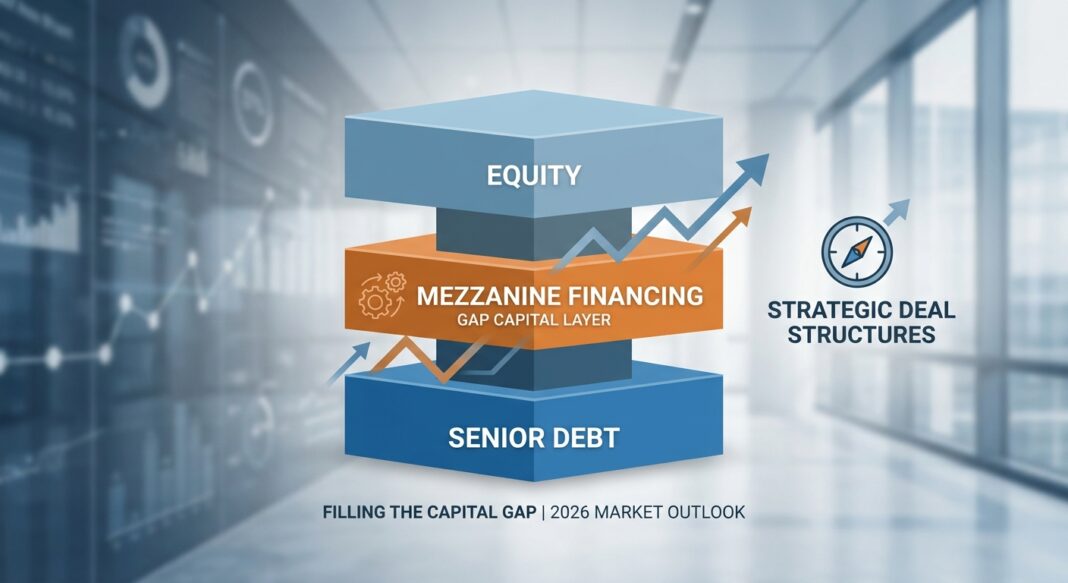
This gap is not a financing failure. It is a structural feature of growth-stage acquisition capital, and it is precisely where mezzanine debt operates. Mezzanine fills the space between senior debt capacity and the equity floor, without requiring the permanent dilution of a priced equity round.
Understanding how to size the gap, select the right instrument, manage total cost across the full stack, and negotiate the structure intelligently is one of the highest-leverage capital skills a growth-stage operator can build. This article is a practitioner’s guide to exactly that, grounded in how the market is actually pricing and documenting these deals in 2026.
The Capital Stack: A Layer-by-Layer Breakdown
A growth-stage acquisition typically involves three to four discrete financing layers, each with a different cost, structural expectation, and risk tolerance. Understanding the mechanics of each layer is prerequisite to knowing where mezzanine belongs and how to deploy it correctly.
Layer 1: Senior Secured Debt (Bank or Direct Lending)
The cheapest layer in cash-pay terms and the first to be placed. Senior lenders set the floor (and the ceiling) for everything below them. In 2026, bank facilities for growth businesses typically price at SOFR + 250–450 basis points, while direct lending senior facilities clear at SOFR + 500–700 basis points, sized at 2.5x–4.0x EBITDA depending on business quality and sector. This layer carries a first lien on operating assets and controls the intercreditor agreement that every junior tranche must negotiate against.
Layer 2: Unitranche (The Compressed Alternative)
For acquisitions in the $25M–$200M enterprise value range, unitranche has become the dominant debt instrument. A unitranche collapses senior and junior debt into a single instrument, with one lender group, one document, and one interest rate. The borrower trades a modestly higher all-in cost for deal certainty, faster execution, and fewer counterparties to manage. Median all-in coupons on unitranche facilities in the $5M–$50M band were clearing at approximately 10.2% as of June 2026, per S&P LCD, with leverage capacity reaching 4–5x EBITDA, roughly 100–150 basis points above comparable broadly syndicated loans. Unitranche wins when the acquisition timeline is compressed and intercreditor complexity is the primary structural risk.
Layer 3: Mezzanine / Subordinated Debt (The Gap Capital Layer)
When leverage requirements exceed what a senior or unitranche provider will deploy (or when the operator wants to preserve equity ownership at scale) mezzanine fills the structural gap. Mezzanine debt has three defining structural features that distinguish it from senior debt: its subordinated and unsecured position, its option for Payment-in-Kind (PIK) interest, and its equity kicker, almost always in the form of stock warrants.
In 2026, the all-in cost of mezzanine runs 13%–18%, structured as a cash-pay coupon of 8%–12%, plus a PIK component of 2%–4% (which accrues to principal rather than paying current cash), plus warrant coverage of 1%–5% of fully diluted equity. At a total investor IRR of 16%–22% including the equity component, mezzanine is expensive, but it avoids the permanent dilution of a priced equity round.
Layer 4: Preferred Equity, Seller Notes, or Rollover Equity
When the debt stack is fully stretched but the equity check would still be prohibitively dilutive, a fourth layer can bridge the final gap. Preferred equity from structured capital providers carries equity-like rights with a fixed return expectation. Seller notes, where the seller takes back a portion of the purchase price as deferred debt, represent the lowest-cost junior capital available in any transaction and should always be negotiated first before approaching third-party mezz or preferred providers.
A Worked Example: The $30M Acquisition Stack
Target: A B2B software services company, $4.5M EBITDA, $30M acquisition price (6.7x EBITDA)
Layer Amount % of EV Pricing / Terms Senior Secured (Direct Lender) $15.75M 52.5% 3.5x EBITDA | SOFR + 575 bps Mezzanine / Sub Debt $5.25M 17.5% 1.2x EBITDA | 10% cash + 3% PIK + 3% warrants Seller Note $1.50M 5.0% 6% cash interest | 3-year term Sponsor Equity $7.50M 25.0% Common equity Total $30.00M 100% Wtd. avg. cost ~9.8% cash-pay
This structure uses total leverage of 4.7x EBITDA, stretches the debt stack without subordinating the equity to an excessive fixed charge burden, and keeps equity ownership above 25%, enough to maintain governance control and preserve meaningful upside at exit.
Mezzanine vs. Alternatives: Trade-Offs Across the Stack
Selecting mezzanine over the alternatives is a function of four variables: leverage requirement, dilution tolerance, execution timeline, and covenant flexibility. Each competing structure makes a different trade-off across those dimensions.
Mezzanine vs. Unitranche
Unitranche is faster, simpler, and eliminates intercreditor complexity. A unitranche provider deploys one document and one lender group, collapsing first lien and junior risk into a single blended rate. Traditional senior-plus-mezzanine can achieve a lower weighted cost of capital when the mezz carries equity kickers that substitute for headline rate, but intercreditor complexity slows execution and reduces flexibility. Unitranche wins on speed, confidentiality, and single-document control. Mezzanine wins when total leverage requirements exceed unitranche appetite (typically capped at 5x EBITDA) or when the borrower wants to isolate and negotiate the subordinated layer independently to minimize all-in warrant dilution.
Mezzanine vs. Growth Equity
Growth equity is a minority equity investment, typically 20%–40% of the company, written by a private equity sponsor in exchange for a check that funds the same acquisition or expansion objective. The economic difference is permanent: equity dilutes the cap table with no ceiling on cost, while mezzanine is contractually capped at its coupon plus warrant exercise. Sponsors use mezzanine to reduce equity contribution because even at 15%–20% yields, mezzanine is cheaper than the 20%+ returns expected on equity. The trade-off is higher fixed charges and increased financial risk.
Mezzanine vs. Preferred Equity
Preferred equity sits above common equity in liquidation preference but below all debt in the payment waterfall. It typically does not require current cash pay, returns accrue as a liquidation preference multiplier, making it useful when cash flow cannot service mezzanine interest. The cost, however, is structural control: preferred equity investors generally hold governance rights, anti-dilution protections, and drag-along provisions that meaningfully constrain operator flexibility. Mezzanine, by contrast, is a creditor instrument: it does not carry voting rights, does not participate in governance, and its equity exposure is limited to warrant coverage.
Current Market Terms and Structural Standards (Mid-2026)
The following data points reflect market conditions as of the publication of this article in Q3 2026. Structures and pricing move with rate cycles, credit conditions, and lender appetite.
- Mezzanine all-in cost (2026): Mezzanine debt prices at an all-in yield of 13%–17% in 2026, composed of an 11%–14% cash coupon plus 2%–4% PIK, and typically includes 1%–5% equity warrants. This compensates investors for taking a riskier, subordinated position in the capital stack.
- Unitranche benchmark (June 2026): For middle-market credits, unitranche pricing typically runs SOFR + 500–700 basis points (approximately 10%–12% all-in), compared to SOFR + 350–475 basis points for traditional senior debt. Lower-middle-market direct lending spreads cleared at SOFR + 450–475 bps per Chicago Atlantic's Q3 2025 update, a 100–150 bps premium over the syndicated market.
- Covenant pendulum: The share of U.S. private credit lenders that will not do deals without financial maintenance covenants grew dramatically to 46%, climbing 11 percentage points from 2025, pointing to an increased desire on the part of lenders to seek credit deterioration protection. This contrasts sharply with the broadly syndicated market, where covenant-lite loans represented 91.7% of large corporate new-issue institutional loans in the United States in 2024, per PitchBook LCD.
- Cov-lite private credit: Cov-lite deals rose to 21% of private credit transactions in 2025, up from just 4% in 2023, signaling that borrower-friendly documentation is migrating into direct lending, but at a far smaller share than in the broadly syndicated market. Fitch reported the U.S. private credit default rate hit 9.2% in 2025, up from 8.1% in 2024, a data point lenders are responding to with tighter documentation.
- Total leverage capacity (2026): Total leverage caps have compressed to 4x–6x EBITDA in 2026, down from 6x–7x at the 2021 peak, reflecting higher base rates and lender caution. Senior bank loans are typically limited to 3–4x leverage, while unitranche facilities can reach 4–5x leverage. This compression is the primary driver of residual mezzanine demand in the current market.
- Private credit AUM: Global private credit assets under management reached approximately $2.1 trillion in 2025, up from $1.5 trillion the prior year, with roughly 40% of new deployment targeting the lower middle-market growth segment per PitchBook's H1 2026 Private Credit Report. Capital availability is not the constraint, structure and price are.
The Gap Capital Playbook: From Quantification to Close
Identifying the need for mezzanine is straightforward. Executing the process correctly is where most operators leave money on the table or accept unnecessarily restrictive terms. The playbook has four sequential phases.
Phase 1: Quantify the Gap
Before approaching any provider, build a bottom-up sources-and-uses model that maps each dollar of capital to a specific use of proceeds. Acquisition financing, transaction fees, integration costs, and working capital reserves are distinct needs with different risk profiles, and lenders will underwrite them differently. The gap is the delta between senior debt capacity (typically 3.0x–4.5x EBITDA for credit-quality growth businesses) and total capital required. Size this number with precision before entering any process. A schedule with gaps signals preparation failure and undermines negotiating credibility with every provider you approach.
Mezzanine providers hold for five to seven years and underwrite the eventual exit. The model they want to see is not just the acquisition model; it is the integration model, the three-year EBITDA bridge, and the exit thesis with leverage coverage at each stage.
Phase 2: Prepare the Lender Package
The information package for a mezzanine process should include: (i) a CIM or management presentation with business overview, revenue quality analysis, and competitive positioning; (ii) three years of audited or reviewed financials; (iii) an LTM and forward EBITDA bridge with add-back detail; (iv) the sources-and-uses schedule; (v) an integrated financial model with debt service coverage across base, downside, and stress scenarios; and (vi) a covenant compliance model showing headroom against proposed maintenance tests. The EBITDA definition is a negotiating document, market caps on pro forma cost savings add-backs clustered around 25%–35% of EBITDA in 2024, and providers will scrutinize every line.
Phase 3: Run a Competitive Process
Approach four to six mezzanine providers simultaneously. Issue a structured term sheet request with a defined response window of 10–15 business days. Require each provider to specify their proposed all-in pricing, PIK vs. cash-pay split, warrant coverage percentage, covenant package type, and prepayment schedule in their initial response. Running providers in parallel creates the competitive tension required to compress pricing. Running recent LMM debt processes in parallel with 8–12 lenders has demonstrated pricing compression of 75–175 basis points versus single-lender negotiations.
Mezz underwriting timelines run 60–90 days from term sheet to close. Lender diligence includes financial review, customer concentration analysis, industry assessment, and management team evaluation, all of which must clear a credit committee. Build this timeline into the transaction schedule before signing a purchase agreement.
Phase 4: Negotiate the Structure, Not Just the Rate
The headline coupon is the least important number to negotiate. The variables that determine total economic cost and operational impact are: (1) PIK vs. cash-pay split: PIK accrues to principal, compounds leverage, and creates a larger refinancing burden at bullet maturity; (2) warrant coverage and strike price: every warrant dilutes existing common equity, and a $0.01 strike warrant can be highly valuable at a high exit multiple; (3) covenant type: a maintenance covenant requires quarterly financial tests that create technical default risk in a down quarter, while incurrence covenants only test when a restricted action is taken; and (4) prepayment penalty: standard mezz structures include call protection of 2%–3% in year one, stepping down to par by year three or four.
The correct comparison metric when selecting between providers is total cost of constraint: not total cost of coupon. A provider offering 12% all-in with a single maintenance covenant and narrow EBITDA add-back definitions may be structurally more expensive than one offering 14% all-in with incurrence-only covenants and broad definitions. Model both scenarios across the full hold period before signing.
Negotiation Guidance: For Operators and Investors
For Operators
- Maximize senior debt first. Every dollar of senior debt displaced by mezzanine costs 400–800 basis points more in all-in yield. Do not undersize the senior facility to make the process easier.
- Negotiate PIK toggle rights. A PIK toggle (the right to elect cash or PIK interest at each payment date) preserves cash flow flexibility without accreting principal unless you need to. Not all providers offer it; make it a requirement in your term sheet request.
- Cap warrant coverage at 3% or below for a performing credit in a competitive process. Warrant coverage above 5% on a strong growth business transfers disproportionate exit value to the mezzanine lender relative to the structural risk they are actually taking.
- Push for incurrence-only covenants when your business has seasonal revenue or integration-phase EBITDA volatility. Maintenance covenants that test quarterly on forward-twelve-month EBITDA during a year of integration expense will produce technical defaults that are administratively costly even when the business is fundamentally performing.
- Get a full prepayment schedule in the term sheet, not just "standard call protection." Refinancing into a lower-cost facility at year 2.5 is a common post-close optimization, make sure the prepayment economics support it.
For Investors
- Underwrite the intercreditor agreement as carefully as the credit agreement. The standstill period before mezzanine can enforce (typically 30–180 days) and the payment blockage provisions determine your practical recovery position in a distressed scenario.
- Distinguish between PIK as a structural feature versus PIK as a distress signal. PIK elected at origination on a cash-constrained credit is different from PIK elected mid-hold because coverage ratios have deteriorated. Track the toggle election cadence as a leading indicator.
- Stress-test the warrant valuation across exit multiple scenarios before sizing the equity kicker. A warrant position at 3% of equity is meaningful at a 10x exit and irrelevant at a 3x exit. Model the kicker across the full distribution of outcomes, not just the base case.
Key Takeaways
- 🔑 The gap is structural, not optional: In a growth-stage acquisition at 5x–7x EBITDA, senior debt capacity alone rarely closes the deal. Mezzanine is not a last resort; it is a designed layer of the capital stack with a defined role and price.
- 🔑 All-in cost must include warrants: Mezzanine pricing at 13%–17% cash+PIK understates total economic cost. Warrant coverage of 1%–5% of fully diluted equity at a low strike price can add 200–400 basis points to effective IRR at a strong exit. Model the full picture before accepting any term sheet.
- 🔑 Covenant type is a structural cost: The choice between maintenance and incurrence covenants determines operational flexibility across the hold period. In the current market, nearly half of U.S. private credit lenders require maintenance covenants, but this is a negotiating point, not a fixed term.
- 🔑 Competition compresses pricing: The $2.1 trillion private credit market is not short of capital. Running four to six mezzanine providers simultaneously with a defined process creates the conditions for 75–175 bps of pricing compression that a bilateral negotiation will never capture.
- 🔑 PIK compounds, and that matters at maturity: PIK interest accrues as additional principal and is received only at bullet maturity or exit. When the anticipated liquidity event is delayed, the growing PIK balance creates a larger refinancing burden, a risk that must be modeled explicitly, not assumed away.


