
Note: The company and founder in this story are a composite hypothetical case study, clearly labeled as such, constructed from real market structures, published deal mechanics, and verified 2024–2025 market data cited throughout. All market statistics are sourced.
The Story: Seventeen Years of Equity, Zero Liquidity
Marcus had built a niche industrial services business from nothing. Seventeen years in, his company, let’s call it Vantage Field Services (a hypothetical composite), was generating $38 million in revenue and $5 million in EBITDA, with contracts locked in across three southeastern states. His team was loyal. His clients renewed on multi-year agreements. His margins were stable and growing.
On paper, Marcus was worth somewhere between $20 million and $25 million. In his bank account, he had the salary of a man who had been reinvesting every dollar for nearly two decades.
The pressure wasn’t coming from business failure. It was coming from life. A son entering college. Aging parents requiring care. A second home he had promised his wife a decade ago. And a quiet, persistent anxiety that all of his net worth was tied to a single, illiquid asset that could be disrupted by a new competitor, a contract loss, or a key employee departure.
Marcus was not ready to sell. He had no interest in handing the keys to a private equity firm that would install its own management playbook, load the business with debt to fund its own returns, and push for a flip in five years. But he also could not keep living on a founder’s salary while $20 million sat locked inside a balance sheet he couldn’t touch.
His M&A advisor introduced him to a concept he had never seriously considered: a leveraged recapitalization. Not a sale. Not a venture round. A debt-funded transaction that would put real cash in his hands while leaving his ownership stake entirely intact.
The Decision: Two Paths, One Very Different Outcome
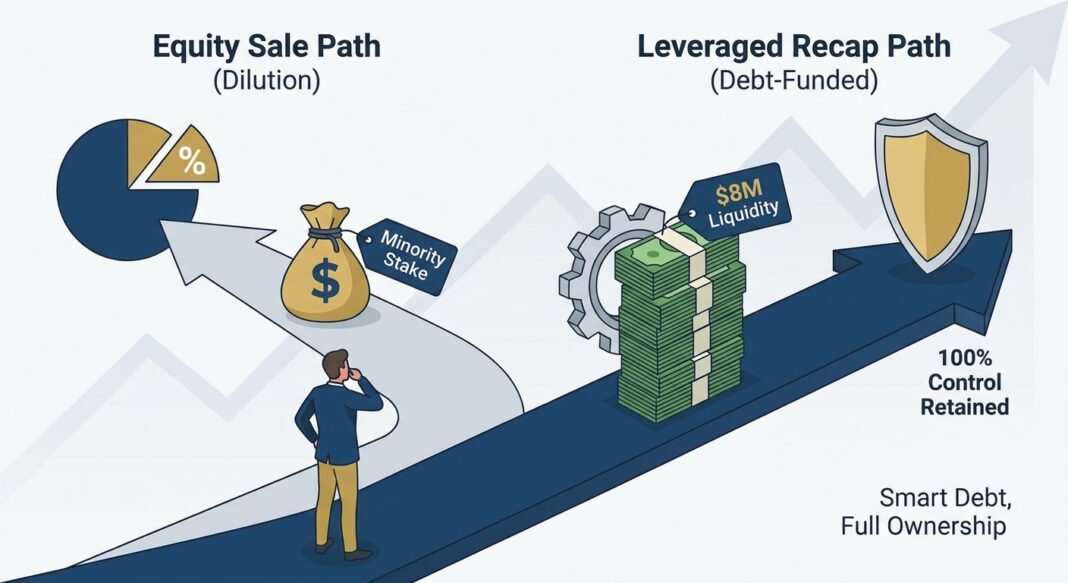
Marcus’s advisor laid out two options side by side.
Option A, Minority Equity Sale (Venture/Growth Equity): Sell 30% to 40% of the business to a growth equity firm at a 6x EBITDA multiple, valuing the company at approximately $30 million. At 35% dilution, Marcus would receive roughly $10.5 million in proceeds but would surrender board representation, accept investor approval rights over major decisions, and create a new stakeholder with a defined exit horizon, typically three to seven years, that may not align with his own timeline.
Option B, Leveraged Recapitalization via Private Credit: Borrow against the company’s cash flow and use the proceeds to fund a special dividend paid entirely to Marcus as the sole shareholder. No equity changes hands. No new owners at the table. Marcus stays in control of every decision.
The structure of Option B, drawn from published lower middle market parameters, looked like this:
- Company EBITDA: $5.0 million
- Debt raised (unitranche facility): $16.0 million (3.2x EBITDA, within the 3x–5x EBITDA range typical for lower middle market transactions, per the Pepperdine Private Capital Markets Report 2024)
- Special dividend to Marcus: $8.0 million (after transaction costs and a retained cash reserve)
- Annual debt service (estimated at ~9.5% all-in cost): ~$1.52 million per year
- Remaining free cash flow post-service: ~$3.0 million, still sufficient to fund organic growth and maintain lender covenants
- Marcus’s ownership post-transaction: 100%
The key insight was the cost of capital comparison. Under Option A, Marcus was effectively selling future enterprise value at today’s price. If Vantage Field Services grew to $7 million EBITDA and sold at 7x in five years, a $49 million enterprise value, the 35% minority shareholder would collect $17.2 million of that exit. Under Option B, Marcus owned all of that upside while paying roughly $7.6 million in total interest over five years to service the debt. The math was not close.
The Outcome: Liquidity, Control, and a Cleaner Balance Sheet by Year Four
Marcus completed the leveraged recapitalization. The unitranche facility closed through a direct lender, the kind of bespoke arrangement that has become increasingly accessible as the private credit market has scaled to institutional depth. The private credit market was estimated at $1.7 trillion in 2024, having grown to outpace both the leveraged loan and high-yield bond markets in total volume, according to data cited by ABF Journal.
In the hypothetical projection of Vantage’s trajectory (grounded in the base case underwriting assumptions Marcus and his lender modeled) here is what the five-year path looked like:
- Year 1: $8 million arrives in Marcus’s personal account. EBITDA holds at $5.1M. Debt service is covered 3.4x. Covenants are maintained comfortably.
- Year 2–3: The business lands a new regional contract. EBITDA grows to $5.8 million. Marcus invests $600K of the dividend proceeds into hiring two senior account managers, a reinvestment his equity partner would have debated in a board meeting.
- Year 4: EBITDA reaches $6.3 million. Accelerated amortization retires $4 million of principal ahead of schedule. Marcus’s leverage ratio drops below 2x EBITDA, well inside market norms.
- Year 5 (optional full exit): A strategic buyer values Vantage at 7x EBITDA, or approximately $44 million. Marcus collects 100% of proceeds. Total personal liquidity across the five years: $52 million ($8M recap dividend + $44M exit).
Had he sold 35% in Year 0 instead, his five-year total would have been approximately $10.5 million (equity proceeds at the time of minority sale) plus 65% of a $44 million exit, or $28.6 million, a combined $39.1 million. The leveraged recap path outperformed the equity dilution path by more than $12 million, while Marcus never once sat across a board table from a shareholder whose return timeline was different from his own.
The Lessons: What This Story Actually Teaches
The Vantage Field Services hypothetical is a composite, but its mechanics are not invented. The market dynamics that make this structure viable are thoroughly documented and actively growing in 2025 and into 2026.
Leveraged loan issuance for sponsored dividend recapitalizations reached $74.3 billion in 2025, growing 11% year-over-year after surging 326% in 2024, according to PitchBook’s April 2026 Interactive Leveraged Loan Volume Report, as cited by Capstone Partners. Dividend recaps and refinancings continued to represent a substantial share of direct lending volume in 2025, per StepStone Group’s second-half 2025 review. And as more founder-owned businesses prepare for succession or recapitalization, demand for bespoke capital solutions continues to grow, a trend reinforced by the declining number of U.S. commercial banks over the past two decades and a U.S. population aged 65 and over that is at a historic high, accelerating ownership transitions, per analysis published by NCPERS.
The lessons are structural, not circumstantial:
1. Liquidity and control are not mutually exclusive.
The founding mythology of American entrepreneurship insists that founders must choose between cashing out and staying in. The leveraged recapitalization dissolves that binary. As Sofér Advisors noted in a 2026 analysis, the leveraged recap allows the owner to extract cash without selling to a third party, the company assumes a higher debt-to-equity ratio, but the founder’s ownership percentage and voting control remain completely intact.
2. The real cost of equity is measured at exit, not at signing.
A 35% minority stake sold today looks cheap when the check clears. It looks very different five years later when a strategic buyer shows up and the liquidation math is done. Every point of equity sold today compounds against the founder at the final exit multiple. Debt, by contrast, has a defined and finite cost, one that ends the moment the loan is retired.
3. Debt service is a discipline, not a punishment.
Critics of leveraged recaps point to debt service as a constraint on growth reinvestment. This is true and worth taking seriously. If a business cannot comfortably service debt at 3x to 4x EBITDA while still funding operations, the business is not an appropriate candidate for this structure. But for cash-flow-stable, contract-backed, or recurring-revenue businesses, the debt service creates exactly the kind of financial discipline that results in tighter operations and faster amortization.
4. Market conditions matter: time the structure to the credit cycle.
The dividend recap window tightened in early 2026, with Q1 volume down 48.9% year-over-year partly due to geopolitical uncertainty, according to Capstone Partners’ June 2026 report. This is a reminder that pricing and available proceeds are not static. Founders who move during periods of lender appetite and competitive private credit markets will access better terms than those who wait for a liquidity crisis to force their hand.
5. Not every business qualifies: know the profile.
Lower middle market leveraged recapitalizations typically close at 3x to 5x EBITDA in total debt, according to the Pepperdine Private Capital Markets Report 2024. Lenders underwrite to durable cash flow, contract visibility, and management depth. Businesses with lumpy revenue, customer concentration above 30%, or EBITDA below $2 million will find the structure harder to execute on competitive terms.
Key Insights
- A leveraged recapitalization funds a special dividend from debt proceeds: the founder receives cash, keeps all equity, and retains full operating control with no new shareholders at the table.
- The math strongly favors the recap over minority equity sales when the business has durable cash flow and a credible growth trajectory, the compounding cost of dilution at exit can exceed total debt service costs by millions.
- The private credit market (estimated at $1.7 trillion in 2024 and growing) has created a deep, competitive lending environment where founder-owned companies can access institutional capital on genuinely competitive terms without touching the equity cap table.
- Lower middle market recapitalizations typically close at 3x–5x EBITDA in total debt; the ideal candidate has recurring or contracted revenue, EBITDA above $2M, and no single customer representing more than 25–30% of revenue.
- Timing matters: leveraged recap windows open and close with credit markets, so founders who proactively model this option, rather than reactively pursuing it during a crisis, access the best terms and the most favorable structures.


