
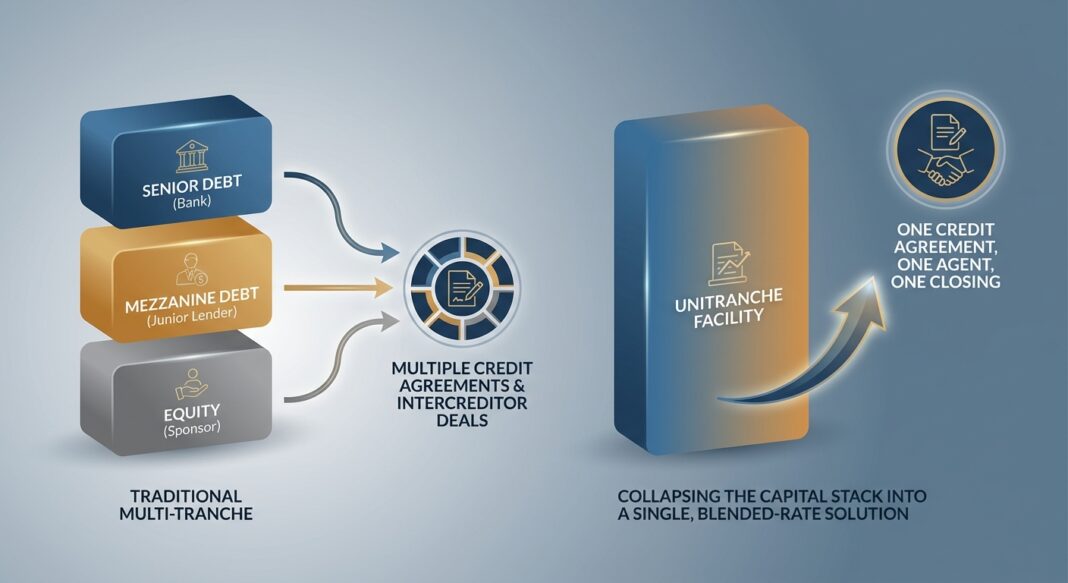
One Loan to Rule Them All
Walk into any mid-market leveraged buyout in 2026 and you will almost certainly find a unitranche loan at the center of the deal. What began as a niche private credit workaround has become the dominant financing structure for sponsor-backed middle-market companies, and understanding how it actually works is essential for anyone evaluating private credit as an investor or exploring it as a capital source for their business.
The concept is deceptively simple on its surface: instead of negotiating separately with a senior bank lender and a junior mezzanine provider, a borrower gets a single loan from a single agent at a single blended rate. No intercreditor battles. No dual due diligence processes. One credit agreement, one closing. But beneath that clean exterior lives a sophisticated internal priority structure that most borrowers never directly see, and that determines exactly who gets paid first when things go wrong.
This article breaks down the mechanics of unitranche lending, walks through a concrete deal example with real pricing context, and connects the structure to live market data so both investors and operators can use this knowledge to make better decisions.
What a Unitranche Loan Actually Is
A unitranche structure is a single secured credit facility in which two or more groups of lenders share the same security interest on the borrower’s collateral but agree among themselves on a payment priority through a separate, private document called an Agreement Among Lenders (AAL). According to Mayer Brown (July 2026), the unitranche facility is typically documented in a single credit agreement, with the borrower owing obligations to a single group of lenders at a "blended" pricing rate, one interest rate applicable to the entire facility.
That blended rate hides an internal subordination split that the borrower never negotiates directly. The AAL divides lenders into two private categories:
- First-Out (FO) Lenders: Paid first from collateral proceeds and cash flows. They accept a lower return in exchange for reduced recovery risk. This position is often held by a bank providing a revolving credit facility.
- Last-Out (LO) Lenders: Absorb losses ahead of the first-out group. They carry more downside risk and consequently earn a higher interest rate. Private credit funds (Business Development Companies (BDCs), direct lending vehicles) typically hold this position.
As Blue Owl Technology Finance Corp. disclosed in its 2026 SEC filings, unitranche loans combine features of first-lien, second-lien, and mezzanine debt, generally in a first-lien position, and in many cases a single lender may provide most or all of the capital structure above the equity layer. This is precisely what gives unitranche its appeal: a company gets access to significant leverage through a single counterparty, with all the complexity internalized by the lenders themselves.
It is critical to understand that a unitranche is not a traditional first lien/second lien arrangement. In a first/second lien deal, two separate liens exist on the collateral, governed by an intercreditor agreement between distinct secured parties. In a unitranche, there is one lien shared by all lenders: the priority waterfall lives entirely within the AAL, invisible to the borrower and, in some cases, subject to enforceability questions in bankruptcy proceedings.
How It Works: A Concrete Deal Example
Consider a private equity sponsor acquiring a software services company for $100 million. The sponsor contributes $40 million in equity (40% of enterprise value) and needs to finance the remaining $60 million in debt.
Traditional Two-Tranche Structure (Old Way):
- Senior Bank Term Loan: $40 million at SOFR + 275 bps (~6.4% all-in)
- Mezzanine Note: $20 million at 12–14% (often with equity warrants)
- Two separate lenders. Two due diligence processes. Two closings. Intercreditor negotiation required. Timeline: 90–120 days.
Unitranche Structure (Current Market):
- Single Unitranche Facility: $60 million at SOFR + 475–500 bps (~8.4–8.7% all-in at a SOFR rate of approximately 3.7%)
- Internally, the direct lender may bifurcate: $15 million first-out to a bank partner at SOFR + 275 bps, and $45 million last-out retained at SOFR + 575 bps
- One credit agreement. One agent. One closing. Timeline: 45–60 days.
The borrower pays a single blended rate and deals with a single relationship. The lenders handle all internal priority mechanics through the AAL. The borrower’s cost is somewhat higher than a pure senior bank loan, but dramatically simpler, faster, and more certain than assembling a multi-tranche structure, particularly for middle-market companies that lack the public market access required for broadly syndicated loans.
The spread premium is the price of that convenience and certainty. As the direct lending market describes it, the last-out position earns a higher rate because it absorbs first-dollar losses after equity is exhausted; it is carrying junior risk inside a first-lien wrapper.
Current Market Conditions: Where Unitranche Pricing Sits Today
Unitranche has not just survived the post-2022 rate cycle; it has expanded its market share. Here is what current data shows:
| Metric | Data Point | Source |
|---|---|---|
| Median unitranche spread, LBO deals (Q4 2025) | SOFR + 475 bps | PitchBook LCD, Jan 2026 |
| Spread widening since late 2025 | ~50–100 bps wider | Lord Abbett / PitchBook, June 2026 |
| Unitranche spreads (Q2 2026 range) | 4.75%–5.50% over benchmark | Valuation Research Corp., July 2026 |
| CDLI (private credit benchmark) 2025 annual return | 9.3%; 20-yr avg 9.5% | Cliffwater CDLI, March 2026 |
| Covenant-lite share of direct lending deals (2025) | 21% (up from 4% in 2023) | McKinsey / Proskauer, June 2026 |
| Global private credit AUM (2026) | ~$1.7 trillion | Preqin / PitchBook, 2026 |
| Bank C&I lending standards (Q2 2026) | Basically unchanged; demand stronger from large firms | Federal Reserve SLOOS, August 2026 |
The market environment heading into late 2026 is notably more lender-friendly than 2024–early 2025. According to Lord Abbett’s June 2026 midyear outlook, spreads have widened roughly 50 to 100 basis points since late 2025, and defensive structural terms have improved alongside that repricing. The supply/demand imbalance that compressed spreads through most of 2025, too much capital chasing too few deals, is gradually correcting as M&A activity picks up and some capital providers grow more selective following non-accrual and PIK-toggle concerns in software-sector portfolios.
According to PitchBook LCD (January 2026), record private credit/middle-market CLO issuance of $43.1 billion in 2025, up from $38.5 billion in 2024, has been a structural demand driver for unitranche paper, as CLO vehicles can hold these instruments efficiently. This structural demand is part of why unitranche spreads remained remarkably stable even as macro volatility spiked during Q2 2025 tariff uncertainty.
Meanwhile, the Federal Reserve’s July 2026 SLOOS shows C&I bank lending standards were essentially unchanged in Q2 2026, a stabilization after a tightening cycle, but the April 2026 SLOOS noted that banks reported tighter standards for loans to non-depository financial institution (NDFI) borrowers, including business credit intermediaries, over the prior year. That regulatory friction around bank-to-fund lending keeps private credit platforms structurally advantaged in originating directly to middle-market companies that cannot access the broadly syndicated loan market.
Decision Framework: For Investors and Operators
For Investors Evaluating Private Credit Exposure
When reviewing a direct lending fund or BDC with heavy unitranche exposure, investors should evaluate several structural dimensions:
- First-Out vs. Last-Out Composition: Not all unitranche exposure is equal. A fund holding predominantly last-out positions carries meaningfully more credit risk than one holding first-out positions, even though both may be classified as "first lien" in portfolio disclosures. Disclosure quality varies significantly across BDCs, investors benefit from reading footnotes carefully.
- Spread Adequacy: With unitranche spreads currently ranging from SOFR + 475 to SOFR + 550 bps in the middle market, investors should evaluate whether the all-in yield, approximately 8.5%–9.5% at current SOFR levels, is adequately compensating for the blended senior/junior risk profile being assumed.
- Covenant Quality: The rise of covenant-lite structures (21% of direct lending deals in 2025, per McKinsey/Proskauer data) means lenders have fewer early-warning triggers to manage deteriorating credits. Funds maintaining maintenance covenants on their unitranche portfolios have historically demonstrated earlier intervention and better recovery outcomes.
- Manager Scale: Concentration risk in unitranche origination is real. According to PitchBook LCD’s 2026 outlook, in the first half of 2025, mega-funds raising more than $5 billion accounted for 42.5% of all capital raised by closed-end private debt vehicles. Larger managers can diversify unitranche exposure across hundreds of issuers; smaller managers may carry higher single-name concentration.
For Business Operators Evaluating Capital Sources
Middle-market operators and their financial sponsors should weigh unitranche against traditional structures on four practical dimensions:
- Speed and Certainty: Unitranche typically closes in 45–60 days versus 90–120 days for a multi-tranche structure. For time-sensitive acquisitions, that execution certainty carries real economic value.
- All-In Cost vs. Blended Cost: Unitranche pricing is higher than a pure senior bank term loan but is often competitive with (or cheaper than) the true blended cost of a senior + mezzanine structure when legal fees, closing costs, and management time are included.
- Relationship Simplicity: One lender relationship, one set of covenants, one amendment process. For operators building toward a recapitalization or sale, fewer lender relationships mean a cleaner process.
- Covenant Negotiation Leverage: In the current market, borrowers with strong EBITDA profiles and defensible business models have meaningful leverage to negotiate maintenance covenant thresholds, EBITDA add-back definitions, and incremental facility capacity, especially with lenders who have dry powder to deploy.
Key Takeaways
- Unitranche is structurally dominant: The single-facility, blended-rate structure has become the default financing tool for middle-market leveraged buyouts, chosen for speed, certainty, and relationship simplicity, not necessarily lowest absolute cost.
- First-out and last-out are not the same risk: The AAL creates internal subordination that the borrower never sees. Investors need to understand which position a fund holds, the risk and return profile differ materially.
- Pricing has shifted lender-friendly: After a prolonged period of spread compression, unitranche spreads have widened approximately 50–100 basis points since late 2025, and the Cliffwater CDLI confirmed that the private credit benchmark returned 9.3% in 2025 with 20-year average returns of 9.5%, a consistent income stream even through rate cycles.
- Covenant erosion deserves attention: Covenant-lite provisions in direct lending jumped from 4% to 21% of deals between 2023 and 2025. That structural shift reduces lender early-warning visibility and is a material due diligence factor for investors evaluating fund quality.
- Bank lending conditions create structural demand: The Federal Reserve’s SLOOS data consistently shows tighter bank standards for NDFI and middle-market borrowers, reinforcing the structural role private credit plays as a capital provider for companies that cannot efficiently access the broadly syndicated market.


