
The Deal That Looks Simple on the Outside
Picture two companies competing to close an acquisition. Company A spends twelve weeks negotiating with a senior bank, a mezzanine fund, and a second-lien lender: three separate credit agreements, three sets of covenants, three closing checklists. Company B calls one private credit manager, signs one loan agreement, and closes in six weeks. Both companies end up with roughly the same amount of debt. Only one of them finished the deal.
That is the practical power of the unitranche loan: today the dominant financing structure in private credit markets. But “simple for the borrower” does not mean “simple in structure.” Inside that single loan lives a carefully engineered risk hierarchy that most business owners never see and many investors underestimate. Understanding how it works (and what it actually costs) is one of the most important literacy tests in private credit today.
What a Unitranche Loan Actually Is
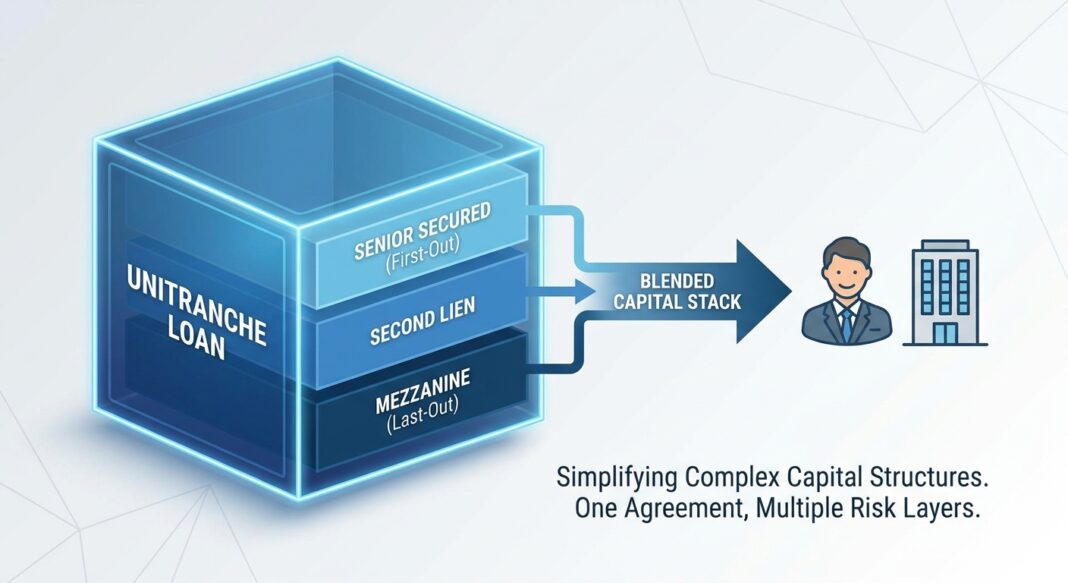
Unitranche is a financing structure that collapses what would normally be multiple layers of debt (senior secured, second lien, and mezzanine) into a single credit facility with one interest rate, one set of loan documents, and one lender relationship. PipelineRoad’s Capital Glossary defines it plainly: the borrower signs one credit agreement, there is no intercreditor agreement to negotiate, and the entire capital structure below equity is compressed into a single instrument.
The complexity, however, lives behind the curtain. When multiple lenders participate in a unitranche facility, they privately divide the economics through an Agreement Among Lenders (AAL). As Mayer Brown (July 2026) explains, rather than creating two separate liens governed by an intercreditor agreement, the first-out/last-out structure achieves internal subordination within a single credit facility, a priority waterfall the borrower is never party to.
The result is two economic experiences inside one loan:
- First-Out (FO) lenders receive payment priority: lower risk, lower yield, analogous to a traditional senior secured position.
- Last-Out (LO) lenders absorb losses first in a stress scenario: higher risk, higher yield, effectively a mezzanine economic exposure dressed in a first-lien wrapper.
The borrower makes one blended interest payment. The AAL then allocates that cash according to its internal waterfall. As the American Bar Association (Fall 2025) notes, the AAL is highly customizable, no two transactions are identical, and it governs the economic and control rights of each lender group, not the underlying security interest itself.
A Concrete Example: The Numbers Behind the Structure
Consider a private equity sponsor acquiring a mid-market manufacturing business at a $50 million enterprise value, putting in $20 million of equity (40% equity cushion) and financing the remaining $30 million with a unitranche loan.
In a traditional structure, that $30 million might be split: $20 million of senior bank debt at SOFR + 275 bps and $10 million of mezzanine at 12–14%. The total blended cost is high, the documentation is complex, and the closing timeline stretches to three months.
In the unitranche, a single private credit manager provides the full $30 million at a blended rate, let’s say SOFR + 525 bps. AlternativeFortune (March 2026), drawing on PitchBook LCD data, notes that unitranche pricing runs roughly 450 to 650 basis points over the floating benchmark, versus approximately 250 to 350 bps for a plain senior loan, precisely because the structure carries junior risk inside a first-lien wrapper.
Internally, the $30 million unitranche might be bifurcated in the AAL as $18 million first-out at SOFR + 375 bps and $12 million last-out at SOFR + 725 bps. The borrower never sees this division. What the borrower gains is speed, certainty of close, and one relationship to manage. What they pay for those benefits is a spread premium over a pure senior loan.
The key structural insight: the last-out position is not a mezzanine loan in name, but it is in economic substance. Investors evaluating unitranche lenders need to understand exactly how much of a given portfolio sits in last-out positions and what covenants govern those tranches in a stress scenario.
Current Market Relevance: What the Data Shows in Mid-2026
Unitranche structures are not a theoretical construct; they now define the mainstream of private credit deal-making. Here is what current market data reveals:
| Metric | Data Point | Source |
|---|---|---|
| Unitranche coupon spread range (Q2 2026) | SOFR + 4.75% to 5.50% | VRC, July 2026 |
| Spread widening since late 2025 | ~50 to 100 bps wider | Lord Abbett / PitchBook, June 2026 |
| CDLI total return, full-year 2025 | 9.3% (interest income: 10.4%) | Cliffwater, March 2026 |
| CDLI trailing 12-month return (to June 30, 2026) | 7.7% | Cliffwater, August 2026 |
| Bank lending standards for C&I loans (Q2 2026) | Basically unchanged; tighter on NDFI loans | Federal Reserve SLOOS, July 2026 |
| Covenant-lite share of direct lending deals, 2025 | 21% (up from 4% in 2023) | McKinsey / Proskauer, June 2026 |
Several dynamics are reshaping the unitranche market right now. According to Lord Abbett’s 2026 Midyear Outlook, more active M&A activity combined with some capital providers becoming more selective has improved the supply-demand balance for lenders with dry powder, meaning lenders now have greater ability to negotiate both price and structure. That is a meaningful shift from the spread compression of 2024 and early 2025.
Simultaneously, the Federal Reserve’s April 2026 SLOOS reported tighter standards across non-depository financial institution (NDFI) loans, including stricter covenants, higher risk premiums, and lower maximum credit line sizes, a clear signal that bank capital is not flowing freely to private credit managers or borrowers who rely on bank leverage facilities. This tightening reinforces the structural role private credit plays as an alternative capital source when bank channels restrict.
Decision Framework: Investors and Operators
For Investors Evaluating Unitranche Lenders
Not all unitranche exposure is equal. Investors evaluating a Business Development Company (BDC) or direct lending fund should consider asking the following questions:
- What percentage of the portfolio is last-out unitranche versus first-out? Last-out positions carry mezzanine-like risk at prices that may or may not fully compensate for it.
- How are unitranche positions marked in a stress scenario? The AAL has seen limited bankruptcy court testing compared with traditional intercreditor agreements, a structural uncertainty worth pricing in.
- Are covenants maintenance-based or incurrence-based? With covenant-lite transactions rising to 21% of direct lending deals in 2025 per McKinsey, the early-warning function of financial covenants is eroding in parts of the market.
- What is the equity cushion beneath the loan? In a unitranche deal, lenders benefit most when sponsor equity represents a meaningful percentage of the capital structure (typically 35–50% or more) providing a genuine loss buffer.
For Business Owners Considering Unitranche Financing
Operators evaluating a unitranche facility typically weigh it against traditional bank or multi-tranche alternatives. Key considerations include:
- Speed and certainty matter when deals are time-sensitive. Unitranche structures are marketed as faster and more execution-certain than syndicated or multi-lender packages.
- The blended rate is higher than a pure senior bank loan: operators should model the all-in cost carefully, including any original issue discount (OID) and fee structures.
- One lender relationship simplifies amendments. When business conditions change and covenant waivers or structural modifications are needed, negotiating with one counterparty is operationally simpler than convening a lender group.
- Bank lending standards matter to your cost of alternatives. When banks tighten, as the Fed SLOOS data consistently shows across 2025 and into 2026, the relative cost advantage of unitranche narrows, private credit becomes the primary option, not just a competitive one.
Key Takeaways
- One loan, hidden complexity: A unitranche presents one facility to the borrower but contains an internal first-out/last-out hierarchy governed by an Agreement Among Lenders that dictates who absorbs losses first.
- Last-out is mezzanine in economic substance: Investors should evaluate last-out unitranche positions with the same scrutiny applied to mezzanine debt, the label “first lien” does not eliminate subordinated economic exposure.
- Spreads are widening in 2026: After bottoming near SOFR + 450–499 bps across much of 2025, unitranche coupon spreads have widened approximately 50–100 bps, improving lender returns for new originations in a more supply-demand-balanced market.
- Bank tightening reinforces private credit demand: The Fed’s SLOOS data through mid-2026 confirms that banks continue to tighten standards for NDFI loans and have broadly maintained tight standards for C&I borrowers, sustaining the structural demand driver for private credit as an alternative capital source.
- Performance has been resilient, but covenant erosion bears watching: The Cliffwater Direct Lending Index has delivered 9.5% average annual returns over 22 years with one negative year. However, with covenant-lite structures rising sharply, investors and operators alike should monitor whether lender protections are keeping pace with credit risk in new vintages.


