
Market & Sector Intelligence | September 4, 2026
The Lender-Friendly Reset Has Arrived, But Dispersion Will Separate Winners From Losers
Private credit markets entered 2026 riding strong momentum, only to collide with three simultaneous shocks: a U.S.–Iran military conflict in February that introduced macro paralysis, an accelerating AI-driven reassessment of software sector credit quality, and a wave of business development company (BDC) redemption requests that exposed structural vulnerabilities inside semi-liquid vehicles. The result has been the most closely scrutinized repricing of private credit in the asset class’s modern history.
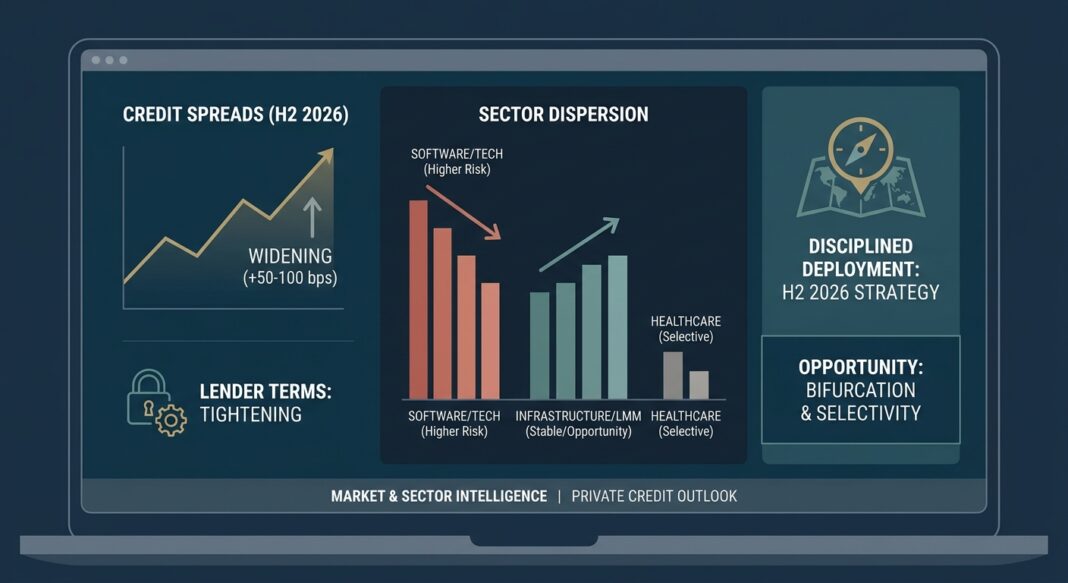
The macro read, however, is not crisis; it is correction. According to PitchBook data cited by Lord Abbett, spreads have widened by roughly 50 to 100 basis points since late 2025, while defensive documentation terms have simultaneously improved. The Federal Reserve’s July 2026 Senior Loan Officer Opinion Survey (SLOOS) confirms that C&I lending standards at banks were essentially unchanged in Q2, and for C&I loans specifically, standards remain easier than the midpoint of their historic range since 2005, a constructive signal for quality borrowers who can access both bank and private channels.
The headline story for H2 2026 is not broad-based distress. It is dispersion: between large-cap and lower middle market, between software and healthcare, between covenant-loose legacy structures and newly negotiated lender-friendly terms. As Chicago Atlantic observed in its Q2 2026 update, strong borrowers continued to find financing while the market became highly selective. For institutional investors and operators, understanding exactly where that selectivity is being applied is now the primary strategic task.
Quantitative Market Snapshot
The table below captures the key pricing, volume, and credit-quality metrics defining the current lending environment. All figures are sourced from publicly available institutional data as of Q2 2026.
| Metric | Current Level (Q2/Q3 2026) | Prior Period | Change | Source |
|---|---|---|---|---|
| Middle Market Direct Lending Spread | SOFR + ~500 bps | SOFR + mid-400s bps (late 2025) | +50–100 bps | Hamilton Lane, 2026 |
| Investment-Grade Corporate Spreads | ~70 bps | ~80–90 bps (Q4 2025) | Tighter | Chicago Atlantic, Q2 2026 |
| High-Yield Bond Spreads | ~250 bps | Near historic tights entering 2026 | Modest widening | Chicago Atlantic, Q2 2026 |
| Leveraged Loan Spreads (BSL) | ~500 bps | Near century lows, end of 2025 | Widening from prior lows | Chicago Atlantic / PitchBook LCD, Q2 2026 |
| Software Sector Secondary Spreads | ~245 bps wider than year-end | In line with B-rated index (YE 2025) | +245 bps vs. YE; +229 bps vs. B index | VRC / PitchBook LCD, June 19, 2026 |
| 3-Month Term SOFR | 3.68–3.69% | 3.67% (Q1 2026) | +1 bp QoQ | VRC, Q2 2026 |
| 5-Year U.S. Treasury Yield | ~4.23% | 3.92% (March 2026) | +31 bps QoQ | VRC, Q2 2026 |
| Typical Direct Lending: Max Leverage Covenant | ~4.0x Debt/EBITDA | Elevated; some sectors reached 7.5x–8.0x | Tightening on new originations | Investing.com / FSB report, 2026 |
| Min. Interest Coverage (FCCR Proxy), New Deals | ~2.5x | Eroded to sub-2.0x in competitive 2024–2025 vintages | Recovering on lender-friendly terms | Investing.com, 2026 |
| Direct Lending Default Rate (TTM, by volume) | 1.5% (May 2026); forecast 2.5% FY2026 | 1.84% (Q3 2025, Proskauer index) | Rising; Fitch PC rate hit 6.0% TTM in May 2026 | VRC / Fitch, May 2026 |
| Direct Lending Q2 2026 Origination Volume | $33.6B (Q2 2026) | $74.7B (Q1 2026) | –55% QoQ; weakest since Q2 2023 | PitchBook/LCD cited by Angel Investors Network, Aug 2026 |
| U.S. PE Deal Count, H1 2026 | 3,999 transactions | 4,619 (H2 2025) | –13.5% HoH | CohnReznick / PitchBook, July 2026 |
Sources: PitchBook LCD, VRC, Hamilton Lane, Chicago Atlantic, Fitch Ratings, Federal Reserve SLOOS (July 2026). Data as of June 30, 2026 unless noted.
Sector-Specific Lender Appetite & Structural Shifts
Software & Technology: Risk-Off, Spreads Severely Dislocated
No sector has been more violently repriced in 2026 than software. VRC reports, citing PitchBook LCD data as of June 19, 2026, that secondary spreads for software credits are approximately 245 basis points wider than year-end levels and roughly 229 basis points above the broader B-rated loan index. The AI disruption narrative has fundamentally altered how lenders underwrite recurring revenue models, with many direct lenders remaining risk-off, others already overexposed, and most limiting incremental exposure amid ongoing uncertainty in borrower performance. Observable Q2 transaction data remains limited as the market awaits clearer visibility on how AI tools will affect software EBITDA trajectories. Operators in this segment should expect higher all-in costs, tighter leverage ceilings, and renewed lender scrutiny of revenue retention rates and customer concentration.
Healthcare: The Sector of Record, But With Nuance
Healthcare led all sectors for private credit deal activity in 2025, accounting for 19% of all direct lending deals, according to Octus Data. It was also the only major sector that did not see significant year-over-year spread tightening in 2025, with spreads landing at an average of SOFR+500 bps in Q4. Demographic tailwinds and non-cyclical service models continue to attract lenders seeking stable cash flows. However, Morgan Stanley’s institutional credit team has flagged healthcare as a sector that has led all areas in loans placed on non-accrual status over the past year, signaling bifurcation between high-quality, essential service platforms and more leveraged physician management or specialty pharmacy structures. The net read: healthcare remains a high-volume sector for private credit, but underwriting selectivity is increasing, particularly for sub-sectors with Medicaid reimbursement exposure.
Infrastructure & Asset-Based Finance: The Structural Beneficiary
One of the most significant structural shifts of 2026 has been the rotation of allocator capital from corporate direct lending into specialty and asset-backed strategies. PitchBook data shows that direct lending’s share of all private debt capital raised globally fell from 58.4% in 2024 to roughly 31% by Q1 2026, as allocators spread into infrastructure debt, real estate credit, special situations, and asset-backed strategies. Specialty finance raised $37 billion in 2025, more than the prior two years combined. Morgan Stanley estimates private credit could supply more than half of the $1.5 trillion needed for global data center buildouts through 2028, cementing AI infrastructure as one of the most consequential new deal verticals for private lenders.
Lower Middle Market: The Divergence Most Commentary Is Missing
While spread compression has dominated large-cap headlines, the lower middle market tells a different story. The spread premium of lower middle market loans over large-cap actually widened to 232 basis points, as the capital wave has not reached the lower end of the market. For lenders operating in the $10M–$50M deal range with borrowers generating $5M–$25M in EBITDA, the combination of wider spreads, real covenants, and rising deal flow from business succession dynamics creates a structurally favorable origination environment, though non-accrual rates in this segment remain the highest across private credit.
Bank Re-Entry: Competitive Pressure Concentrated in the Upper Middle Market
Banks began returning to the market in June 2026, contributing to increased competition in the upper middle market and alleviating some upward pressure on credit spreads in Q2. This dynamic is most acute in sponsor-backed deals above $50M EBITDA. Recent easing of bank regulations may further enhance bank appetite to compete directly with private credit lenders, particularly in large-cap, investment-grade-adjacent transactions where banks retain advantages in balance sheet capacity, syndication networks, and pricing.
Direct Implications for Operators & Institutional Investors
For Borrowers & Operators
The era of borrower-friendly terms that defined 2023–2025 (characterized by spread compression, covenant-lite structures, and flexible leverage multiples) is measurably over for all but the highest-quality credits. The April 2026 SLOOS documented that banks have tightened all terms on NDFI loans, including higher risk premiums, stricter covenants, shorter maximum maturities, stricter collateralization requirements, and lower maximum credit line sizes. Operators should recalibrate their financial models to reflect a normalized minimum FCCR of approximately 2.5x (interest coverage) and a maximum leverage ceiling of 4.0x Debt/EBITDA on new originations, not the 7.5x–8.0x debt-to-EBITDA ratios that appeared in some legacy vintages. M&A financing timelines should be extended, and borrowers in software or AI-exposed sectors should anticipate materially wider pricing and heightened lender due diligence around AI substitution risk to their revenue base.
For operators whose existing debt was written at peak competition (2024–2025 vintages), the risk of covenant trip and waiver negotiation is rising. S&P estimates that 3%–4% of private credit deals have already amended terms to add payment-in-kind (PIK) features midstream, a structural warning sign that cash flow generation is falling short of original underwriting assumptions in a higher-for-longer rate environment.
For Institutional Investors & Lenders
According to PwC’s 2026 Private Credit Survey, 93% of respondents expect flat or lower returns in 2026, with 67% citing greater competition as the primary driver and 64% citing defaults and credit losses. This environment demands a portfolio triage approach: separating legacy vintages written at compressed spreads and elevated leverage from current-vintage opportunities where lender protections have materially improved. The deployment gap, wherein Q2 2026 originations fell 55% quarter-over-quarter to $33.6 billion as managers maintained underwriting discipline rather than cutting standards, is the most important signal that disciplined capital is waiting for the right entry conditions. Managers with dry powder can now be more selective about the credits they choose to finance, a structural advantage unavailable during the compressed-spread period of 2023–2025. Importantly, the Federal Reserve has flagged that deteriorating investor sentiment in private credit raises concerns about a potential contraction in credit availability for middle-market firms, a systemic risk worth monitoring closely in H2 2026.
Forward-Looking View: The Next 3–6 Months
Market expectations reflect a higher-for-longer rate environment, with the forward curve broadly flat as of June 2026. The Fed’s three consecutive 25-basis-point cuts in late 2025 lowered the target range to 3.50%–3.75%, but its subsequent pause through April 2026 reinforced that rate relief for floating-rate borrowers will be incremental rather than decisive. With the 5-year Treasury at 4.23% and SOFR at 3.68%, all-in yields on new direct lending transactions in the SOFR+500 bps context remain in the 8.5%–9.5% range, meaningfully above the 7.5%–8.0% all-in yields that defined the compressed-spread period.
The second half of 2026 is likely to be defined by dispersion: between strong borrowers who continue to access competitive financing and weaker structures where credit quality bifurcation will widen pricing gaps further. The message for deal teams and fund managers is clear: returns will be driven less by multiple expansion and financial engineering, and more by execution, operational improvements, and disciplined capital deployment.
On the regulatory front, the Financial Stability Board published a full private credit vulnerabilities report on May 6, 2026, identifying valuation opacity, inconsistent default definitions, leverage stacked at both fund and portfolio company level, and redemption-liquidity mismatches inside semi-liquid vehicles as systemic concerns. This report increases the probability of enhanced disclosure requirements or structural guardrails on retail-accessible private credit vehicles in H2 2026 and 2027, a headwind for product distribution but a potential tailwind for institutional-only structures that offer cleaner governance and transparency.
Key Market Insights: Five Actionable Takeaways
- Spreads have reset, and documentation is tightening: Middle market direct lending spreads have moved back to SOFR+500 bps from the mid-400s of late 2025, and minimum interest coverage floors on new deals are recovering toward 2.5x, restoring a margin of safety that had eroded during peak competition. Institutional investors evaluating new fund commitments should scrutinize vintage-year underwriting standards and stress-test existing portfolio company FCCR positions against a flat-to-slightly-higher rate path.
- Software exposure is the single largest idiosyncratic risk in leveraged credit: With secondary spreads 245 bps wider than year-end and many lenders risk-off on incremental exposure, operators with software platform assets should anticipate constrained refinancing windows and elevated spread costs through at least H1 2027. Lenders with legacy software exposure should pressure-test revenue retention assumptions under an AI disruption scenario.
- The deployment gap is the most important signal in the market: Q2 2026 originations fell 55% QoQ to $33.6 billion as disciplined managers maintained standards rather than chasing compressed deals. This is a healthy dynamic, but one that could reverse quickly if deployment pressure from investors forces managers to compromise underwriting. LPs should monitor capital call cadence and deal selectivity metrics as leading indicators of potential standard erosion.
- Lower middle market remains structurally superior for risk-adjusted lenders: A 232 bps spread premium over large-cap, real covenant packages, and lower bank re-entry competition make the $5M–$25M EBITDA segment the highest-conviction opportunity for new originations, provided lenders have the sourcing infrastructure to operate efficiently at that deal size.
- Regulatory and FSB scrutiny will reshape product structures: The May 2026 FSB vulnerabilities report and ongoing scrutiny of valuation practices, PIK loan proliferation, and semi-liquid vehicle mismatches are likely to drive a structural shift toward more institutionally governed private credit vehicles. Asset managers that invest in transparency infrastructure now will be better positioned for capital flows as allocators apply higher governance standards to new manager selections.


