
The Financing Gap That Banks Won’t Touch, and Equity Shouldn’t Have To
Picture a $12M EBITDA specialty services company generating 22% organic growth. The owner wants to acquire a $30M revenue bolt-on that would elevate the combined platform to a genuinely institutional size. The bank will stretch to 3.0x senior leverage, roughly $36M, against the pro forma. That covers the target. But it leaves nothing for the integration capital reserve, the working capital bulge at close, or the earnout buffer. The deal dies on the napkin.
This is the architecture of the lower middle market financing gap: not a lack of opportunity, and not a lack of creditworthiness, but a structural mismatch between what conventional bank senior debt can support and what the actual capital need requires. Mezzanine debt was invented to fill precisely this space.
Today, that gap is both wider and more navigable than it has ever been. Private credit has grown from approximately $250 billion in assets under management in 2008 to over $2 trillion by 2024, and the lower middle market sits at the centre of its expansion. Operators who understand how to engineer the mezzanine layer (its mechanics, its true cost, and its negotiation leverage points) can close deals their competitors cannot.
Structure Breakdown: How the Mezzanine Layer Works
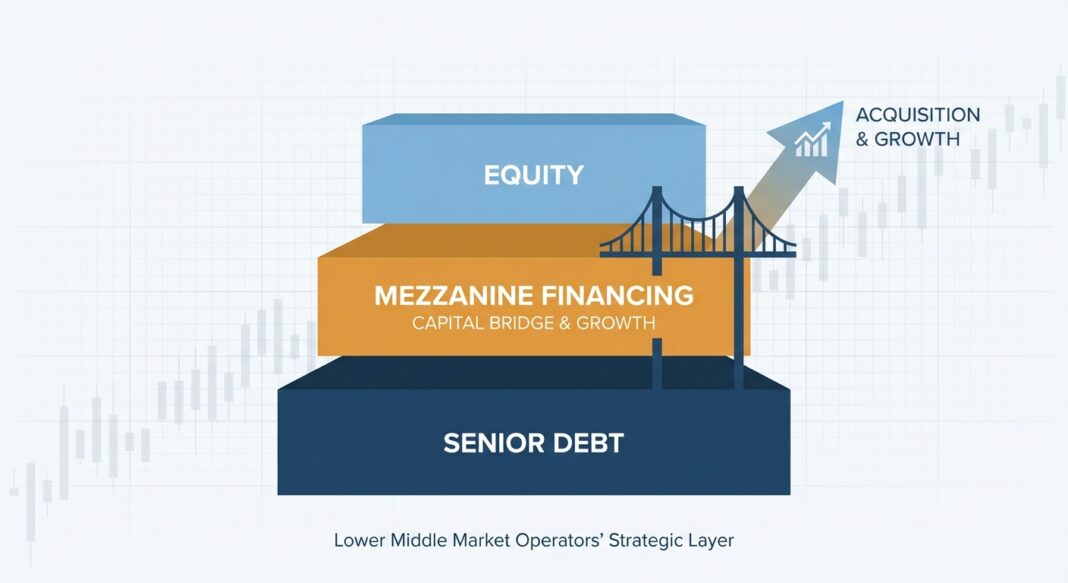
Where It Sits in the Capital Stack
Mezzanine debt is a hybrid financing instrument positioned between senior secured debt and common equity in the payment waterfall. It is structurally subordinated, meaning senior lenders are repaid first in any liquidation or restructuring. This subordinated and unsecured position, combined with its bullet-maturity repayment profile, is precisely what makes it both expensive and flexible.
The three defining features that distinguish mezzanine from senior debt are: its subordinated position, its option for Payment-in-Kind (PIK) interest, and its equity kicker, almost always in the form of stock warrants or conversion rights.
Component Breakdown
- Cash Interest: The current-pay portion of the coupon, typically 8–12% per annum, paid quarterly. This is the floor of the lender’s return and the borrower’s most visible cost.
- PIK (Payment-in-Kind) Interest: A non-cash interest component, typically 2–4%, that accrues to the outstanding principal balance rather than being paid in cash each period. PIK does not provide current cash income to the lender; it compounds as additional principal and is received only at bullet maturity or upon an exit event. For the borrower, it preserves near-term cash flow but compounds the total debt burden over the hold period.
- Equity Kicker (Warrants): The most consequential and negotiated feature. Warrants give the mezzanine lender the right to purchase a percentage of the company’s equity, typically 1–5%, at a nominal or pre-agreed strike price, allowing the lender to participate in enterprise value creation at exit. Warrants act as an equity kicker, letting lenders share in the company’s upside if it grows.
- Origination Fees: Typically 1–2% of the facility amount, paid at close and adding to the effective all-in cost.
Illustrative Example: A $15M Mezzanine Tranche in a $45M Acquisition
Consider a lower middle market operator acquiring a bolt-on target at a $45M enterprise value. The capital stack is engineered as follows:
- Senior Bank Term Loan: $27M at SOFR + 275 bps (~8.0% all-in), 3.0x EBITDA on a $9M pro forma, 5-year term, amortising at 10% per annum, maintenance covenants.
- Mezzanine Tranche: $12M at 10% cash pay + 3% PIK + warrants for 3% of fully diluted equity at a $0.01 strike, 6-year bullet maturity, one maintenance covenant (total net leverage ≤ 6.0x), with a 30% equity cure right.
- Equity (Existing Owner + Co-Investor): $6M, representing roughly 13% of the total capital requirement, a structurally lean equity contribution that preserves control.
The all-in cost of the mezzanine tranche, accounting for the cash coupon, PIK compounding over a 5-year hold, the warrant value at a 7x exit multiple, and a 2% origination fee, produces a lender IRR in the range of 16–20%: a return profile consistent with current market standards for the lower middle market segment. For the borrower, the blended cost of capital across the full stack is meaningfully lower than a pure equity raise at comparable dilution.
Current Market Pricing (as of Q3 2026)
Mezzanine debt for performing lower middle market companies currently prices in the range of 8–12% cash interest plus 2–4% PIK, generating lender all-in IRRs of 16–22% when warrants are included. This cost compensates lenders for taking a riskier, subordinated position in the capital stack. By comparison, unitranche facilities for upper middle market sponsored transactions are pricing at SOFR + 425–475 bps, with core middle market credits commanding 50–100 bps higher. The average private unitranche coupon was reported at approximately 9.00% at the end of 2025, but unitranche is a first-lien instrument; mezzanine carries structurally deeper subordination and therefore commands a meaningful premium.
Mezzanine vs. Alternatives: When Each Structure Wins
Mezzanine vs. Unitranche
The rise of unitranche lending has been one of the defining structural trends of the past decade. Unitranche facilities merge senior and junior debt into a single credit agreement with one blended rate, with the risk split residing in a private Agreement Among Lenders (AAL), a first-out/last-out arrangement the borrower never sees. Unitranche became dominant because it gives private equity sponsors speed, certainty of close, and confidentiality. Unitranche financings now represent approximately 30% of sponsored middle market transactions, reflecting both sponsor preference for execution certainty and the expanding capabilities of direct lenders to provide larger hold sizes.
For borrowers, the trade-off is clear: unitranche delivers structural simplicity and execution speed at a cost premium over traditional senior debt. The ability to work with a single lending group simplifies ongoing portfolio management, particularly during covenant modifications or add-on acquisitions. However, traditional mezzanine remains relevant in several contexts: very large transactions where unitranche lenders cannot provide the full quantum of debt, situations where the borrower wants to minimise total cost by maximising cheaper senior debt separately, deals where the sponsor or management team wants equity kickers to align lender incentives, and portfolio company add-on financings where existing credit agreements restrict additional senior debt.
Mezzanine vs. Minority Equity
The core trade-off between mezzanine and minority equity is the direction of the dilution clock. Mezzanine is dilutive through warrants, but that dilution is capped at the warrant coverage percentage and only crystallises at exit. Minority equity dilutes the cap table immediately and permanently at the valuation set at close. For operators confident in growth trajectory, mezzanine preserves more of the equity upside; for operators uncertain about near-term performance, equity avoids the debt service burden and PIK compounding risk. Lower middle market capital raises in 2024, 2025, and 2026 have increasingly stacked minority equity with a senior credit facility and sometimes a mezzanine layer to keep dilution below 30% while still funding the acquisition or growth plan.
When Mezzanine Specifically Wins
Mezzanine is the optimal structure when: (1) the deal size exceeds the SBA 7(a) $5M cap and bank senior leverage alone creates a funding gap; (2) the business has 8%+ revenue growth and recurring cash flow to support the combined debt service; (3) the operator wants to minimise equity dilution in anticipation of a higher-valuation exit; and (4) the hold period is defined, typically 4–7 years, providing a clear runway for the bullet maturity. Avoid mezzanine when margins are declining, cash flows are volatile, or when the combined debt service would exceed 60–80% of EBITDA, which creates a debt service spiral that constrains growth and risks default.
Current Market Terms: What the 2026 Mezzanine Market Looks Like
Five Data Points That Define the Current Environment
- All-in lender IRR target of 16–22%: The current cost structure for lower middle market mezzanine is 8–12% cash interest plus 2–4% PIK plus warrants or equity co-investment covering 1–5% of the equity, producing a 16–22% all-in lender IRR. This has been stable through the rate cycle because the equity kicker component is recalibrated to maintain the target return as cash coupon levels shift.
- Renewed institutional interest in 2025–2026: In 2025–2026, mezzanine funds have seen renewed interest as investors seek strategies with built-in cash yields in a higher-rate environment. Key providers include BDCs (Ares Capital Corporation, Blue Owl Capital, Main Street Capital, FS KKR) and specialty mezz funds including Audax Mezzanine, Madison Capital, Twin Brook, Maranon Capital, and Antares Capital.
- Covenant design divergence: The mezzanine market has resisted the cov-lite drift that characterises large-cap syndicated lending. Over 90% of large-cap leveraged loans are now covenant-lite, with recovery rates on cov-lite senior secured debt trailing covenanted loans by roughly 10 percentage points. By contrast, middle-market direct loans often still include at least one maintenance covenant, typically a leverage ratio test, giving lenders the quarterly visibility to intervene before a deteriorating borrower reaches formal default. For the lower middle market mezzanine borrower, this means a maintenance covenant is standard but negotiable in its tightness.
- Cov-lite creep in private credit broadly: Cov-lite deals rose to 21% of private credit transactions in 2025, up from just 4% in 2023, a signal that borrower leverage is increasing at the larger end of the private credit market, even as true middle market deals retain covenant discipline.
- PIK toggle risk flagged systemically: The Financial Stability Board flagged rising borrower reliance on PIK toggles and other distress signals that allow borrowers to defer cash payments. In a cov-lite structure, a lender cannot prevent PIK elections or even use them as a renegotiation trigger. For mezzanine borrowers, this cuts the other way: PIK flexibility is a genuine liquidity management tool, but when it compounds beyond the lender’s comfort level, it can accelerate an otherwise preventable restructuring conversation.
The Gap Capital Playbook: From Quantification to Close
Step 1: Quantify the Gap
Before approaching any capital source, build the acquisition or growth model to identify the precise funding gap. The gap is not the total enterprise value of the target; it is the difference between what senior lenders will provide on a pro forma basis and the total capital requirement including purchase price, transaction costs, integration reserves, and working capital. Use a conservative senior leverage assumption, no more than 3.0–3.5x EBITDA for a lower middle market bank senior facility, and size the mezzanine tranche to bridge exactly that gap without over-levering the combined entity above 5.5–6.0x total net leverage.
Step 2: Prepare the Materials Package
Mezzanine lenders underwrite on a 60–90 day timeline from term sheet to close. They require: three years of trailing audited or reviewed financials for both the platform and the target; a detailed pro forma LBO or acquisition model showing debt service coverage, leverage step-down, and cash flow waterfall; a management presentation addressing customer concentration, revenue recurrence, and the integration thesis; and a clear use-of-proceeds narrative. Weak management presentations are the most common reason term sheets are not issued in the lower middle market, not financial metrics.
Step 3: Run a Focused Process
Approach three to five mezzanine providers simultaneously. Do not run a wide, unfocused process. The mezzanine market is relationship-driven; lenders who feel they are in a competitive auction for a commodity deal will price accordingly. Anchor the process around two or three providers who have sector familiarity, then use the third term sheet as pricing discipline. The acquisition funding process typically runs 16–24 weeks end-to-end when senior and mezzanine tranches must be co-underwritten.
Step 4: Negotiate the Structure
The highest-leverage negotiation points for borrowers are: (1) Warrant coverage percentage and strike price: push for warrants capped at 2–3% of fully diluted equity with a nominal strike, rather than a higher coverage at a fixed valuation; (2) PIK toggle optionality: negotiate the ability to toggle between cash and PIK at the borrower’s election for the first 12–18 months post-close, providing liquidity flexibility during the integration window; (3) Equity cure rights: secure the right to inject equity to cure a leverage covenant breach before the lender has acceleration rights, typically sized at 25–35% of the tested covenant; (4) Call protection schedule: mezzanine lenders typically require a no-call period of 1–2 years and a premium of 2–3% in year three, stepping down to par thereafter; and (5) Incremental debt baskets: ensure the mezzanine credit agreement permits additional senior debt capacity for future bolt-on acquisitions without triggering a consent requirement, typically structured as the greater of a fixed dollar basket and a leverage-based grower.
Structuring Guidance: What Operators and Investors Should Prioritise
For Operators
The true cost of mezzanine is almost always higher than the headline interest rate suggests. A mezzanine facility advertised at 14% is not a 14% cost of capital; it is that cash coupon plus PIK interest that compounds over a three-to-five year term, plus warrants that give the lender 3–5% of the company, plus 2% upfront fees. Run the full cost comparison explicitly before signing the term sheet: model the IRR impact of the warrant at your base case and upside exit multiples, and compare that total dilution against what a minority equity raise would cost at the same valuation. The operators who use mezzanine well are the ones who run this math before signing, not after.
Also monitor PIK compounding discipline. When borrowers elect PIK interest, the outstanding balance compounds, increasing the total debt burden. If the anticipated liquidity event is delayed, the growing PIK balance creates a larger refinancing burden at bullet maturity, a risk that becomes acute in deteriorating credit markets.
For Investors Evaluating Mezzanine-Backed Deals
Underwrite the warrant dilution explicitly in the returns waterfall. The equity kicker is not free upside, a $0.01 strike warrant can be very valuable at a high exit multiple, or effectively worthless if the company is sold at a distressed valuation. Model both scenarios. Additionally, assess whether the maintenance covenant has adequate cushion, the financial covenant should carry an initial buffer of 25–35% over the base case plan, stepping down as cash flow grows. Tighter initial cushions in competitive deal environments are a signal of lender aggression, not borrower strength.
Key Takeaways
- Mezzanine solves the structural gap between what bank senior debt can support and what acquisition or growth financing actually requires; it is not a substitute for senior debt or equity, but a precision tool that preserves control when sized and priced correctly.
- The all-in cost is 16–22% lender IRR in the current lower middle market environment, composed of 8–12% cash interest, 2–4% PIK, warrant coverage of 1–5%, and origination fees, operators must model this full cost before comparing to equity alternatives.
- PIK compounding is a time bomb when mismanaged: the ability to defer cash interest preserves near-term liquidity but exponentially increases the bullet repayment obligation if the hold period extends beyond plan.
- Covenant design is a borrower asset: negotiating an adequate maintenance covenant cushion (25–35% above base case), a robust equity cure right, and a PIK toggle election window are the three structural protections that materially reduce the risk of a technical default during integration or macro stress.
- The unitranche is not always the answer: for lower middle market operators with an existing bank relationship, a desire to minimise blended cost, or a complex intercreditor dynamic from a prior financing, a traditional senior-plus-mezzanine split can deliver a lower all-in cost and better covenant flexibility than a unitranche priced at the current market premium.


